





16 Luxury Christmas Tree Ideas with Rich Color and Texture

A luxury Christmas tree can begin with burgundy berries, snowy branches, or a collection of ornaments you bring out every December. The richness comes from how those pieces relate: velvet beside reflective glass, a generous bow above quieter branches, or gold repeated from the tree into the room.
Table Of Content
- Classic Christmas Trees with Rich Color and Texture
- 1. A Burgundy Berry Tree with Velvet Baubles and Branch Sprays
- 2. A Tartan Tree with Golden Carousel Horses and an Embroidered Skirt
- 3. An Ivory Angel Tree with Red Velvet and Golden Magnolias
- 4. A Copper Woodland Tree Beside a Matching Pinecone Mantel
- Frosted Christmas Trees with Soft Light and Contrast
- 5. A Pearl and Champagne Tree Echoed in the Wreath and Mantel
- 6. A Blush Snowdrift Tree with Ribbon Pockets and Gold Starbursts
- 7. A Frosted Butterfly Tree with Airy Silver Wings
- 8. A Navy Velvet and Champagne Tree with Frosted Branches
- Christmas Trees with Statement Ribbon and Tailored Shapes
- 9. A Slim Black, White, and Gold Tree with Tailored Ribbon Bows
- 10. A Burgundy Bow Tree with Long Gold Ribbon Cascades
- 11. A Plum and Gold Tree with a Crown and Fringed Velvet Swags
- Whimsical Christmas Tree Themes with a Polished Finish
- 12. A Gingerbread Village Tree with Lit Cottage Ornaments
- 13. A Peppermint Tree with Sweeping Candy Sprays and a Toy Soldier
- 14. An Emerald and Champagne Tree with a Polar Bear Ribbon Spiral
- Personal Christmas Tree Displays with a Different View
- 15. An Heirloom Ornament Tree with Open Gold Cameo Frames
- 16. A Mirror-Paired Tree with Two Coordinated Ornament Faces
- Final Toughts
These 16 luxury Christmas tree ideas explore different ways to build that finished picture. You’ll find elegant Christmas tree decorations, expressive ribbon treatments, and playful Christmas tree themes, with guidance on the color, texture, and scale that make each arrangement worth lingering over.
Quick Takeaways
- Give the tree one clear organizing feature, such as a ribbon route, floral clusters, or a repeated ornament shape.
- Vary ornament sizes and finishes so detailed pieces have quieter surfaces around them.
- Repeat a few selected colors or materials in the skirt, gifts, wreath, or nearby furnishings.
- Consider the whole display, from topper to base, while keeping doors, seating, and everyday walking routes usable.
Before You Decorate: Scale, Placement, and Light
Picture the tree with its topper and widest decorations in place. A slim evergreen can gain considerable width through bows or projecting stems, while an angel adds height above the needles. Check the outline from the sofa or doorway where you’ll see it most often, and leave room to reach the stand and any water reservoir.
The U.S. Fire Administration’s holiday guidance recommends keeping trees at least 3 feet from heat sources and clear of exits, watering cut trees daily, inspecting light strands, and following the manufacturer’s limits for connected strands. Use flameless candles around densely layered decorations, and observe any stricter requirements for your fireplace or heating appliance.
With the location settled, look at the room’s existing colors. The wall behind the tree, the nearest chair, and the floor beneath it all influence how clearly the decorations show. A pale background makes dark berries readable; wood gives copper a quieter setting; blue upholstery can bring contrast to cream ornaments.
Classic Christmas Trees with Rich Color and Texture
Traditional colors offer plenty of room for variation. Berries, tartan, embroidered fabric, and pinecones each give familiar red, green, and gold a different character.
1. A Burgundy Berry Tree with Velvet Baubles and Branch Sprays
Deep wine ornaments give red berries somewhere to shine. Against dark evergreen, the berries read as small bright points, while oversized burgundy spheres create broader areas of color. A few cherry-red glass ornaments can brighten the middle without turning the whole tree the same shade.
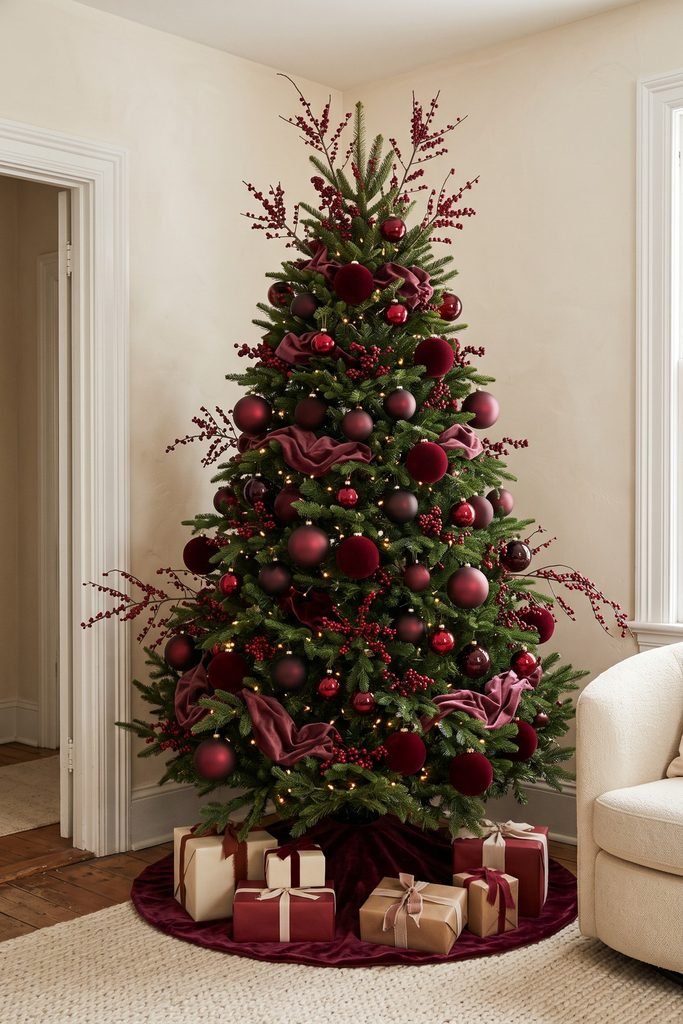
That difference in scale matters. Fine stems carry plenty of detail, so smooth matte or velvet-finish baubles give the eye a pause between them. Scatter smaller ornaments deeper inside the branches, keeping the largest dark spheres visible near the surface.
Let some berry sprays extend beyond the tree’s outline, especially near the crown and lower sides. Their uneven tips make a full tree feel more botanical. An ivory wall behind them helps each branching shape stand out.
Finish with a wine-colored skirt and restrained gifts below. When decorating a large tree, these broad shapes help the red remain visible across the room. Keep the longest stems on the sides that face open wall space, where they can spread without catching anyone passing.
Find the Burgundy Berry Layers
Burgundy berry sprays and matte ornaments echo the contrast between fine stems and broad, quiet shapes.
2. A Tartan Tree with Golden Carousel Horses and an Embroidered Skirt
Golden carousel horses bring a collected feeling to a tree, particularly when their poses vary. One might rear upward while another stretches forward, giving the branches small sculptural moments to discover.
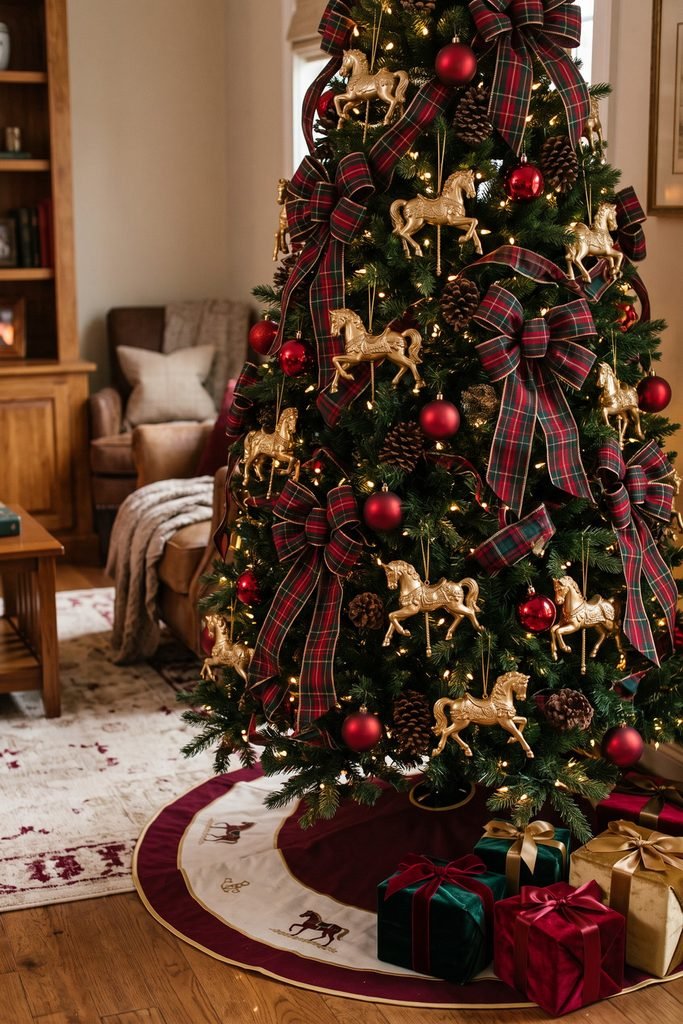
Dark red, green, and black tartan makes a strong companion. The broad checks supply pattern behind the horses, and gold hanging cords carry a fine line between ornament and branch. Space the bows so each horse keeps a recognizable outline; a ribbon tail across its legs can hide the detail that makes it special.
A few plain red glass balls and rough pinecones give the figurines different surfaces around them. Warm lights catch the gold finish while the darker plaid recedes into the greenery.
Carry the textile story down to an embroidered skirt with burgundy panels and a gold border. An equestrian motif can echo the horses above, with velvet-wrapped gifts nearby. This vintage-inspired Christmas tree feels gathered over time through its repeated colors and varied figures. Lightweight ornaments and a neat opening around the stand keep the arrangement manageable.
Pair Golden Horses with Tartan
Golden horse ornaments and red-and-green tartan ribbon give the collected display its repeating figures and patterned backdrop.
3. An Ivory Angel Tree with Red Velvet and Golden Magnolias
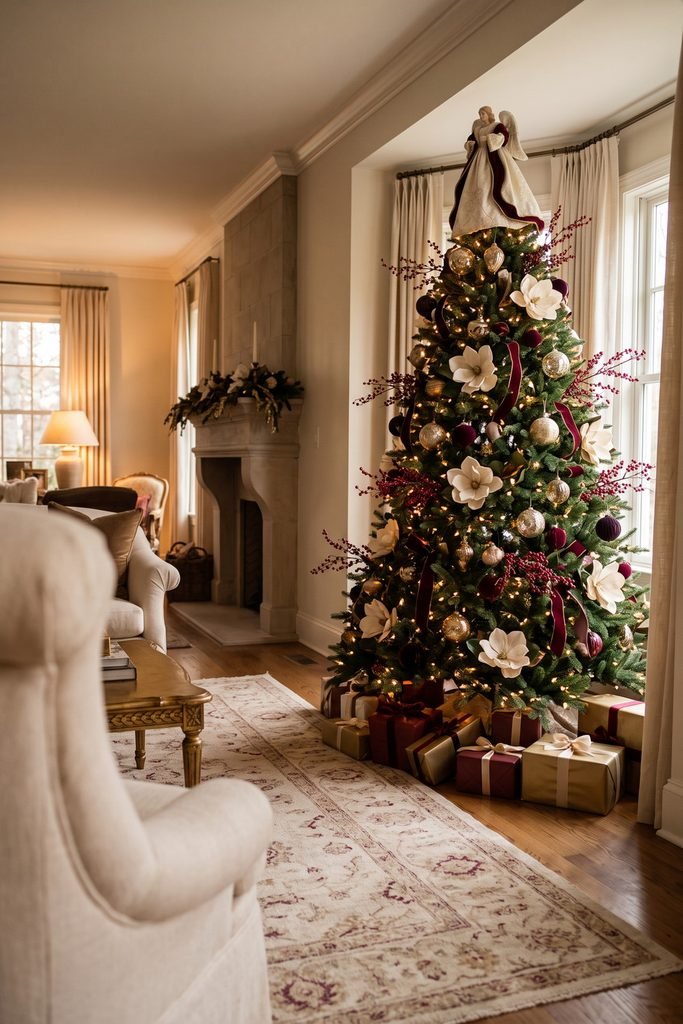
An ivory angel with a burgundy cloak already contains the beginnings of a tree palette. Gold embroidery, pale fabric, and deep red can travel down through the branches, making the topper feel connected to everything below it.
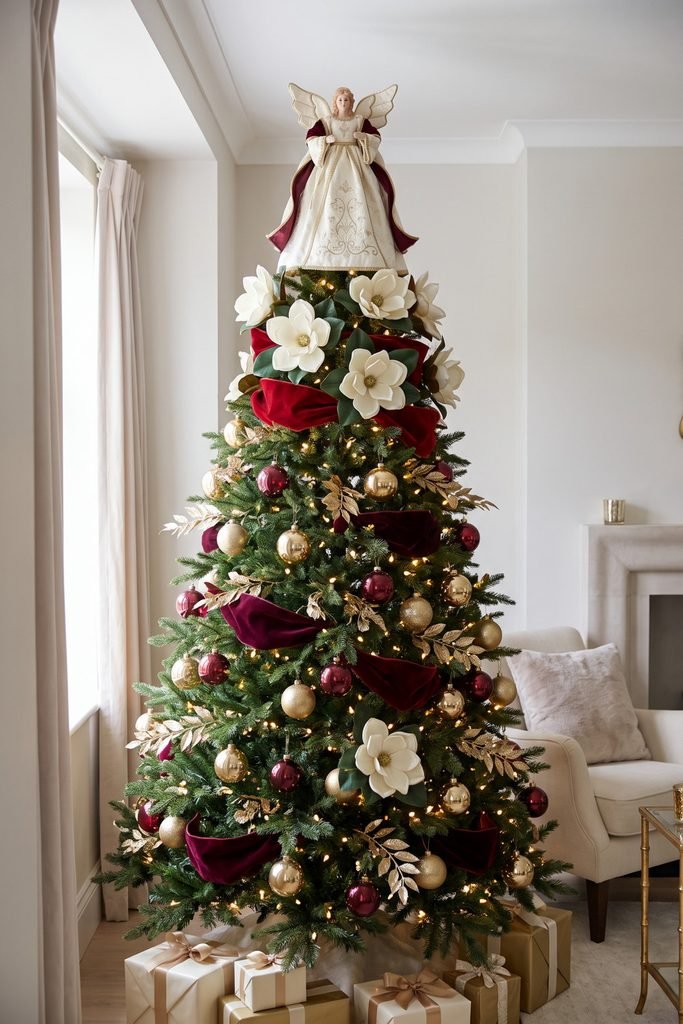
Broad ivory magnolias repeat the gown’s lightness. Nestle them among gold spheres, keeping enough greenery around the petals for their shapes to remain clear. Deep red velvet folds create shadow between those pale clusters, and a few burgundy ornaments carry the color farther down.
Fine gold leaf sprays can echo the embroidery without competing with the flowers. The contrast between flowing fabric, broad petals, and reflective glass gives the display several kinds of detail to enjoy.
Allow headroom for the angel and choose a topper compatible with the tree’s support. In a fireplace room, pale upholstery and a simple mantel can give the decorated tree room to command attention while maintaining the required heat clearances. For a softer whole-room setting, explore these French country cottage Christmas decor ideas, where worn wood and delicate textiles offer another way to carry traditional Christmas colors.
4. A Copper Woodland Tree Beside a Matching Pinecone Mantel
Copper looks especially rich when it has something rough beside it. Pinecone scales, dark needles, and a wood-grain backdrop give brushed and reflective ornaments a textured setting.
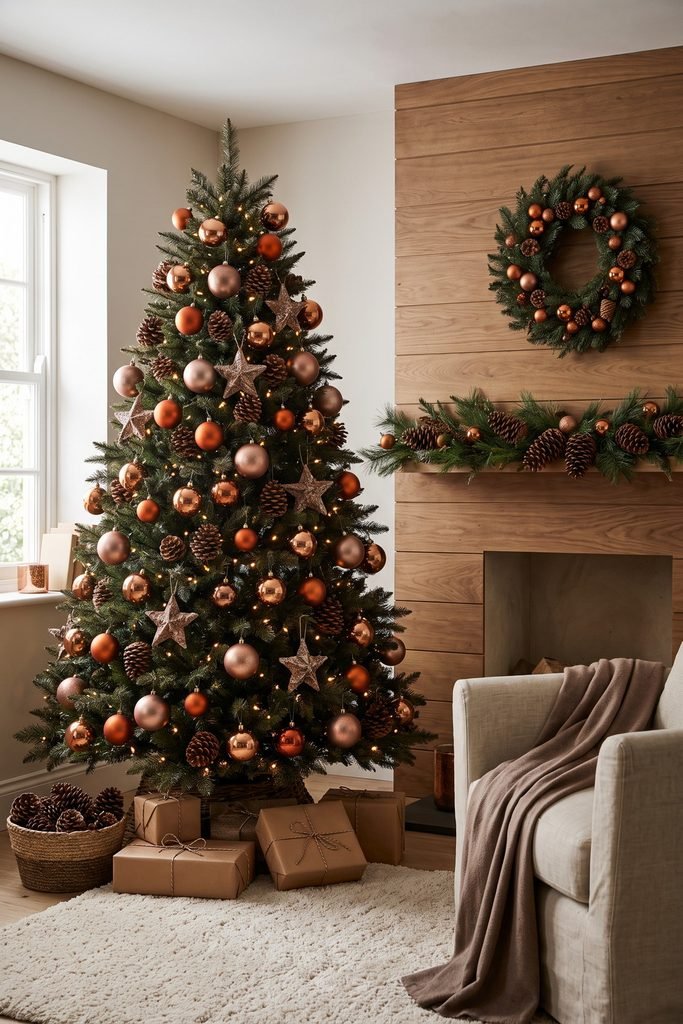
Mix the copper finishes across the tree. A polished sphere catches a bright reflection, while a brushed ornament holds a quieter patch of orange-brown. Small stars can break up the round shapes, with pinecone clusters appearing near selected branch ends.
Extend a few of those details into a wreath and low mantel garland. The tree can carry the largest ornaments, with smaller copper accents in the wreath and more greenery along the mantel. That change in scale lets the room repeat a palette without feeling uniform.
Cream linen, a pale rug, and simply wrapped gifts give the darker materials some breathing room. Keep the floor arrangement compact and the fireplace’s required clearances intact. Within this holiday home decor scheme, even a small repeat of copper beyond the tree makes the warmth feel distributed through the room.
Frosted Christmas Trees with Soft Light and Contrast
Snowy branches change how ornaments read. They can soften pale colors, outline dark flowers, or provide a textured background for larger shapes.
5. A Pearl and Champagne Tree Echoed in the Wreath and Mantel
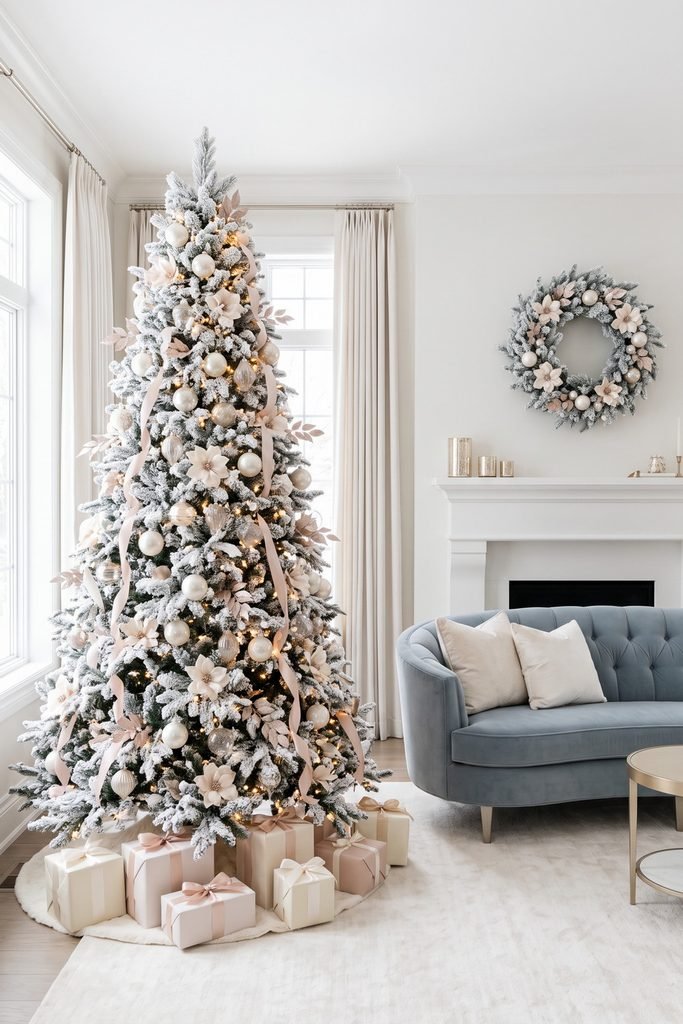
The room becomes part of this tree’s appeal. Pearl ornaments, champagne glass, and pale satin flowers repeat in a wreath above the mantel, while muted blue upholstery supplies a gentle contrast nearby.
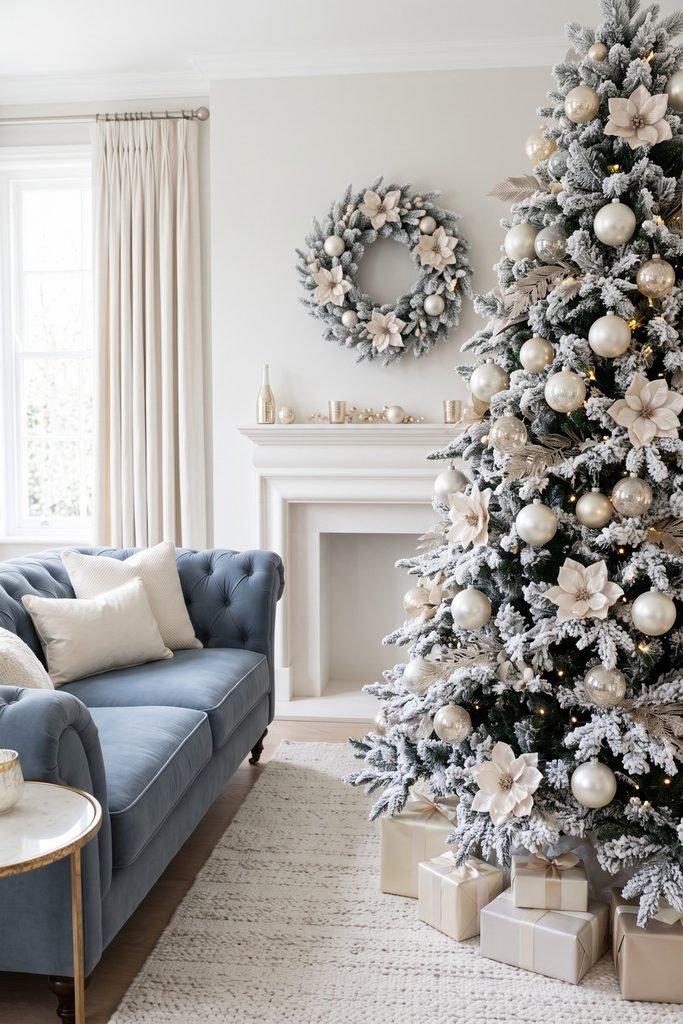
Choose one flower shape to carry between the tree and wreath. Its larger blooms can sit among the tree’s snowy branches, with smaller versions appearing in the wreath. A few low gold details on the mantel continue the finish while leaving the tree as the room’s tallest decorative element.
A cream palette benefits from these subtle shifts in surface. Pearl-finish balls look soft against flocking; reflective champagne ornaments bring small flashes of light; metallic leaves add a finer edge between the larger forms.
If the sofa is blue or blue-gray, let it remain visible beside the tree. The cooler fabric gives all those pale ornaments a clearer setting. A gold tray on a nearby table can repeat the metal once more, keeping the connection between furnishings and tree easy to see.
6. A Blush Snowdrift Tree with Ribbon Pockets and Gold Starbursts
Blush ribbon gains depth when it disappears into snowy branches and returns in soft folds. Those tucked sections create little recesses, with pale fabric emerging between thick white tips.
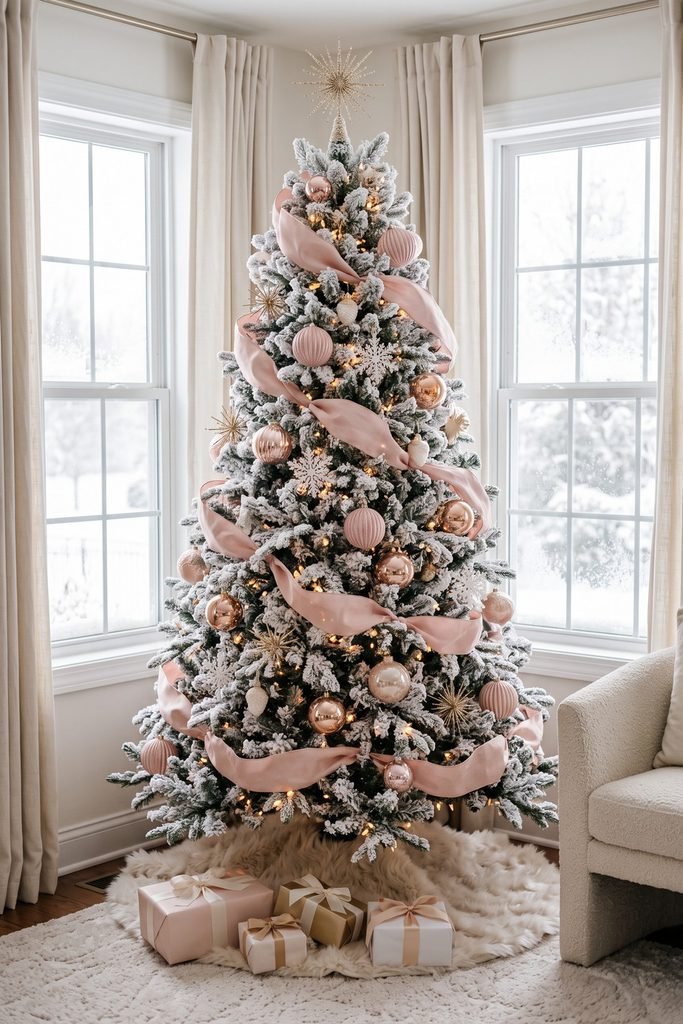
Follow that movement with a mix of ribbed blush ornaments and smooth rose-gold balls. Ribbing breaks reflections into narrow lines, while mirrored finishes catch larger glimpses of the room. The variation keeps a pale palette from becoming a single wash of pink.
Leave generous areas of flocking exposed. The snowy texture is what gives the ribbon its soft surrounding edge, and too much fabric can conceal it. Small snowflakes and fine gold starbursts provide lighter marks between the larger decorations.
A starburst topper draws the eye upward without adding another heavy fabric shape. Below, a fluffy pale skirt continues the snowy effect around a compact group of gifts. Keep the skirt contained within the display so its loose edge stays out of the walking route.
Gather the Blush Ribbon and Ribbed Details
Soft blush ribbon and ribbed pink ornaments offer the fabric folds and fine surface detail described in this snowy palette.
7. A Frosted Butterfly Tree with Airy Silver Wings
White butterflies need space around their wings. With gaps between the largest shapes, their angled silhouettes can suggest an upward flight through the tree.
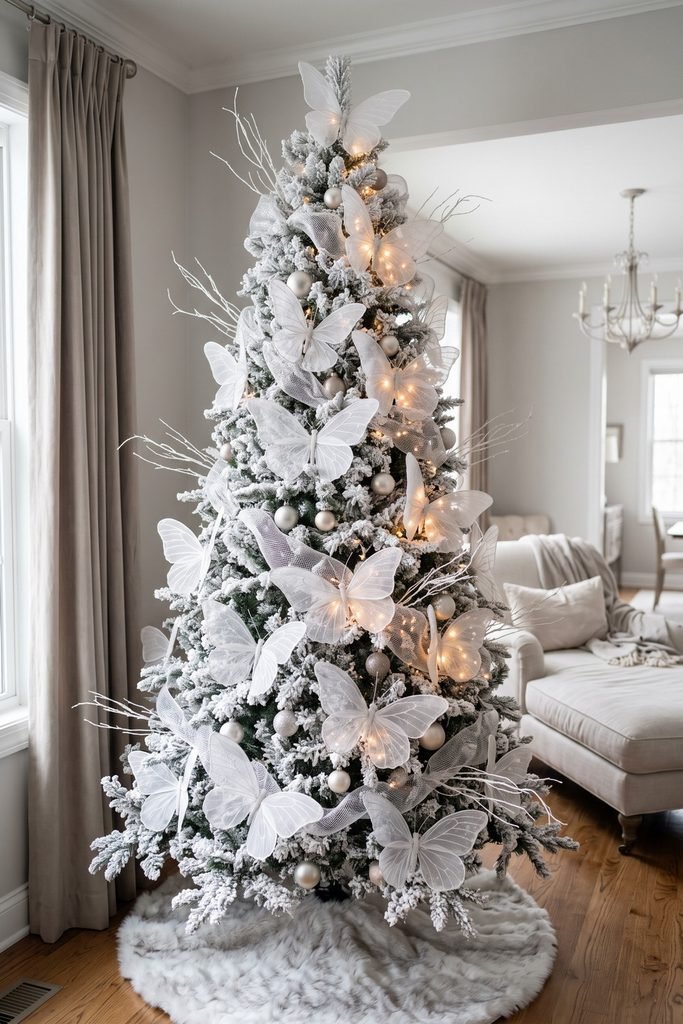
Vary their direction slightly. A wing turned toward the room reads differently from one seen at an angle, and that change gives the arrangement movement. Fine white twig sprays can continue the rising line beyond the needles, while airy silver mesh adds a softer curve inside the branches.
Keep the smaller ornaments quiet: a few matte pale spheres will support the butterflies without drawing attention away from their outlines. The strongest wing shapes should remain easy to pick out from across the room.
Warm tree lights behind translucent decorative wings can lend them a gentle glow. Choose lightweight pieces suited to the branches, with no need for a separate lighting invention. A compact, soft base and pale surroundings allow the wing shapes to remain the tree’s clearest feature.
8. A Navy Velvet and Champagne Tree with Frosted Branches
Dark navy flowers become much easier to see when pale needles surround their edges. Their broad petals provide a strong shape against fine frost, giving a winter tree depth before the smaller ornaments are considered.
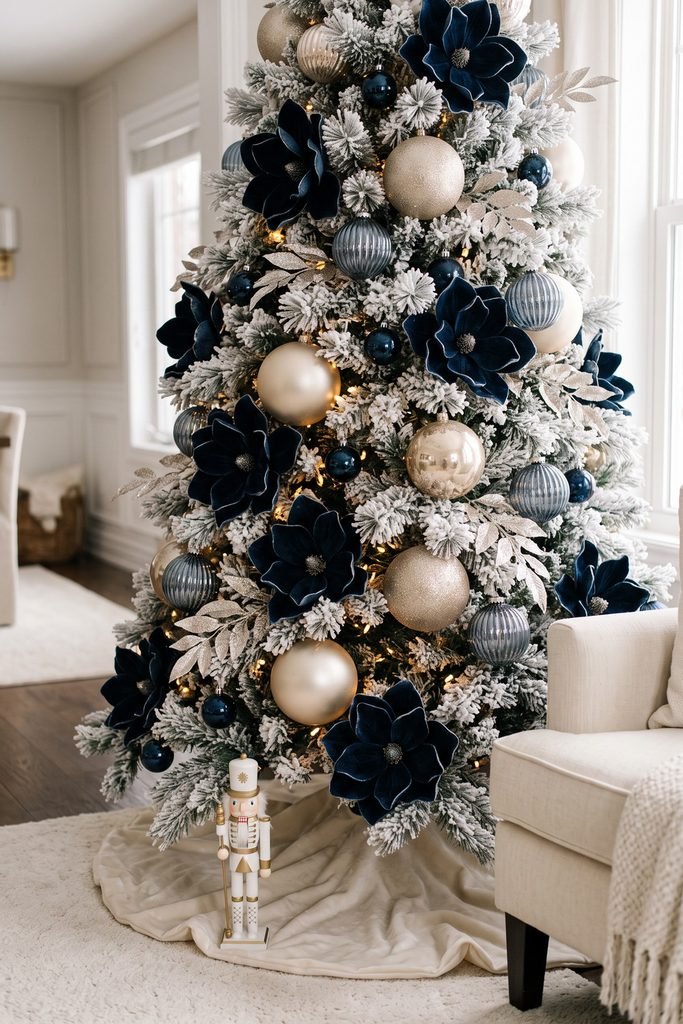
Space the floral clusters through the tree, leaving snowy foliage between them. Smaller blue glass ornaments can sit deeper inside, where they echo the flowers with a different finish. Oversized champagne spheres bring light into the darkest groupings.
That combination gives navy several roles: the flowers create the main anchors, glossy blue balls add reflections, and a few slate-blue accents soften the transition toward silver and white. Metallic leaves supply the smallest glints.
Warm internal lights can keep the frosted palette from feeling stark after dark. Nearby light-colored seating offers a quiet setting for the dark blooms. A white-and-gold nutcracker may echo the champagne finish at the base, if there is room; the floral contrast remains strong enough to carry the tree on its own.
Find the Navy Floral Contrast
Navy floral picks and champagne ornaments supply the dark petal shapes and lighter reflective accents for this frosted-tree direction.
Christmas Trees with Statement Ribbon and Tailored Shapes
Ribbon can define a tree’s whole silhouette. Its pattern, fold, and route matter as much as the amount you use.
9. A Slim Black, White, and Gold Tree with Tailored Ribbon Bows
A narrow corner tree can carry a crisp, formal arrangement through a few well-spaced bow clusters. Black-and-white stripes give each bow a defined edge, with plain white ornaments separating the pattern from dark greenery.
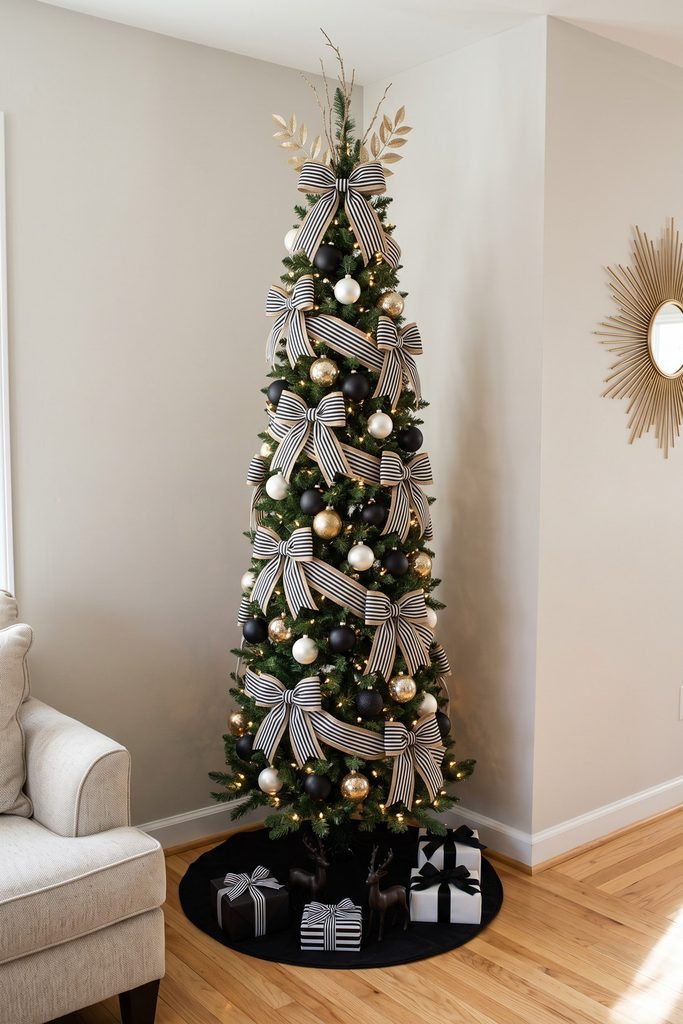
Keep the ribbon tails long enough to show their stripes while allowing the tree’s slim outline to remain visible. Matte black balls add quiet depth; reflective gold ornaments bring occasional flashes of warmth between the white spheres.
Repeat black at floor level in the skirt and gift boxes. That darker base grounds the lighter decorations above, especially against pale walls and a wood floor. A nearby gold mirror can echo the ornaments without requiring more pieces on the tree itself.
Let the corner determine the display’s footprint. The skirt and gifts should fit around a stable stand, leaving a comfortable route past the tree. A narrow crown of fine sprays can finish the vertical line without spreading across the adjoining walls.
10. A Burgundy Bow Tree with Long Gold Ribbon Cascades
One generous bow can carry most of a tree’s drama. Burgundy velvet gives its loops depth, while gold-striped ribbon catches the light along their edges.
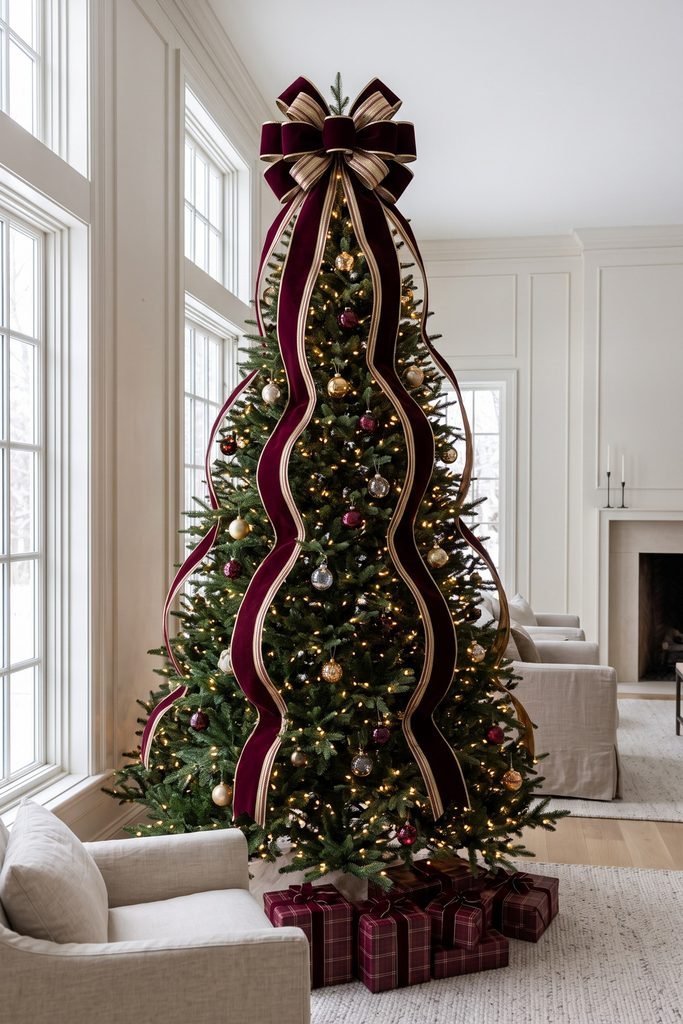
Below the bow, let two visible ribbon routes descend through the branches. Their curves can differ, with sections moving inward and others returning toward the surface. Keeping the routes distinct makes the bow’s colors readable all the way down.
The surrounding ornaments can stay quieter: simple glass spheres, warm lights, and a few burgundy accents leave room for the long textile lines. Plaid-wrapped gifts repeat the red at the base, helping the upper feature feel connected to the floor.
When planning how to decorate a large Christmas tree, judge the bow from the main seating area as well as nearby. It should have enough presence to read across the room while fitting beneath the ceiling. Choose lightweight, supported components appropriate to the actual tree, and finish the tails above the floor. Tall windows can emphasize the display’s height; the ribbon still needs a convincing, supported shape within the branches.
Bring Burgundy Velvet and Gold Stripes Together
Burgundy velvet ribbon and gold-striped ribbon provide the contrasting surfaces for a generous bow and its descending tails.
11. A Plum and Gold Tree with a Crown and Fringed Velvet Swags
Gold fringe gives a velvet swag a visible lower edge. Repeated in broad curves across the branches, it can make a plum tree feel almost architectural, with the crown forming a clear finish above the fabric tiers.
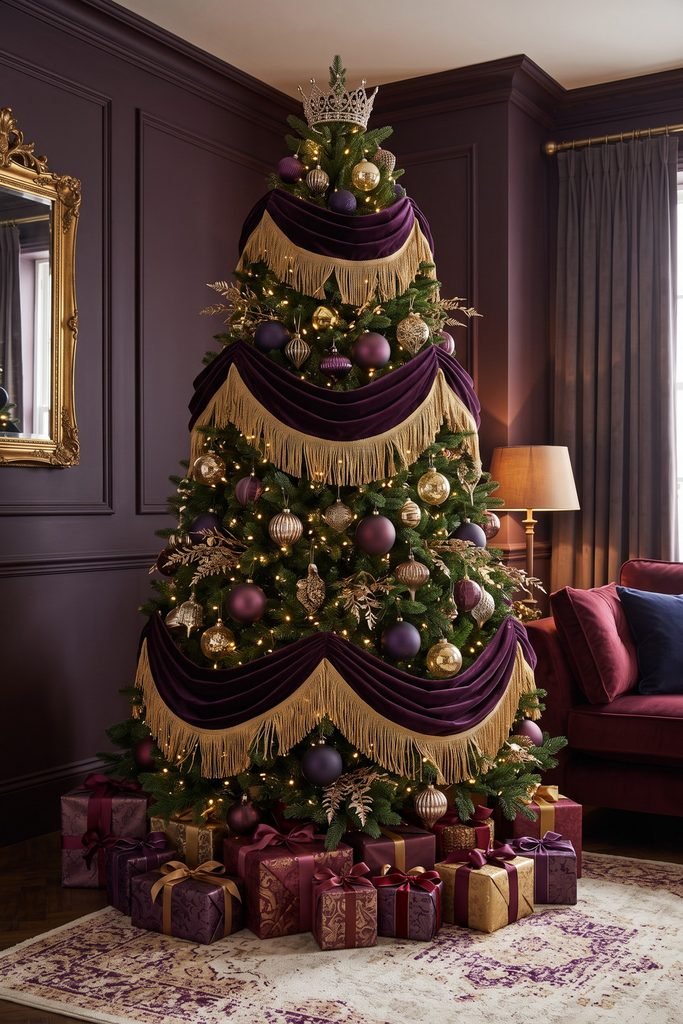
Choose velvet in deep plum or aubergine and let the swags retain their curved shape. Their arcs provide the main rhythm, so the ornaments between them can vary: matte purple spheres, a few ribbed baubles, and selected gold filigree pieces.
The matte surfaces give the eye a quieter place beside the detailed trim. Fine gold foliage can connect the spaces between swags, but the fringe should remain easy to follow.
This formal Christmas tree suits a room with rich upholstery or gilded details. A gold mirror can echo the crown, and burgundy fabric nearby can deepen the plum palette. Keep the crown lightweight and compatible with the tree, allowing the textile curves below it to do much of the decorative work. The effect comes from that repeated crown-to-swag relationship.
Whimsical Christmas Tree Themes with a Polished Finish
Playful ornaments have their own kinds of structure. Cottage landmarks, candy shapes, and a flowing ribbon route give each theme a clear identity.
12. A Gingerbread Village Tree with Lit Cottage Ornaments
A gingerbread cottage gives the eye a destination among the branches. Its roof, windows, and pale icing edges make a recognizable little building, even when the tree holds plenty of surrounding detail.
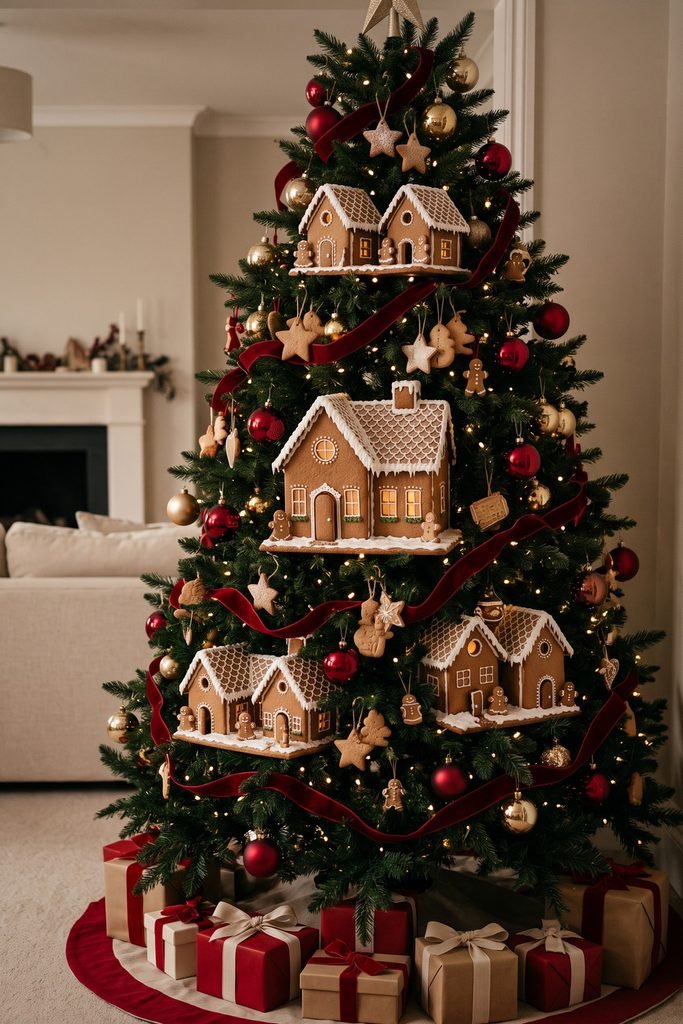
Give one cottage a prominent position, then let smaller house groupings step down through the greenery. Cookie figures and biscuit-shaped ornaments can gather near those landmarks, creating a village feeling through their scale and placement.
White icing lines are especially useful against gingerbread brown. They separate roof edges and tiny doors from the darker needles behind them. Red velvet folds and selected glass balls carry the brighter Christmas color between the houses.
Choose purpose-made illuminated cottage ornaments if you want glowing windows, with support suited to their size and weight. A red-and-cream base can continue the palette below the branches, leaving the houses as the most detailed pieces. Keep the surrounding room comparatively quiet so the little architectural shapes remain worth looking at closely.
Find the Gingerbread Village Shapes
House ornaments create the village landmarks, while smaller cookie-shaped decorations carry the gingerbread theme between them.
13. A Peppermint Tree with Sweeping Candy Sprays and a Toy Soldier
Peppermint disks create a bold pattern that reads quickly across a room. Their round faces work particularly well with taller candy-cane sprays at the crown, where the change in shape stretches the tree upward.
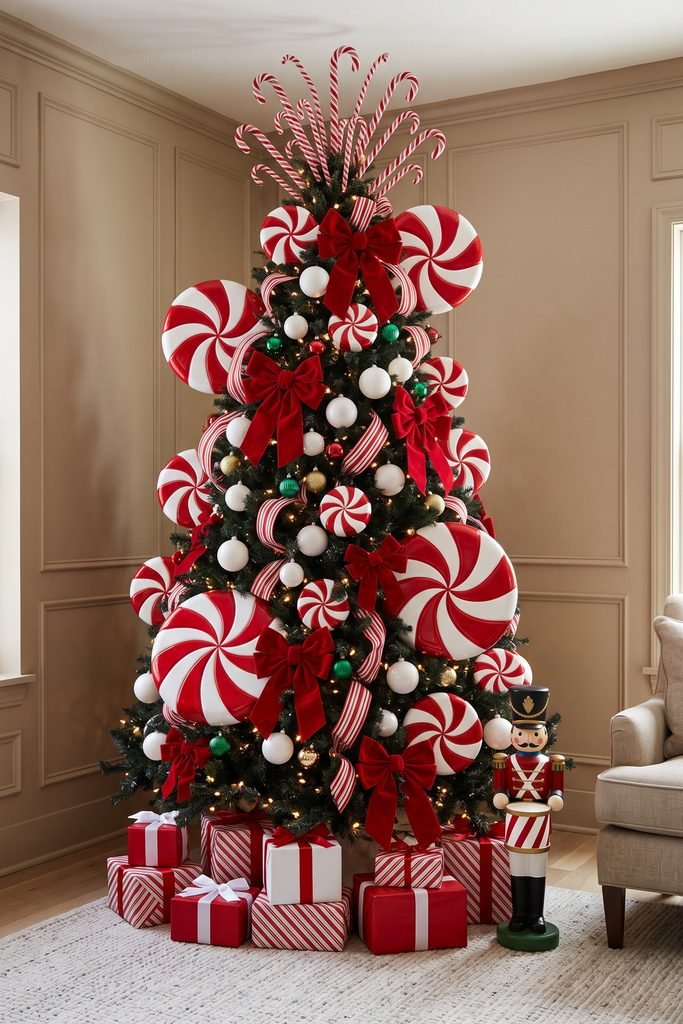
Plain white ornaments give those stripes and swirls a pause. Place them between the busiest pieces so each peppermint face has a clear surrounding area. Vary the disk sizes, with smaller candy shapes carrying the pattern into narrower branches.
Red bows and striped ribbon can continue the movement downward. A little emerald and gold may appear in supporting details, while red and white remain dominant.
One floor-standing toy soldier gives the display another strong vertical form. Position it beside a compact gift group, keeping the tree’s shape and the nearby aisle visible. The soldier’s painted stripes can echo the candy pattern without requiring a whole collection of figures. Secure tall pieces appropriately and keep projecting crown sprays away from places where people pass.
14. An Emerald and Champagne Tree with a Polar Bear Ribbon Spiral
The ribbon is what connects these small ivory bears. A broad champagne curve travels from a proportional top bow through the branches, with spaced figures appearing along its route.
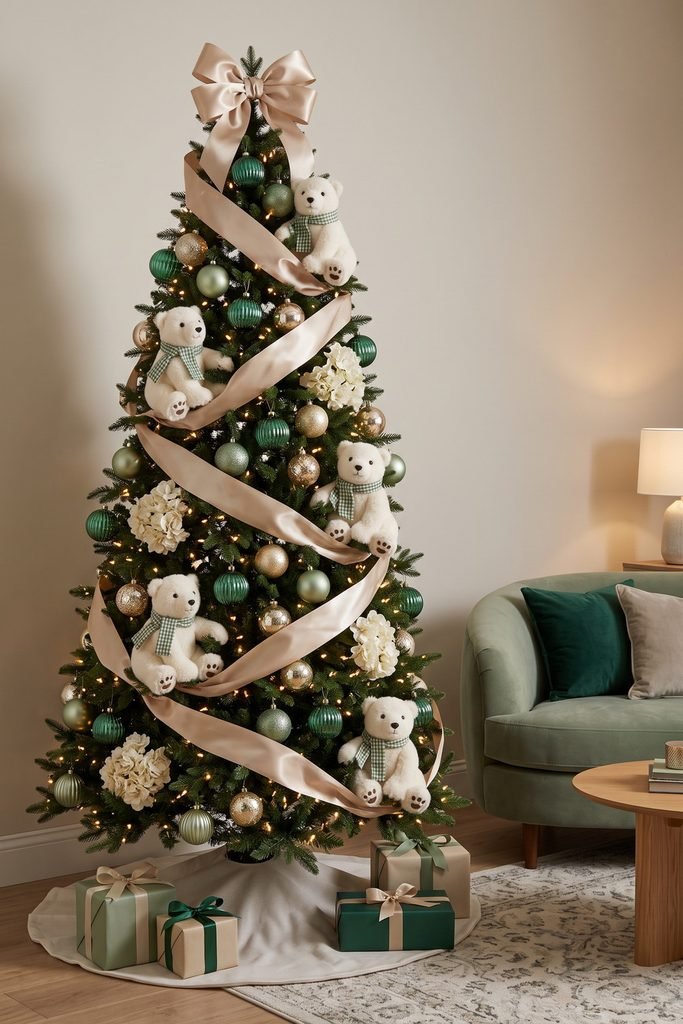
Five small bears can give the display a repeating character without filling every gap. Let each remain separate enough to recognize, with the ribbon folds visible between them. Coordinated scarves can pick up a little green pattern while keeping the figures visually related.
Emerald ribbed ornaments anchor the softer forms. Their defined grooves contrast with plush fabric and smooth satin, while ivory flowers and selected gold accents keep the palette light enough for the bears to stand out.
In a room with sage seating, the green decorations can connect the tree to the sofa. Warm lights give the deeper branches some glow, with the large bow serving as the upper starting point. Choose small decorative figures compatible with the branches and keep the lower ribbon contained within the display. The finished effect depends on seeing a continuous ribbon route between the figures.
Personal Christmas Tree Displays with a Different View
Small keepsakes and a tree’s hidden side offer two further possibilities. Each becomes part of the display through a deliberate relationship with its surroundings.
15. An Heirloom Ornament Tree with Open Gold Cameo Frames
A tiny glass ornament can disappear among full branches and large baubles. An open gold oval around it gives that small piece a larger visual boundary while keeping the ornament itself at the center.
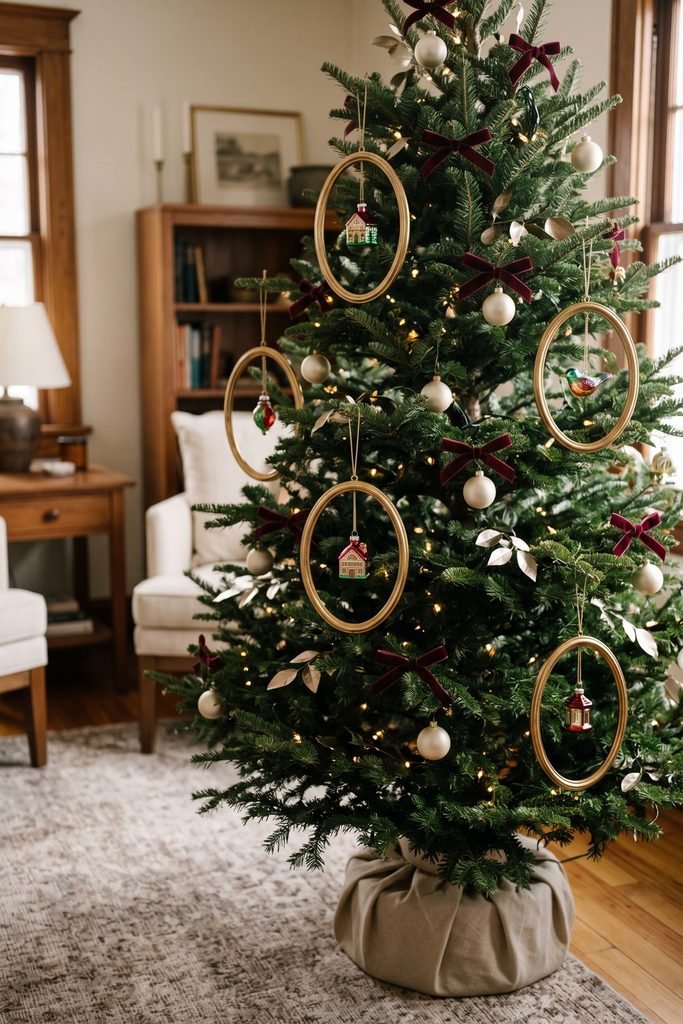
For this display, choose lightweight open outlines without glass or solid backing. Each oval surrounds one miniature keepsake, with a clear gap in the foliage behind the opening. You should be able to recognize the small ornament and see the empty space around it.
Repeat four to six of these framed openings across a full tree, spacing them enough for their shapes to remain distinct. A slim tree might use three smaller openings. Antique-gold finishes, wine velvet knots, and a few matte ivory balls can support the arrangement, allowing the heirlooms’ own colors to vary.
Vintage ornaments and newer family keepsakes can share this setting. Their different details become the reason to look closer, so keep neighboring foliage and filler decorations restrained. Use supports suitable for the actual ornament and open frame, without assuming the branch can carry a heavy picture frame.
Where young children may reach the tree, follow CPSC’s guidance on fragile ornaments and small removable decorations. The appeal is the miniature held clearly within its larger, empty outline.
16. A Mirror-Paired Tree with Two Coordinated Ornament Faces
One tree can offer two color stories when a nearby mirror reveals the side facing away from the room. Imagine ivory and champagne ornaments on the main face, with emerald and gold on the face turned toward the mirror.
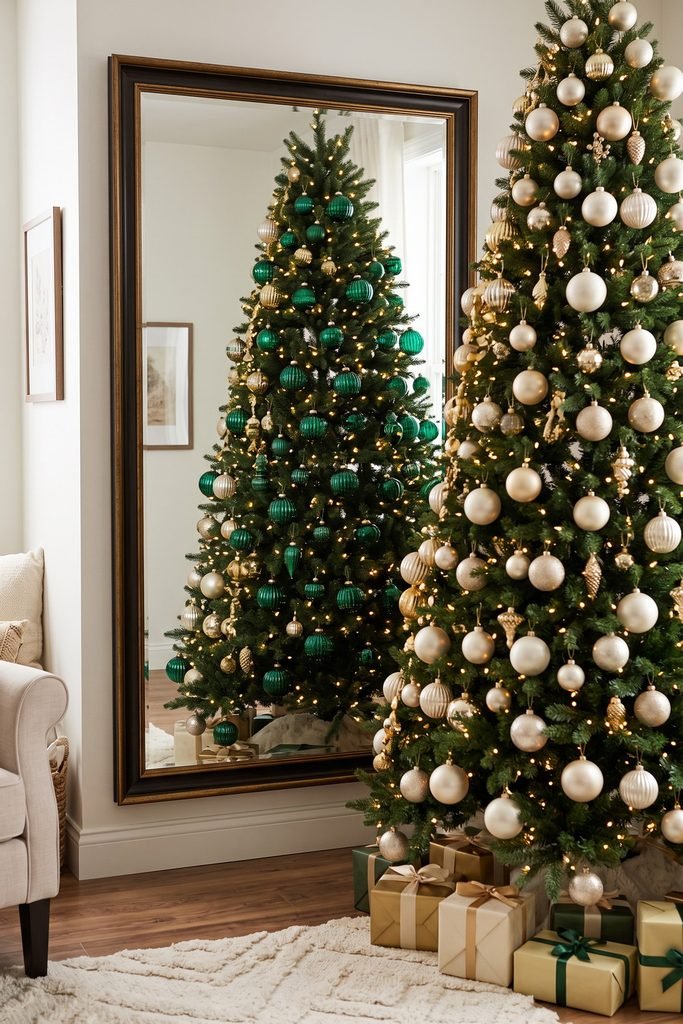
Gold connects the two. Carry it through the side where the palettes meet, using similar ornament sizes on both faces. That shared transition helps the tree feel like one considered arrangement, even though the reflected view has a different dominant color.
The placement needs to reveal the relationship. Begin with a mirror already securely installed according to its own manufacturer’s instructions, then check what it reflects from the sofa or doorway. Position the tree so the mirror shows some of its emerald side while the ivory front remains visible directly. Keep a little mirror frame visible so the second view is easy to understand.
A slim tree with narrower decorated side zones can adapt the idea where space is limited. Leave access around the stand and preserve the walking route. Small warm lights on both sides help the darker reflected face remain visible after daylight fades.
Final Toughts
This proposed arrangement gives the usually hidden branches a purpose. Its success comes from an actual second view of the same tree, with enough connection between the colors for both sides to belong together.
Choose the relationship you most want to bring into your room: berries against velvet, snowy branches around blush ribbon, or small heirlooms inside open gold outlines. Carry that feature from the upper branches to the base, leaving enough space for its details to show. A tree feels complete when its colors, textures, and strongest shapes have a clear connection to one another and to the home around it.