





18 French Country Cottage Christmas Decor Ideas with Vintage Charm
French country cottage Christmas decor pairs weathered furniture with softer, more delicate details: velvet against evergreen, silver ornaments inside an old wooden bowl, or blush ribbon falling beside patterned china. The room’s everyday pieces give the decorations somewhere to belong.
- Quick Takeaways
- Before You Decorate: Fit, Light and Greenery
- Christmas Trees and Cozy Cottage Rooms
- 1. Drape an Airy Tree with Blush Ribbon and Porcelain Accents
- 2. Pair a Sparse Urn Tree with a Linen Reading Chair
- 3. Display a Bare-Branch Tree Above Rustic Crates
- 4. Place a Lift-Off Christmas Village Tray on a Plaid Ottoman
- 5. Layer a Cottage Bed in Plaid Beneath a Glowing Ledge
- Mantels and Collected Christmas Displays
- 6. Layer a French Mantel with Red Velvet and Heirloom Art
- 7. Build an Ivory Village Above Chunky Knit Stockings
- 8. Fill a Weathered Dough Bowl with Silver Baubles
- 9. Drape a Mirror Console with Dried Oranges and Ivory Bows
- 10. Nest a Glowing Village Between Blue-and-White Ginger Jars
- French Country Christmas Entries
- 11. Wrap a Cottage Doorway in Evergreen and Burgundy Velvet
- 12. Dress an Entry Bench in Red Botanicals and a Basket Tree
- 13. Build a 24-House Advent Village on French Shutter Panels
- Christmas Kitchens and Holiday Tables
- 14. Frame a Kitchen Window with Citrus Garland and Basket Trees
- 15. Style a Christmas Hutch with Mugs, Plaid and Berry Jars
- 16. Frame a Gingham Breakfast Nook with Evergreen Swags
- 17. Fill a Garden Urn with Ivory Roses and Burgundy Velvet
- 18. Curve a Miniature Christmas Garden Around an Open Bistro Table
- Bring the Look Together, One Corner at a Time
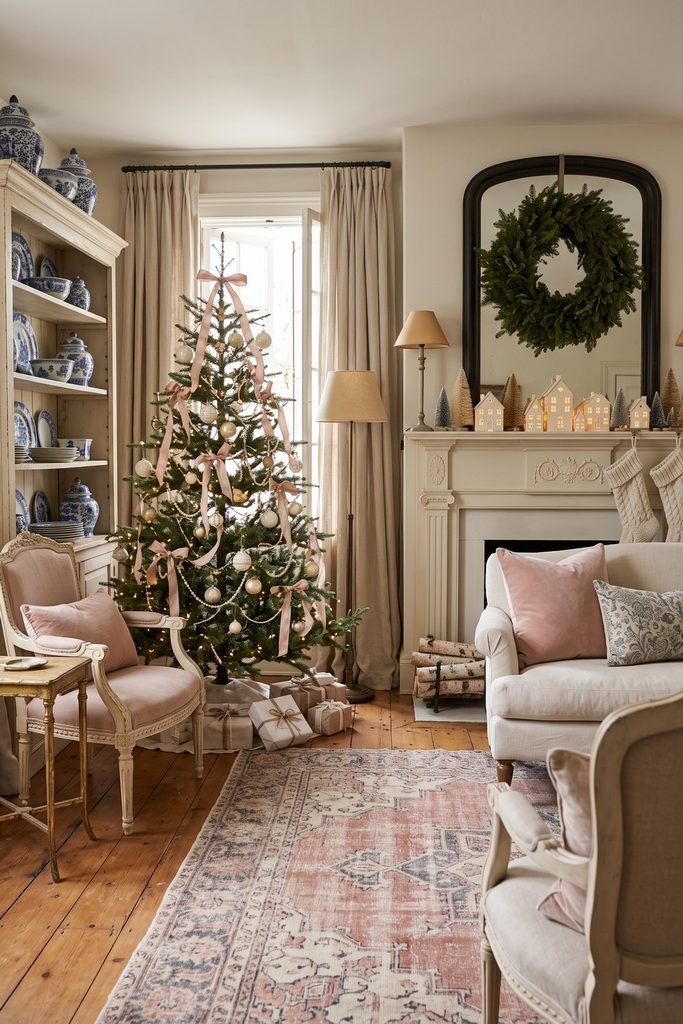
These 18 ideas carry that collected feeling through trees, mantels, entryways, kitchens, and holiday tables. Some are generous and layered; others gather Christmas into one chair corner or a removable display. Follow the combinations that suit your home, paying attention to how color repeats, where textures meet, and which surfaces you still need to use.
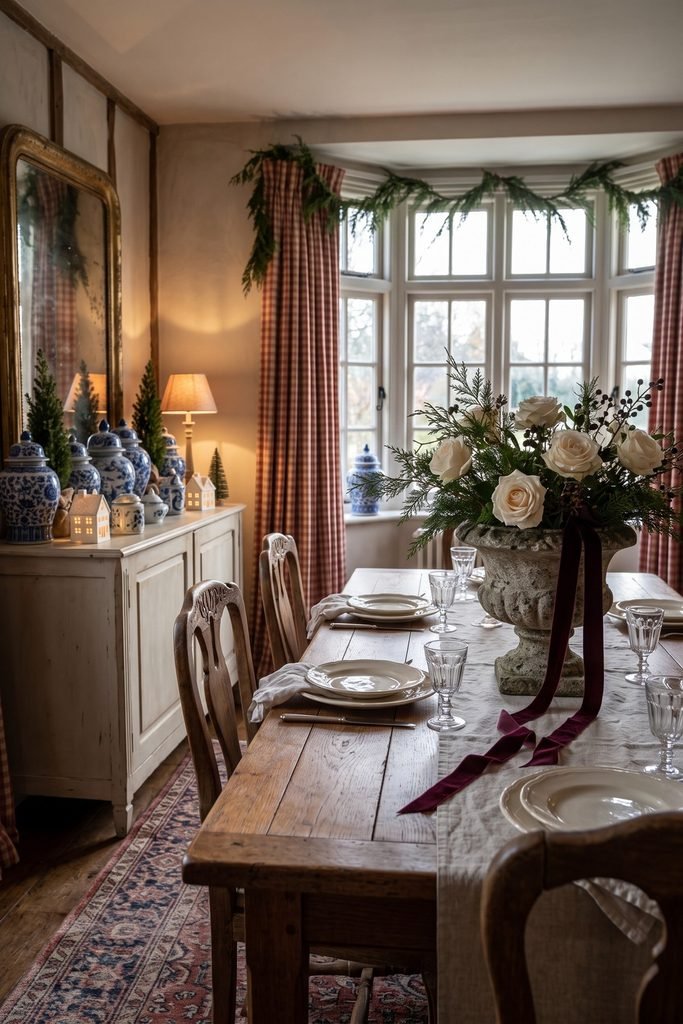
Quick Takeaways
- Keep pale paint, warm wood, and greenery as a base, then repeat one accent such as faded red, blush, or blue-and-white china.
- Pair a rough or worn-looking surface with something finer: glass, porcelain, velvet, or softly falling ribbon.
- Give small decorations a larger anchor, such as a mirror, urn, tray, or furniture piece.
- Preserve usable seats, counters, doorways, and dinner settings. Contained arrangements make seasonal changes easier to manage.
Before You Decorate: Fit, Light and Greenery
Check the everyday space first. Open doors, pull out chairs, and set down the dishes you normally use. A decorative basket or urn also needs to accommodate the tree’s actual stand or pot, with access for care.
For lighting and tree placement, follow the U.S. Fire Administration’s holiday guidance: inspect light strands, keep Christmas trees at least 3 feet from heat sources, and water cut trees daily. Battery-operated flameless candles suit the densely layered displays below. Use lights intended for their indoor or outdoor location, following their instructions.
Fresh greenery needs attention throughout the season. University of Minnesota Extension notes that indoor greens can dry and become brittle; keep pine and cedar in cooler spots away from heat and vents. Protect furniture beneath water-containing vessels.
Christmas Trees and Cozy Cottage Rooms
A French country Christmas tree can set the palette for nearby chairs, trays, and textiles.
1. Drape an Airy Tree with Blush Ribbon and Porcelain Accents
Blush ribbon needs room to fall. On an open-branch tree, loose bows and long tails remain visible between the ornaments, giving the decoration a softer movement than tightly packed ribbon loops. Concentrate the blush in a few generous lengths, with ivory glass ornaments and pale gold scattered between them.
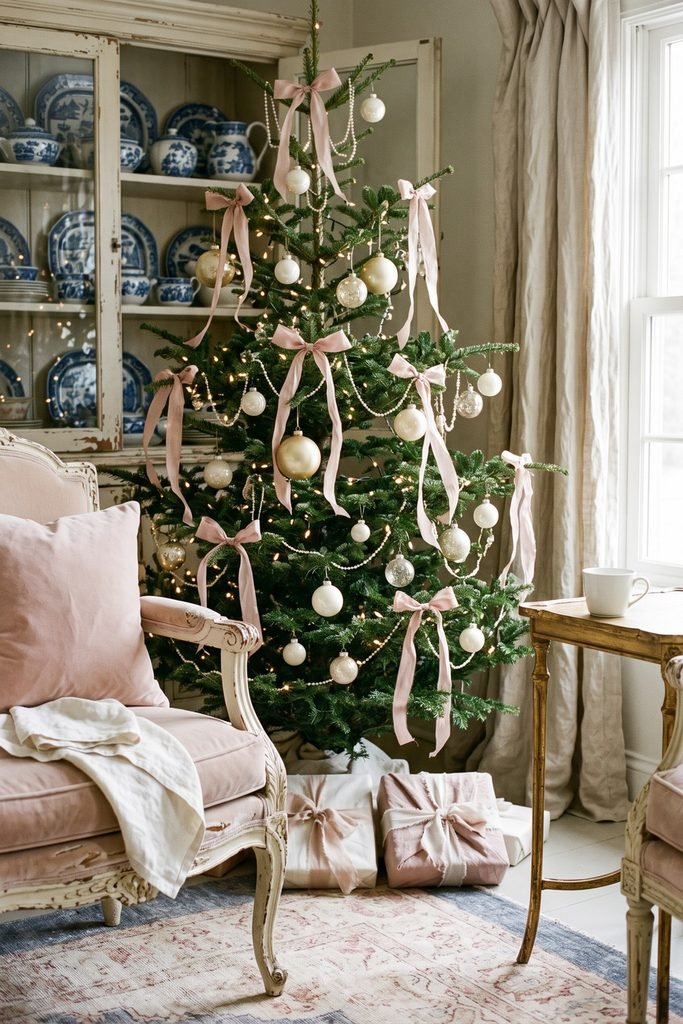
A nearby blue-and-white china collection gives that pale tree a more collected setting. The porcelain’s stronger pattern stays on the shelves while the ribbon carries the gentler color beside it. A carved cream chair and a small gilded table can bridge the two areas; one blush cushion is enough to repeat the accent beyond the branches. A few loosely spaced pearl-like strands can add another fine line through the tree.
Leave some green branch tips exposed and gather a few cloth-wrapped gifts at the base. Stand back before adding more: the spaces between the bows are part of the arrangement.
Find the Soft Ribbon and Ornament Mix
Pair blush ribbon with ivory ornaments to echo the tree’s pale palette.
2. Pair a Sparse Urn Tree with a Linen Reading Chair
A broad, weathered urn gives a slender evergreen enough presence to sit beside substantial furniture. Its rough rim and weighty shape ground the fine branches above, especially when the ornaments are small, pale, and widely spaced.
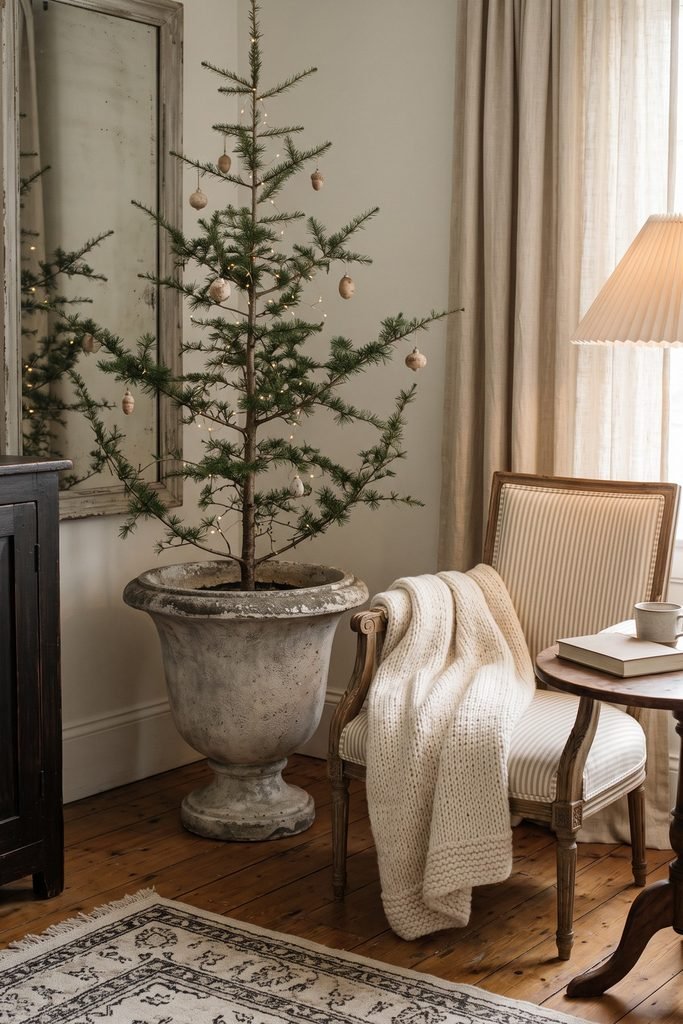
The reading chair completes the corner. Striped linen-look upholstery introduces a little pattern, while a cream throw and shaded lamp make the seat feel ready to use. A narrow drink table holds a book and cup; a tall distressed mirror catches a glimpse of the greenery behind them.
Choose the support inside the urn before arranging its outer layers. A cut tree needs a suitable stand and accessible water reservoir; a potted tree needs room for its actual container and care. Keep the vessel’s full outline visible so the tree appears settled into the room, with the chair comfortably alongside it.
3. Display a Bare-Branch Tree Above Rustic Crates
The attraction of a bare-branch tree is its outline. A red bauble hanging from one crooked limb can become a focal detail because there is open space around it. Cream ornaments and a fine strand of warm lights keep the branching structure readable.
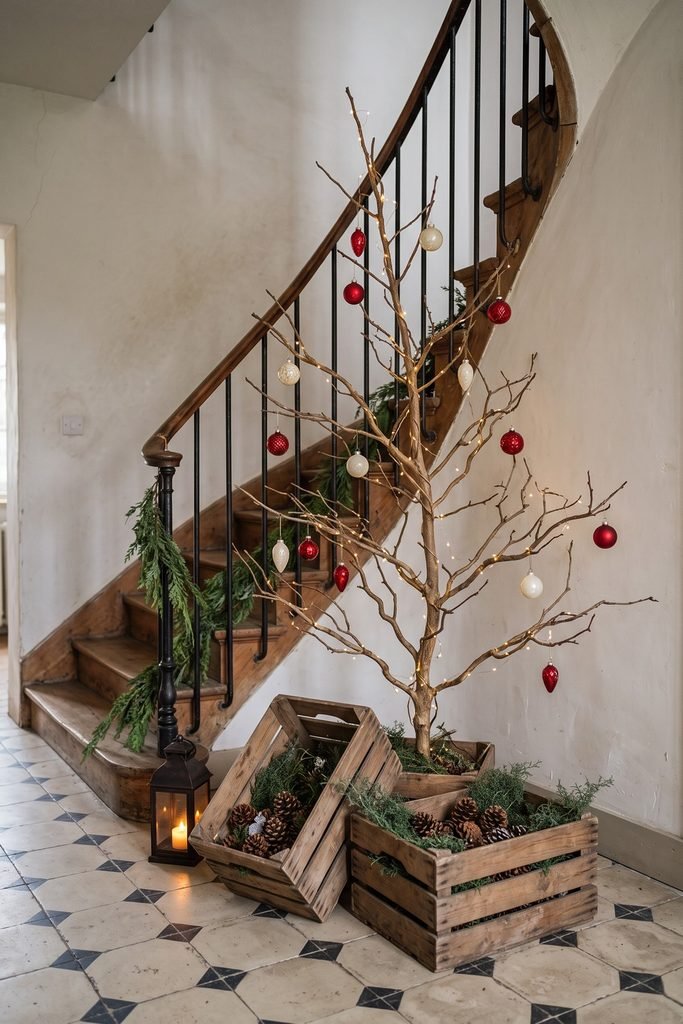
Below, two staggered wooden crates give the display a broader base. Tuck a small amount of evergreen and a few differently sized pinecones into the low arrangement, with an LED lantern visible beside them. The crates repeat the tree’s rough texture, while glass ornaments supply a finer finish.
A staircase makes a particularly strong backdrop: the rising rail echoes the tree’s upward movement. The branch structure still needs its own secure base; treat crates as decorative staging. Keep the entire arrangement beside the walking route, with clear access to the steps and handrail.
4. Place a Lift-Off Christmas Village Tray on a Plaid Ottoman
An upholstered ottoman can carry a whole little Christmas scene when the pieces share a firm, handled tray. The tray gives the arrangement an edge and lets you move it together when the seat is needed.
Red-and-cream plaid looks especially good beneath low ivory houses, clipped greenery, and a small folded-paper tree. The broad textile pattern provides structure; the paper tree’s crisp pleats contrast with softer needles and irregular pinecones. Keep its height modest so it belongs with the houses.
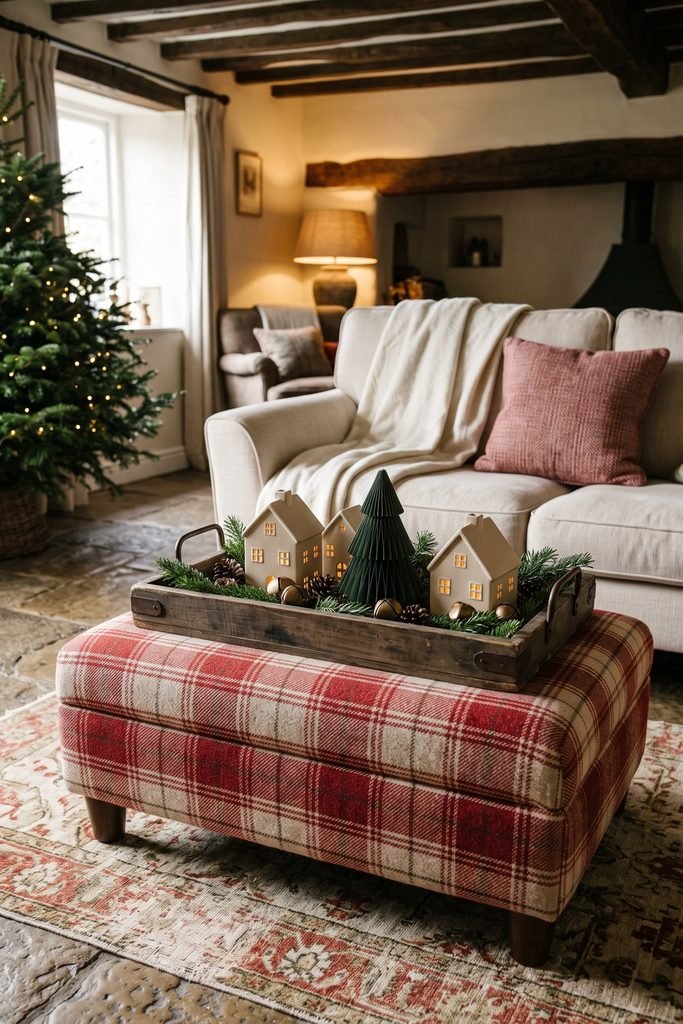
Let plaid remain visible around the tray. A cream sofa and larger Christmas tree nearby provide the room’s bigger shapes, leaving the miniature village as a close-up detail. LED-lit windows add a little glow. Test the tray on your actual upholstery, keep the contents manageable to lift, and place hot drinks on a suitable separate surface.
5. Layer a Cottage Bed in Plaid Beneath a Glowing Ledge
Pattern scale makes a Christmas bed feel layered. A red tartan quilt can carry the largest checks, with smaller cream gingham cushions and a green checked throw folded across the foot. Pale paneling behind the bed gives those patterns a restful background.
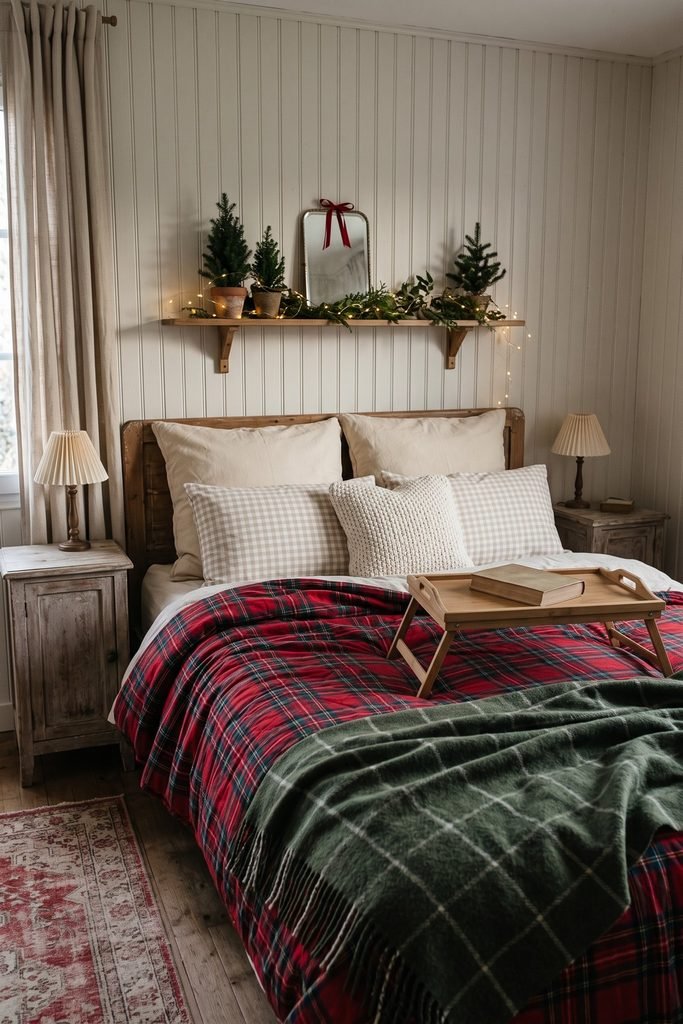
Repeat the red once above the pillows, perhaps as a ribbon on a small mirror. A slim picture ledge can hold that mirror, a few miniature trees, and a light scattering of greenery. Keep the arrangement low enough for the wall itself to remain visible.
For more textile combinations, explore these Christmas bedding ideas. Here, a soft knit layer supplies the final texture. Secure lightweight ledge decorations, keep wires clear of bedding, and switch decorative lights off before sleep.
Layer Red Tartan with Cream Gingham
Large red tartan and smaller cream checks can carry the bed’s layered pattern mix.
Mantels and Collected Christmas Displays
Existing mirrors, artwork, and ceramics can become the framework for a seasonal composition.
6. Layer a French Mantel with Red Velvet and Heirloom Art
Give the largest frame first consideration. An ornate mirror or substantial painting can hold the center of a mantel while smaller seasonal artwork leans to one side. That difference in scale helps an heirloom Christmas display feel assembled over time.
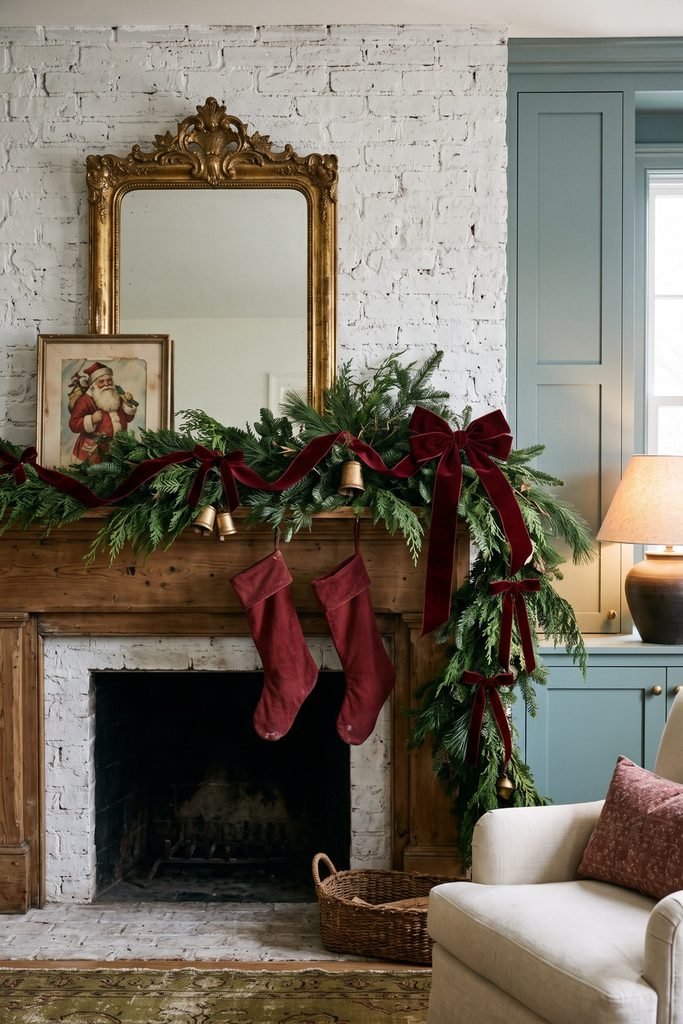
Evergreen can sweep beneath the frames and fall farther at one end. Repeat deep red velvet through a larger upper bow, smaller ties along the greenery, and one or two stockings. A few brass bells provide small highlights among the darker needles. Soft blue-green cabinetry nearby makes the red especially clear against the room’s permanent color.
Choose one secondary collection to emphasize: a portrait or a group of plates. Leave enough space to read its shape. This layered treatment suits a nonworking fireplace. For a fireplace you use, follow its specific clearance instructions and keep combustible decorations out of the opening and away from heat.
7. Build an Ivory Village Above Chunky Knit Stockings
An ivory village gains depth from changing rooflines. Set taller buildings toward the back, lower cottages in front, and narrow bottlebrush trees in the gaps. Small breaks between groups let the individual houses remain recognizable.
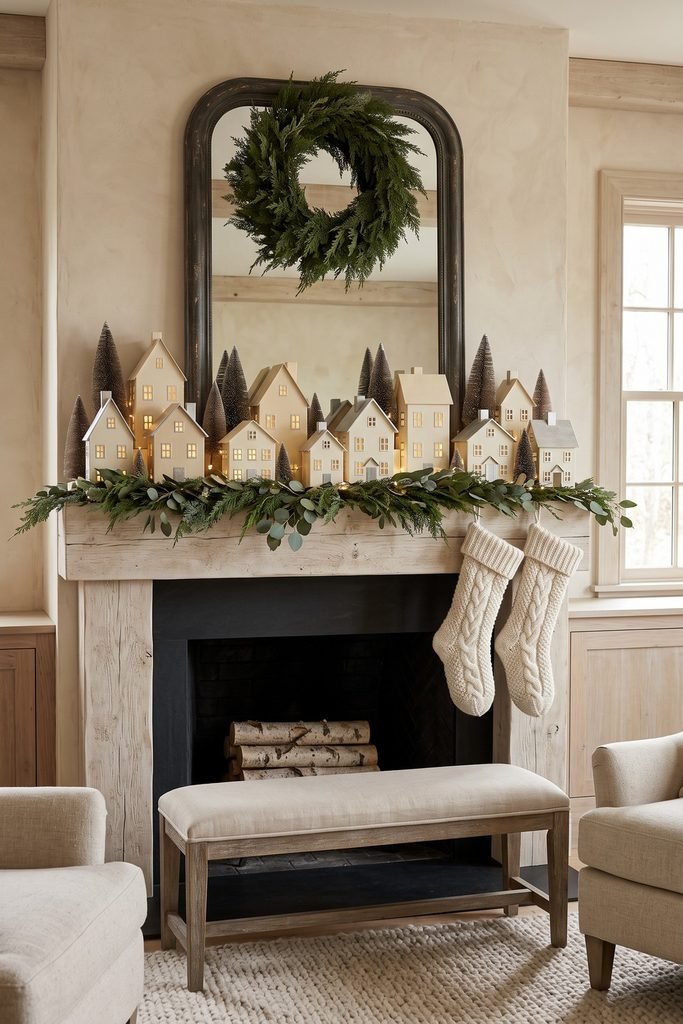
Chunky knit stockings bring a much softer texture beneath that architectural band. Above it, a tall arched mirror and simple wreath supply larger shapes, giving the little buildings a setting. A dark mirror edge is useful against pale plaster because it defines the display’s upper outline.
Keep the palette close—cream, parchment, pale wood, and muted silver—with evergreen providing the deepest color. Warm LED windows can carry most of the sparkle. On a nonworking hearth, a narrow bench adds another low layer; in a room without a fireplace, the village can occupy a long console, with stockings displayed separately from any heat source.
8. Fill a Weathered Dough Bowl with Silver Baubles
Silver looks different against old wood. Its reflections become more noticeable beside a dark, uneven grain, especially when the bowl contains a mixture of large ornaments, small rounds, and slightly different finishes.
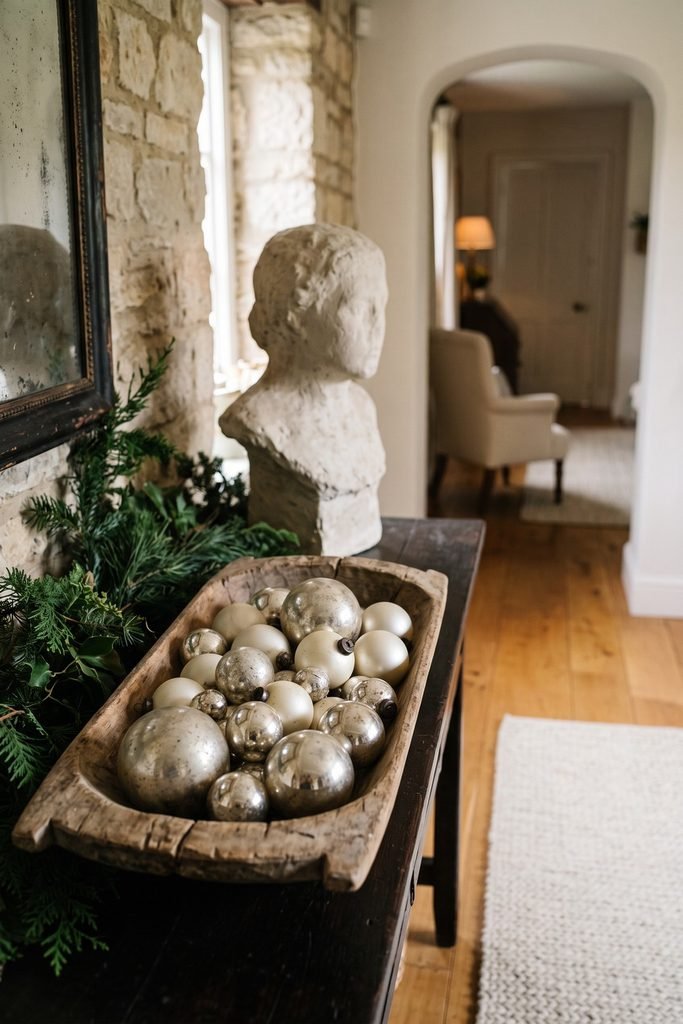
A long dough bowl offers enough space to nest those shapes together. Begin with a few larger baubles, then fill around them while allowing some wood to show near the rim. Ivory ornaments can soften the silver, particularly against a rough stone wall.
One pale sculptural object behind the bowl gives the arrangement height. A small bust, carved figure, or similarly substantial object is enough; its matte surface provides another contrast to the reflective ornaments. Add loose greenery along the nearby wall or mirror edge, keeping the bowl itself legible. A stable console and nonfragile ornaments are sensible choices where the display is within reach.
Pair Weathered Wood with Silver
A rustic wooden bowl and varied silver ornaments supply the contrast at the center of this display.
9. Drape a Mirror Console with Dried Oranges and Ivory Bows
Two mirrors with different outlines can give a console the presence of a larger architectural feature. An arched frame behind a smaller oval or rectangular one creates layers before any greenery is added. Secure each independently, then plan the garland around their combined shape.
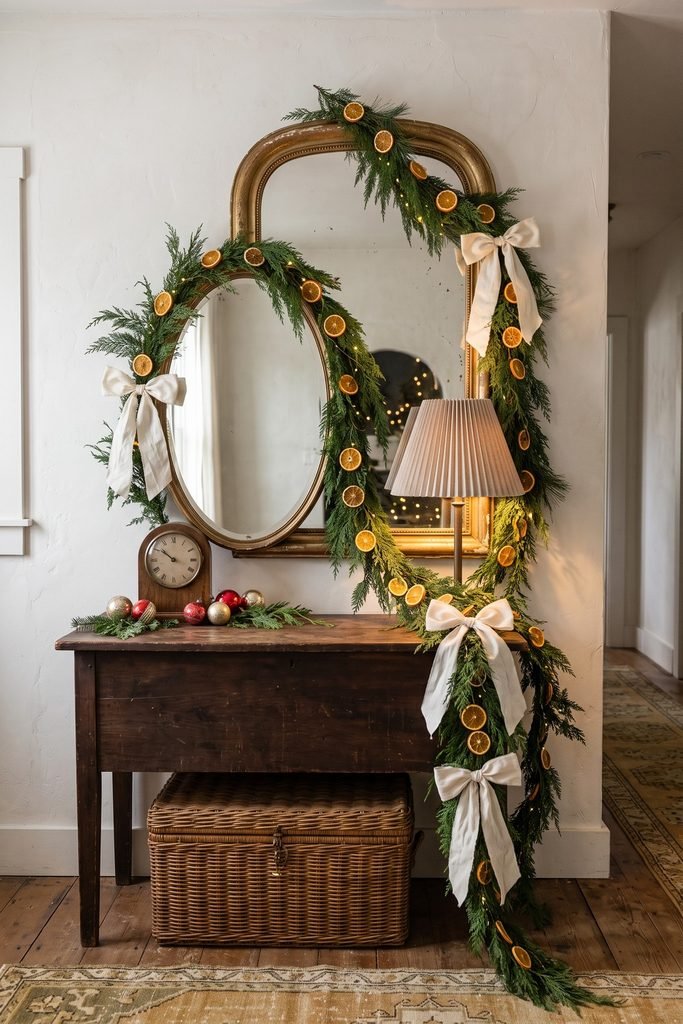
Dried-orange rounds repeat the mirrors’ curves at a smaller scale. Thread them through fine evergreen at loose intervals, allowing one side of the garland to fall farther down the cabinet. Long ivory bows give the dense green texture a few broader, simpler lines.
Keep portions of the mirror glass open to catch the room’s light. Below, a small mantel clock and a few treasured ornaments can gather into one group. A dark trunk under the console adds a low anchor, while the lighter ribbon draws attention upward. Use flameless light around the dried fruit and greenery.
10. Nest a Glowing Village Between Blue-and-White Ginger Jars
Your china can become part of a Christmas village’s landscape. Large blue-and-white ginger jars create the tall background, with small ivory houses tucked into the spaces between them. Their contrasting scales make the arrangement feel deeper than a single row of cottages.
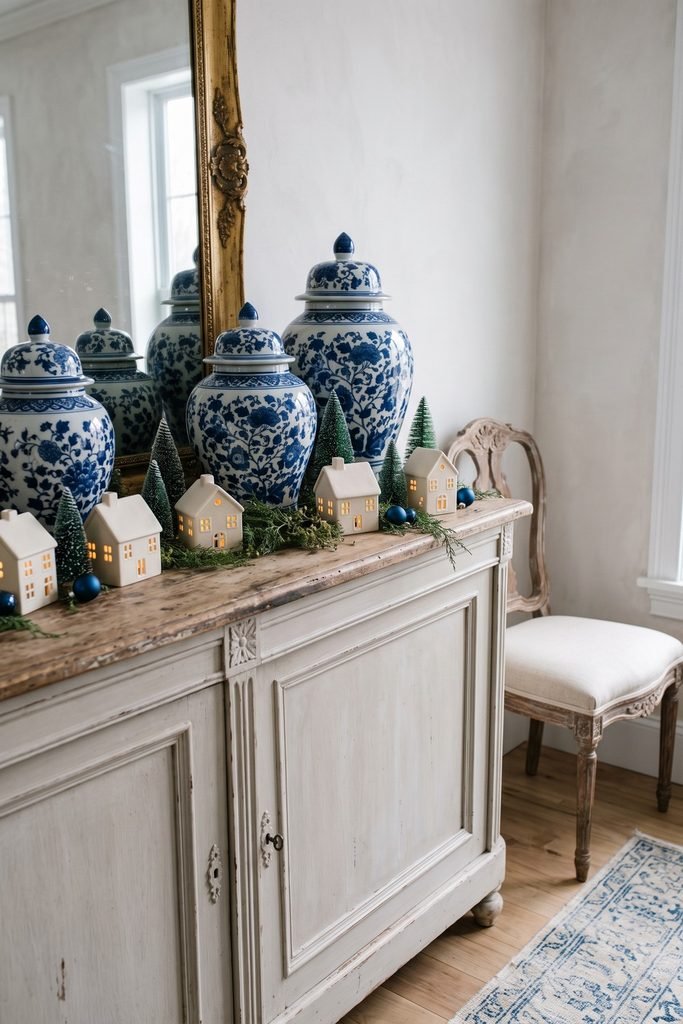
Keep the houses relatively plain so their rooflines remain clear beside the porcelain patterns. A few narrow trees can connect the lower village to the taller jars. Low evergreen along the sideboard unifies the base, with just a handful of blue baubles repeating the pottery’s color.
Arrange houses into two or three small groups, leaving some cabinet surface visible between them. Warm-lit windows stand out against the cool blue decoration. Leave switches reachable and protect the furniture from moisture, so enjoying the village each evening requires moving only its small pieces. Valuable jars can stay in their settled positions at the back.
French Country Christmas Entries
Carry the decorating outward to the doorway, then give the entry its own useful seasonal focal points.
11. Wrap a Cottage Doorway in Evergreen and Burgundy Velvet
Broad burgundy ribbon gives a lush evergreen doorway a clear accent. The fabric’s large areas of color remain readable among fine needles, small leaves, and irregular branch tips.
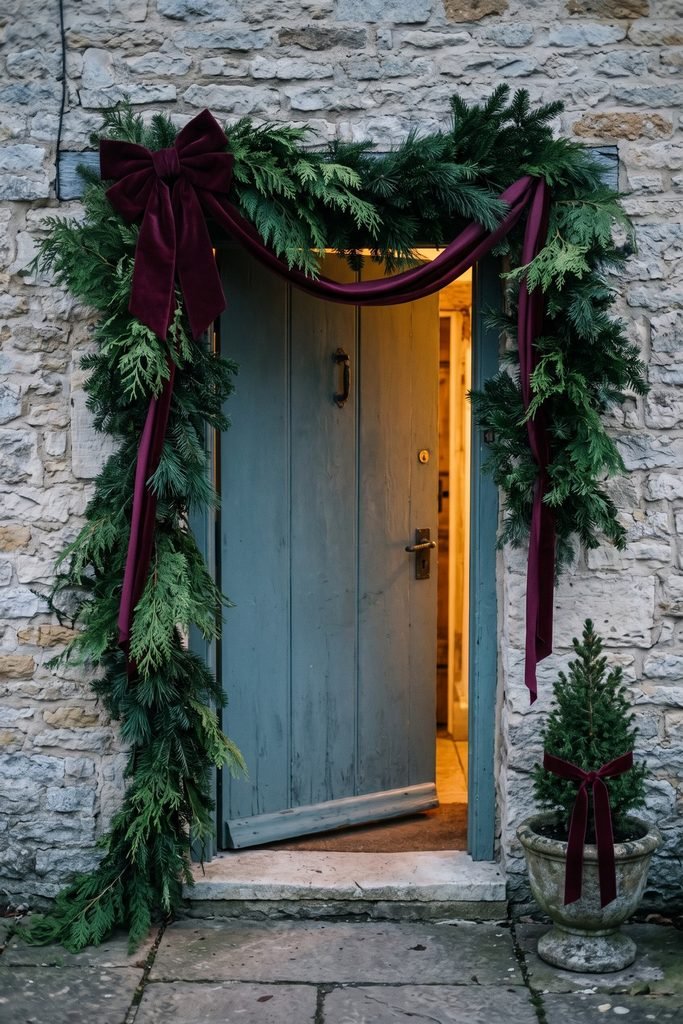
Scale the greenery to the door frame, letting one side fall a little farther for a relaxed outline. A generous bow near an upper corner and a shallow fabric swag can provide enough drama for a residential entrance. Keep ribbon tails above the ground and clear of the hardware.
One small potted tree beside the door repeats the greenery at a lower level. A little matching ribbon connects it to the upper display, while warm light from inside makes the opening the center of the scene. Check the full door swing and approach before finishing. Mounting and material choices need to suit the surface and actual exposure, including any lights used outdoors.
12. Dress an Entry Bench in Red Botanicals and a Basket Tree
A red botanical cushion can do much of the decorating on a carved cream bench. Its large flower or leaf shapes stand out against pale wood, with a smaller patterned cushion adding a second textile scale at the opposite end.
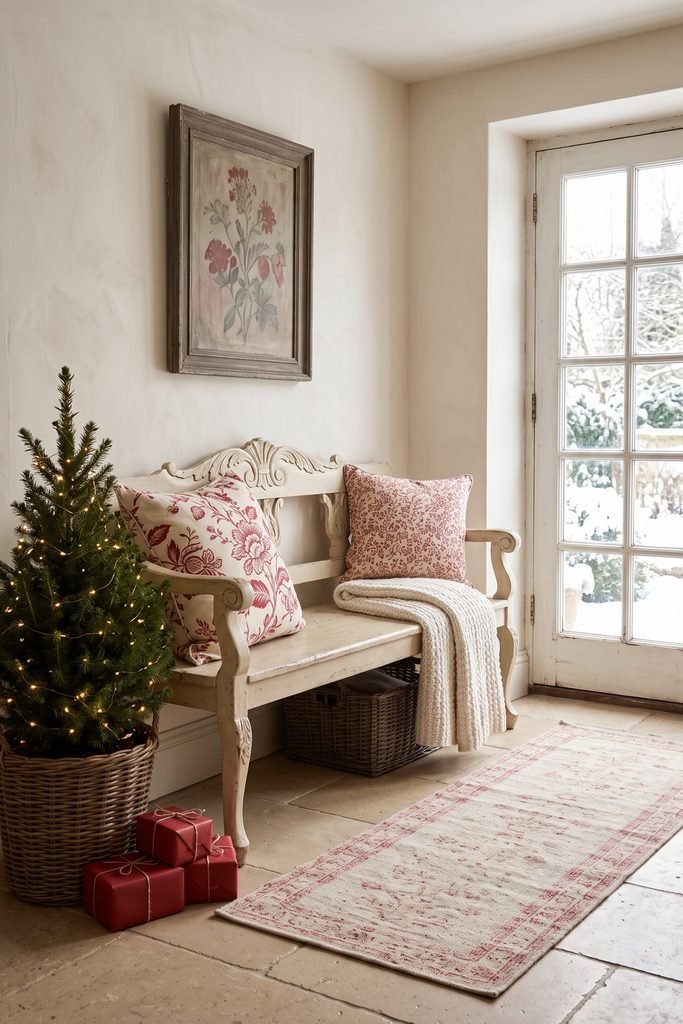
Leave the middle of the seat available. An ivory throw can fold over one arm, and a woven basket below can hold everyday necessities. A compact basket tree beside the bench repeats the cushions’ green and red; a few neatly wrapped gifts connect it to the floor.
This French country entryway works best when the bench remains a real place to sit. Test that position, open the nearby door, and adjust the tree or gifts to preserve both actions. Framed botanical artwork above can repeat the theme quietly.
Red Botanicals for the Entry Bench
Look for red botanical patterns on an ivory ground to echo the bench cushions.
13. Build a 24-House Advent Village on French Shutter Panels
For a custom Advent display, plan two shutter-style panels above a slim entry console. Each panel carries four shallow ledges with three opening house boxes on every ledge: twelve houses per panel, twenty-four altogether.
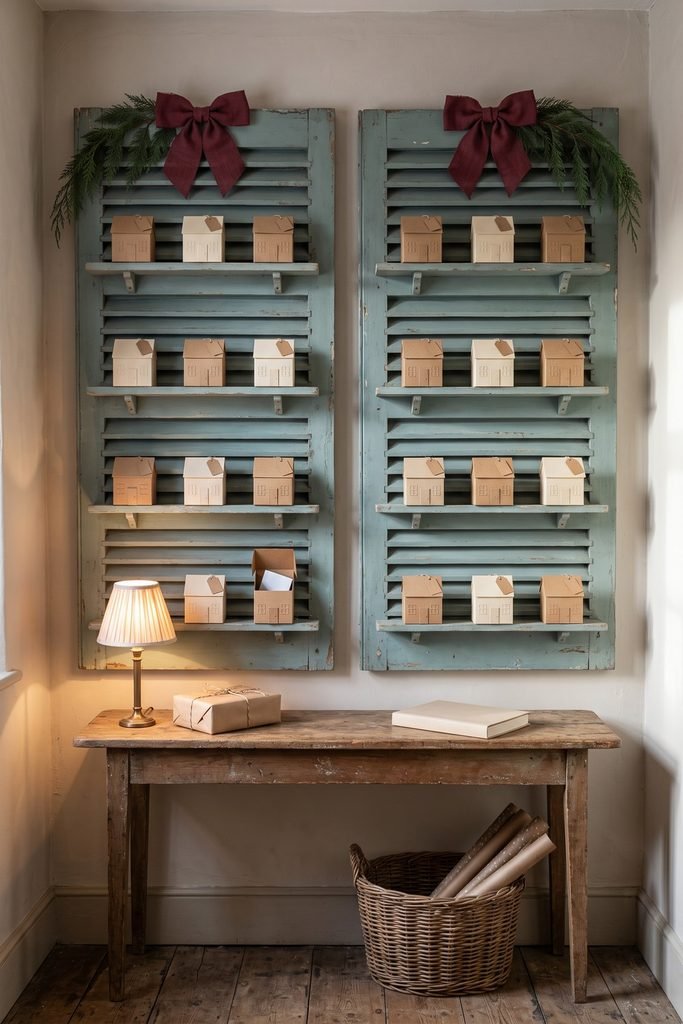
The vertical arrangement gives the village architectural presence while leaving the tabletop useful. Faded blue-green panels make kraft and ivory houses easy to distinguish, with small burgundy bows connecting the two sides. A little evergreen can sit near the tops; the opening boxes need clear space around their lids.
Treat the numbered houses as accessible compartments. A folded note or other suitable small surprise goes inside each one, and the lower houses can invite daily participation. A lamp and a wrapped parcel can still occupy one end of the console, with wrapping supplies in a basket underneath.
This is a proposed styling and organization project, so work out box opening, comfortable reach, panel weight, and wall fixings before building. Lightweight new panels offer more control over the design than heavy salvaged shutters. Another approach is a ready-made twenty-four-compartment organizer with a shutter-style surround. The defining features remain the same: a readable house grid, front access to each compartment, and a useful surface below. Keep the ledges and boxes removable if you want to pack away the seasonal pieces afterward.
Christmas Kitchens and Holiday Tables
In working rooms, let the Christmas layers follow the space left around dishes, food preparation, and conversation.
14. Frame a Kitchen Window with Citrus Garland and Basket Trees
A shelf above the sink offers a long, readable line for natural holiday decor. Fine evergreen can follow its front edge, with dried-orange slices forming a shallow scallop beneath little houses or a few familiar kitchen pieces.
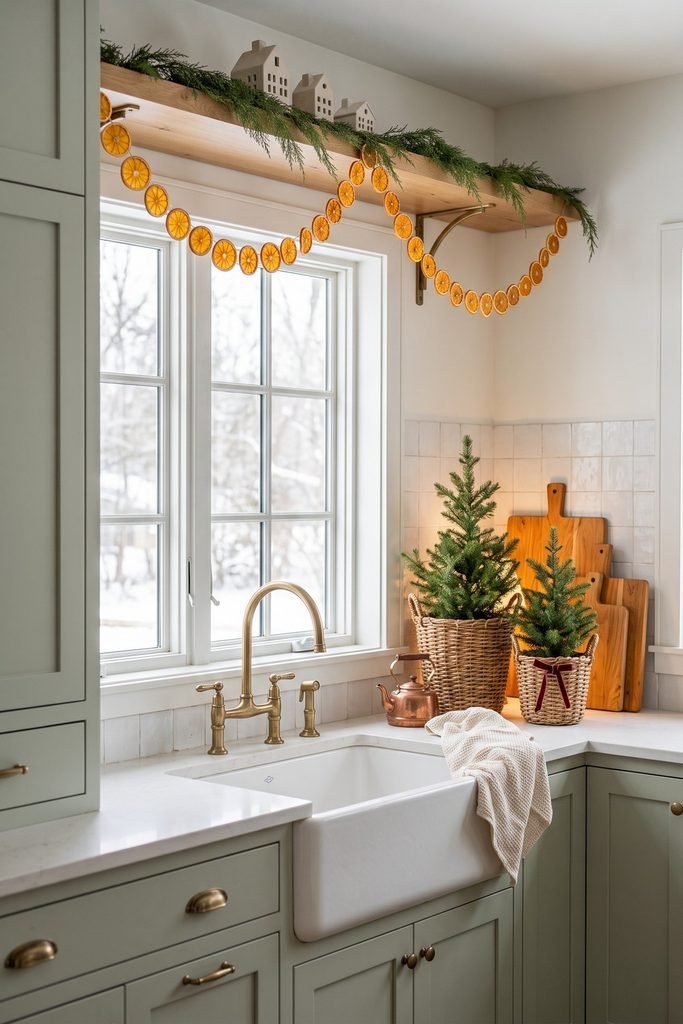
The oranges make a warm connection between white tile, brass hardware, and wooden cutting boards. Gather the boards at one counter end with two small basket trees at different heights. Their woven containers soften the flat cabinet surfaces, while the boards give the little trees a background.
Copper accents or a narrow burgundy ribbon can repeat that warmth in small amounts. Keep the main counter and sink area available, with plants protected from routine splashes and lined containers beneath their pots. Place the whole decorative group away from the stove and hood. The window, shelf, and useful kitchen surfaces should still read clearly when the garland is finished.
15. Style a Christmas Hutch with Mugs, Plaid and Berry Jars
Collections look more settled when their shapes repeat. A few Santa mugs grouped on one hutch shelf form a recognizable family; stacked cream plates on another provide a larger, quieter area beside them.
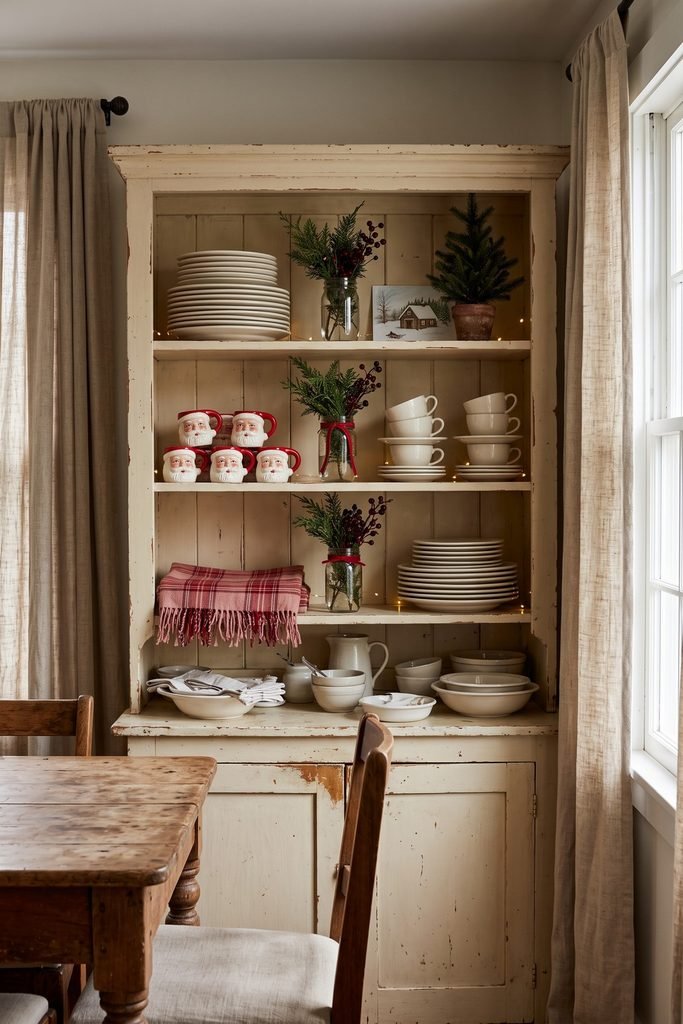
Folded plaid gives the display a broad patch of color, particularly among many small ceramic faces and tree shapes. A single seasonal portrait can lean behind a miniature fir, giving that shelf a clear center. Clear jars holding fine greens and berry-like stems introduce height while leaving the dishes visible through the glass.
Keep the useful crockery within comfortable reach, with seasonal pieces grouped around it. A glass-front wall cupboard offers a compact version of the same approach. Protect wood beneath branch jars, and keep decorative plant material separate from vessels currently being used for food. One ribbon tied around a jar neck can repeat the plaid’s red across the shelves.
Browse Nostalgic Hutch Details
A few vintage-style mugs and clear branch jars can support the hutch’s collected display.
16. Frame a Gingham Breakfast Nook with Evergreen Swags
Christmas can sit around the table as well as on it. In a window bay, red-and-cream gingham curtains create repeated vertical bands, while soft evergreen swags connect the tops of the openings.
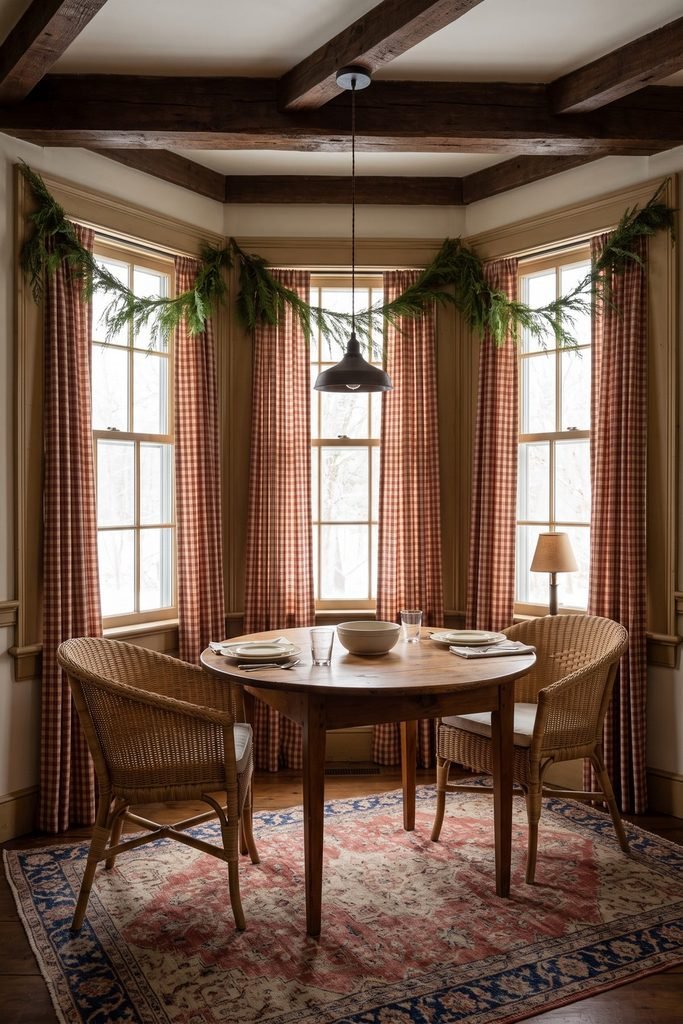
Use the same check scale across the curtain panels so the windows feel related. Wood or wicker chairs and an old patterned rug give the red fabric a softer setting. A plain cream bowl and two modest place settings can be enough for the round tabletop.
Preserve the daylight between the curtain edges. The greenery should frame the view, with windows and curtains still able to operate. Use appropriate independent fixing points, keep greens away from radiators, and leave the chandelier’s structure free of improvised heavy hanging decorations. The repeated window treatment supplies the festive emphasis.
17. Fill a Garden Urn with Ivory Roses and Burgundy Velvet
Ivory roses bring softness to a substantial garden-style urn. Fine evergreen can spill past its rough rim, with darker berry-like stems placed between the pale flowers. A burgundy velvet tail concentrates the deepest color in one flowing line.
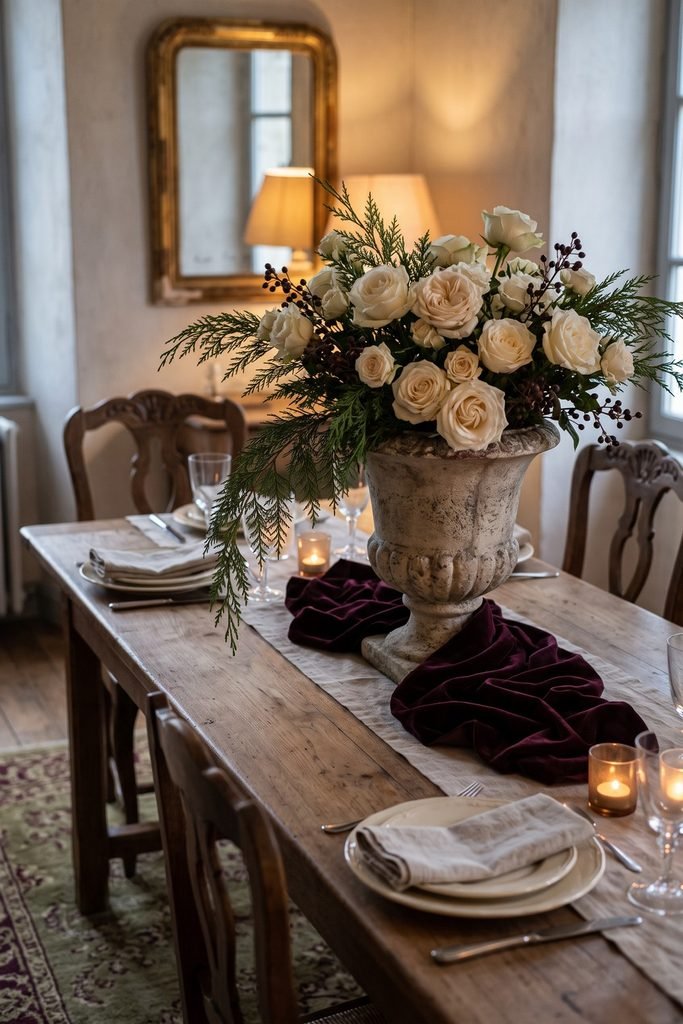
That contrast lets the vessel feel weathered while the flowers remain delicate. Keep the arrangement slightly uneven, with one longer spill of green, and repeat the ivory in the plates or napkins nearby. A linen runner gives the ribbon somewhere calm to fall.
On a generous table, the urn can sit toward the far end or side, with low settings in front. Check the view between opposite seats before adding the tallest stems. A sideboard is another setting if dinner needs the tabletop. Use a water-tight liner and table protection, keep decorative stems away from food, and select known materials appropriate for your household. Soft lamplight can reveal the urn’s texture beside the petals.
18. Curve a Miniature Christmas Garden Around an Open Bistro Table
A small round table can hold a miniature winter garden along its far edge while keeping the center and near side available for dinner. Plan the shape with three separate shallow dishes, curving them into a narrow crescent inside the table’s edge.
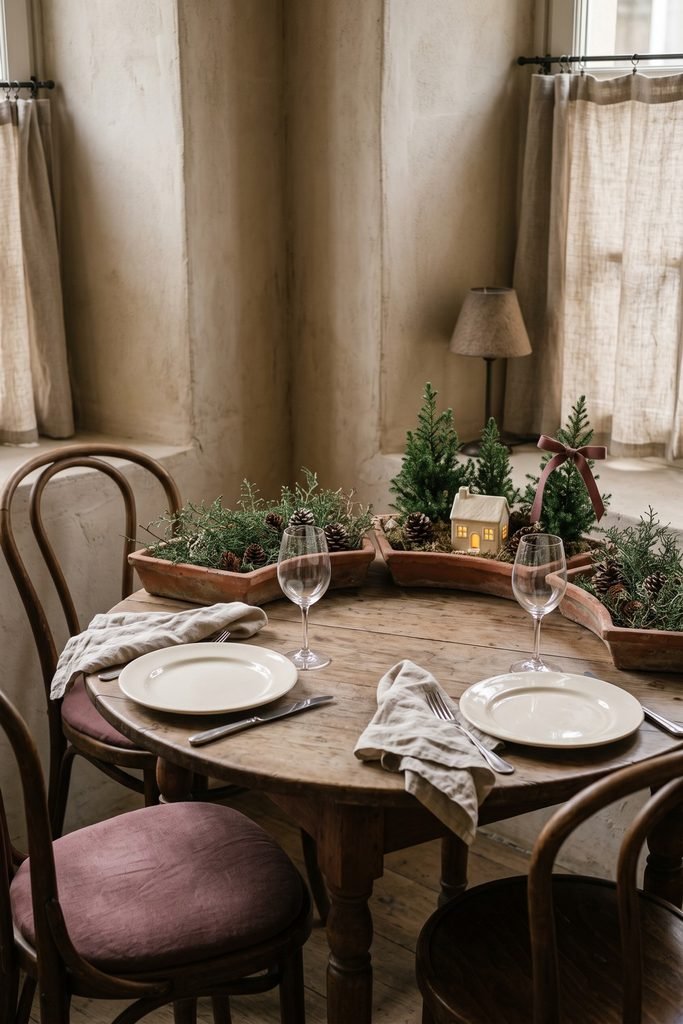
Set out two complete place settings first, including glasses and the serving space you expect to need. The remaining area determines the size of the dishes and their decoration. Small firs belong toward the back; lower evergreen and tiny cones can run along the front of each module. One warm-lit ivory cottage gives the garden a focal point, with its battery light and base kept dry.
Weathered terracotta or stone-look dishes relate naturally to a wooden bistro table. A short burgundy ribbon on one little tree can echo a chair cushion, connecting the miniature scene to the room.
Keep the three bases separate and removable. Each can move to a sideboard when a serving dish needs more room, with the other modules left intact. This proposed arrangement needs a real tabletop mock-up; adjust the footprint before filling the dishes. Contain any moisture, protect the finish, and keep plant material clear of food. The useful center is part of the design.
Find Bases for a Miniature Table Garden
Shallow dishes and a battery-lit cottage can supply the garden’s separate display pieces.
Bring the Look Together, One Corner at a Time
Choose a few arrangements that share something with your existing rooms: a blue porcelain collection, red patterned fabric, pale carved furniture, or weathered wood. Repeat that connection through selected ribbons, greenery, and ornaments, letting each space keep its own character.
For another collected holiday direction, explore these primitive Christmas decorating ideas. Give your chosen displays room to be enjoyed alongside the everyday life of the house.