





15 Christmas Ideas for Hanging Ornaments From the Ceiling
Hanging ornaments from the ceiling gives Christmas decorating another place to shine: above the table, beside a window, or in a corner that usually stays bare. A branch strung with glass-like baubles feels completely different from a velvet ornament cluster or a trail of golden stars.
Table Of Content
- Before You Hang: Scale, Sightlines, and Support
- Window and Corner Ornament Displays
- Hang a Woodland Ornament Curtain Above the Window
- Make a Red-and-White Ornament Cascade in a Ceiling Corner
- Hang a Red-and-Ivory Mobile With Snowmen and Little Houses
- Let Ornaments Spill Between Floating Gift Boxes
- Christmas Ceiling Decorations for Hallways and Entries
- Float Snowflakes and Icicles Beneath a Warm-Light Canopy
- Repeat Garland-and-Bauble Rows Along the Hallway
- Frame a Room Opening With Gingerbread Ornaments
- Suspend Oversized Velvet Baubles With Evergreen Crowns
- Statement Shapes for Tables and Covered Porches
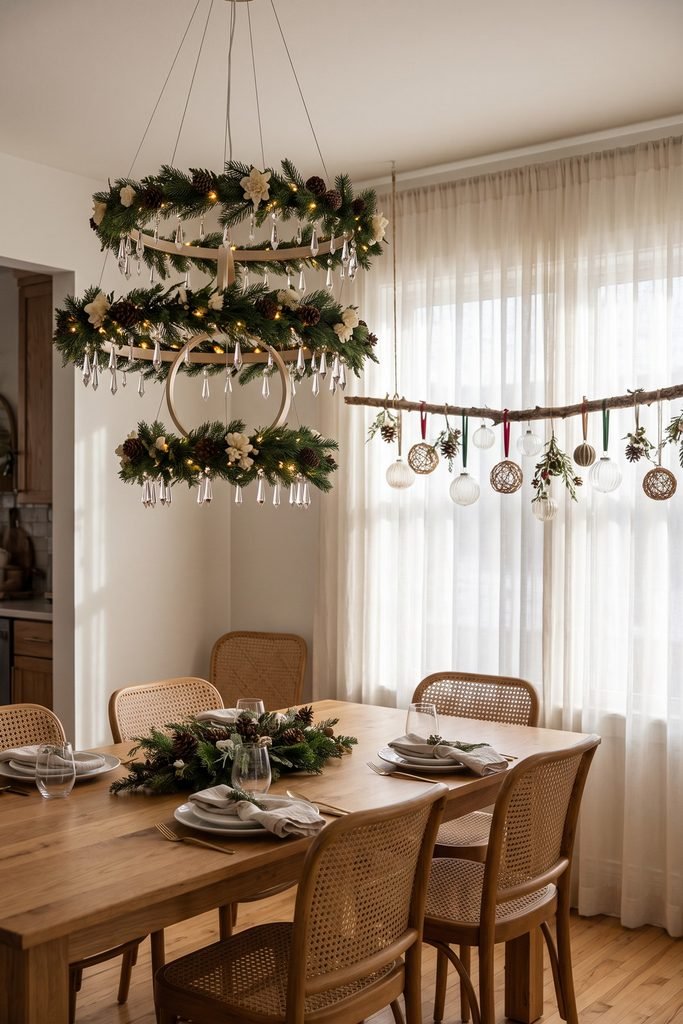
- Layer Crystal-Drop Hoops Above the Dining Table
- Hang a Mini Christmas Tree Canopy With Stars and Gifts
- Turn Clear Umbrellas Into Glowing Ornament Chandeliers
- Candy, Characters, and Christmas Stories
- Hang a Candy-Shop Ornament Curtain Beneath a Beam
- Hang a Wreath-Topped Spiral of Gingerbread and Candy
- Float a Santa Sleigh and Reindeer Along the Ceiling
- Let a Hanging Angel Trail a Waterfall of Stars
- Final Toughts

These 15 arrangements explore those differences through color, texture, shape, and placement. Some suit a compact apartment nook; others need the height of a stair hall or covered porch. Look for the display that fits your room, then let its strongest detail lead the rest of the decorating.
Quick Takeaways
- Give the arrangement a clear home: a window, corner, table, or overhead border.
- Combine a few readable silhouettes with smaller supporting details.
- Let matte, woven, plush, and reflective finishes play different roles.
- Keep room use, sightlines, and the full suspended weight part of the plan.
Before You Hang: Scale, Sightlines, and Support
Decide where the display will live before choosing its drop lengths. A corner arrangement can descend beside furniture; a hallway canopy needs to leave the passage clear. Above a table, check the view from a seated position so the decorations do not interrupt conversation. Allow windows, doors, and curtains to work normally.

The complete arrangement includes its frame, greenery, cords, lights, and ornaments. Match the support to that full weight and the actual ceiling surface, following the hanging product’s preparation, placement, and weight instructions. Large branches, hoops, and custom displays need their own suitable support. An existing light fixture should not be assumed to carry extra decoration.
For illuminated displays, follow the lights’ indoor or outdoor labeling and inspect them for damage. The U.S. Consumer Product Safety Commission’s holiday guidance also recommends tested light sets, keeping small removable decorations out of children’s reach, and avoiding food-like trimmings in homes with small children. That last point matters for candy and gingerbread themes.
Keep paper, ribbon, and greenery away from flames. Flameless candles can provide a lantern glow near those materials.
Window and Corner Ornament Displays
A bounded area gives a hanging display a clear outline. The window frame, wall corner, or sideboard helps you judge its width and where the lowest pieces should finish.
Hang a Woodland Ornament Curtain Above the Window
A rough branch suspended from the ceiling makes a beautiful partner for clear ornaments. Its uneven outline gives the display a strong top edge, while the baubles below allow daylight to remain part of the scene. Small woven spheres and jute cords repeat the branch’s natural texture.
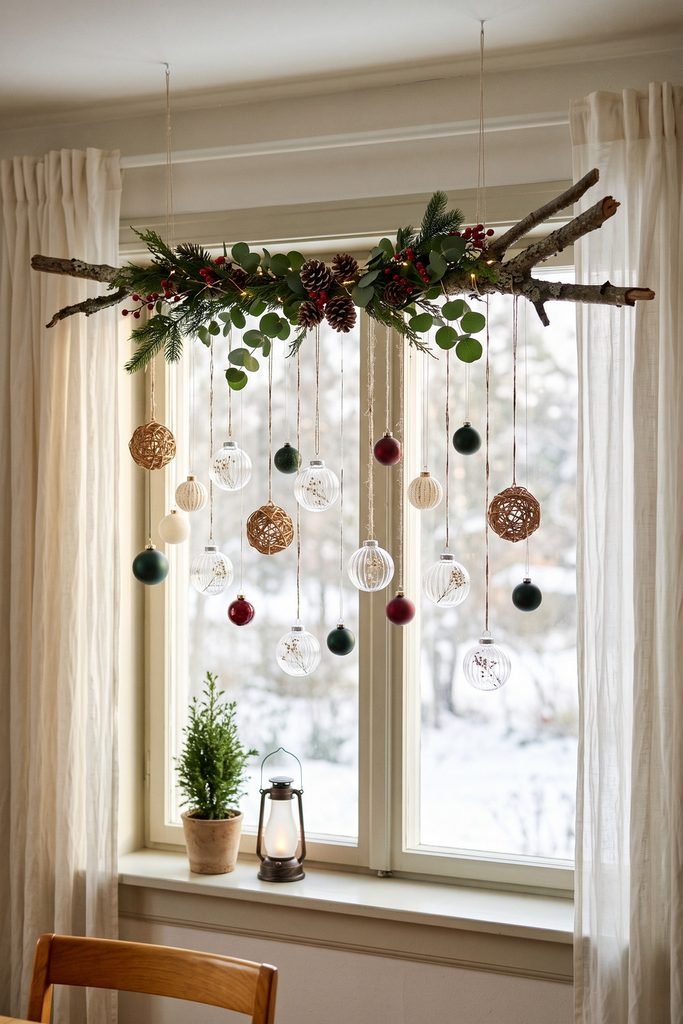
Forest-green and cranberry ornaments add weight to an otherwise pale window. Spread a few across the arrangement so one side does not become much darker than the other. Clear and ribbed pieces can sit between them, with unequal drops creating a loose lower edge. A little greenery inside selected transparent ornaments rewards a closer look.
Keep the branch visible between small evergreen sprays, eucalyptus, berries, and pinecones. The contrast comes from seeing bark beside delicate, light-catching forms. For Christmas window decorations above a deep sill, a small plant and one flameless lantern below are enough to repeat the woodland mood. The hanging curtain remains the main event, with room for light to pass through it. These woodland Christmas tree ideas offer a related way to repeat the natural textures elsewhere in the room.
Find the Clear-and-Woven Contrast
Clear fillable ornaments and woven rattan balls echo the contrast between delicate drops and the rough branch.
Make a Red-and-White Ornament Cascade in a Ceiling Corner
An empty corner beside a sofa can hold a surprisingly expressive arrangement. Picture a compact evergreen crown near the ceiling, followed by red, ivory, and muted-gold ornaments descending in a narrow column.
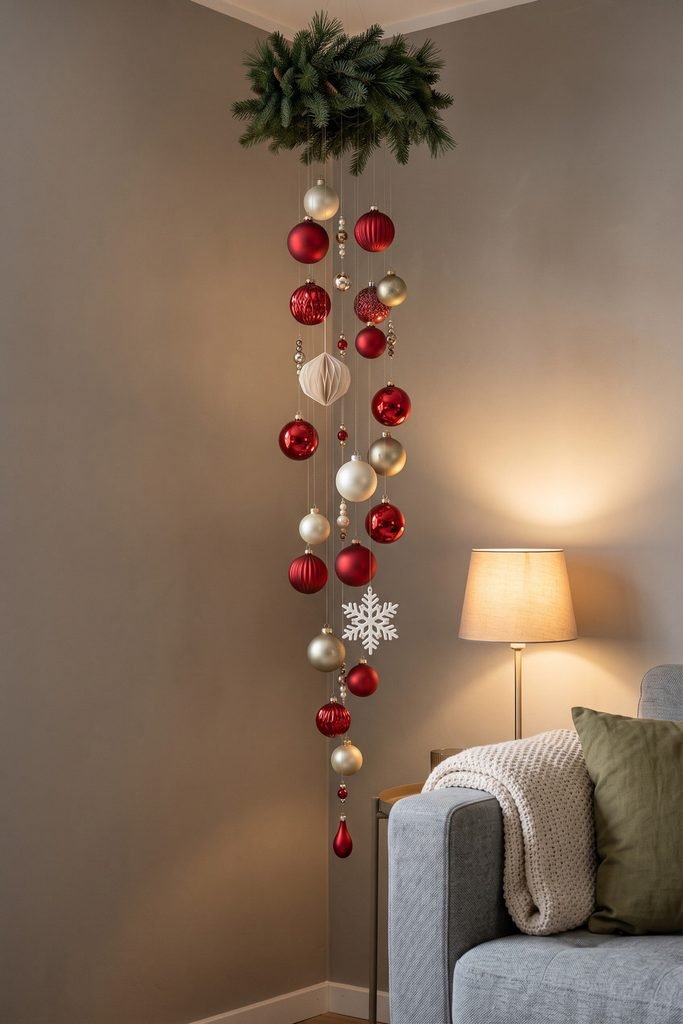
The variation in finish makes the red feel richer. A ribbed bauble catches light along its edges, a matte one reads as a solid shape, and a reflective one picks up the room around it. Ivory creates pauses between those stronger accents. One larger snowflake interrupts the run of circles.
Let the group taper toward the bottom and finish beside the seating. Its narrow shape works especially well against a quiet gray or cream wall, where the smallest beads and the snowflake’s points stay readable.
Hang a Red-and-Ivory Mobile With Snowmen and Little Houses
Felt balls bring softness to the crisp outlines of little wooden houses and snowflakes. Together, they give a small hanging mobile enough texture to hold its own above a sideboard.
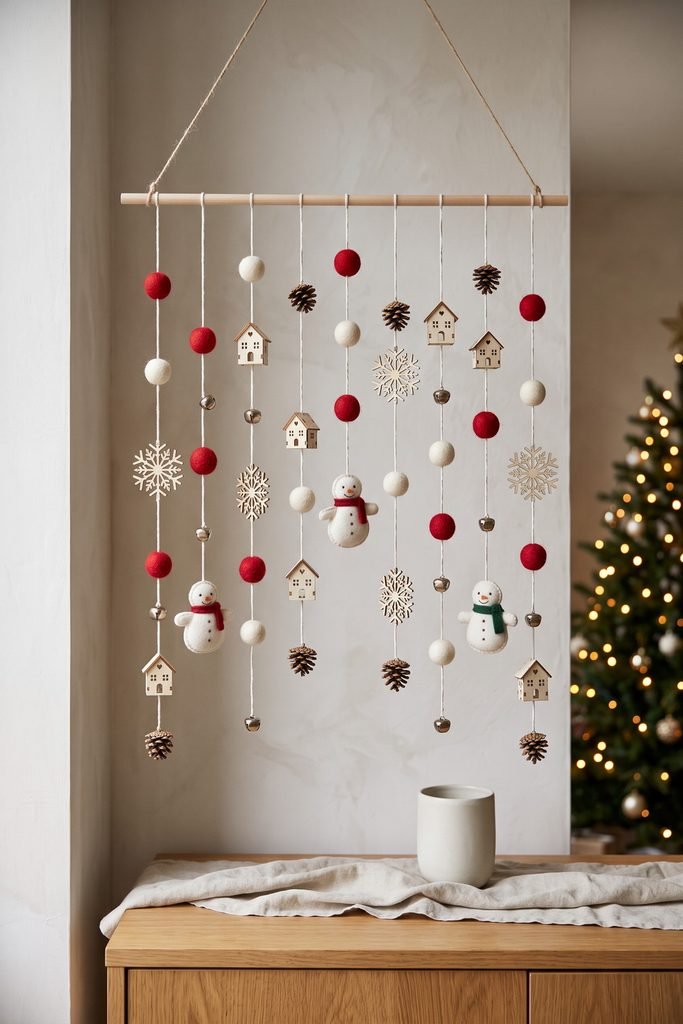
A slim natural-wood dowel keeps the top line simple. Below it, alternate red and ivory forms along strands with different endpoints. A few snowmen become the characters your eye returns to; the surrounding balls, pinecones, and small bells give them space. Leaving some cord visible helps each shape stand apart.
For Christmas apartment decor, this compact format offers a contained focal point. Two or three snowmen can carry the story, while tiny house roofs and pale snowflakes fill out the scene. A plain background is useful here: it lets the small silhouettes register from across the room. The soft spheres also keep the wooden details from feeling too sharp or formal.
Choose the Soft-and-Wood Mix
Red-and-ivory felt balls give the small wooden houses a softer setting.
Let Ornaments Spill Between Floating Gift Boxes
Imagine three open gift boxes suspended at stepped heights, with a curved trail of baubles appearing to tumble from one toward the next. The open mouths give the arrangement its story. Each box seems caught in a different moment of Christmas morning.
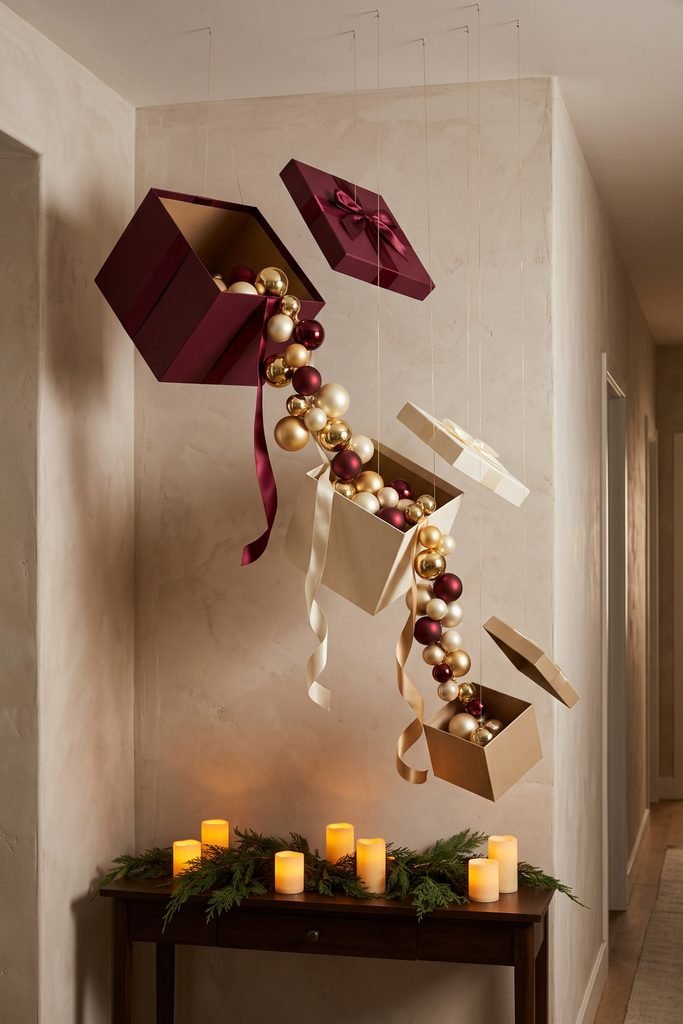
The lids belong close to their matching boxes, slightly offset so the openings remain visible. Between them, the ornaments follow one continuous curve. A few ribbon tails can echo that direction, helping the eye travel from the highest box to the final drop above a console.
Burgundy, ivory, and champagne suit the layered shapes. Repeat the same wrapping colors and just a few ornament finishes so the open boxes remain easy to distinguish. Large gaps between stages are useful; the imagined movement needs room to read.
This is a custom display concept, with the lightweight boxes, lids, and ornaments each supported independently. Ribbon provides the visual connection. A two-box version can bring the same gift-opening story to a smaller corner, and a quiet console below leaves the floating forms in focus. Keep the lowest part beside the usable space, where it can be enjoyed without becoming an obstacle.
Christmas Ceiling Decorations for Hallways and Entries
Hallways offer a long view, while stair halls offer height. Repeated bands, shallow canopies, and a few larger forms make different use of that architecture.
Float Snowflakes and Icicles Beneath a Warm-Light Canopy
Clear snowflakes become more noticeable when their shapes vary. Broad flakes, slim icicles, and small faceted drops catch the light differently, giving a ceiling canopy several layers to look through.
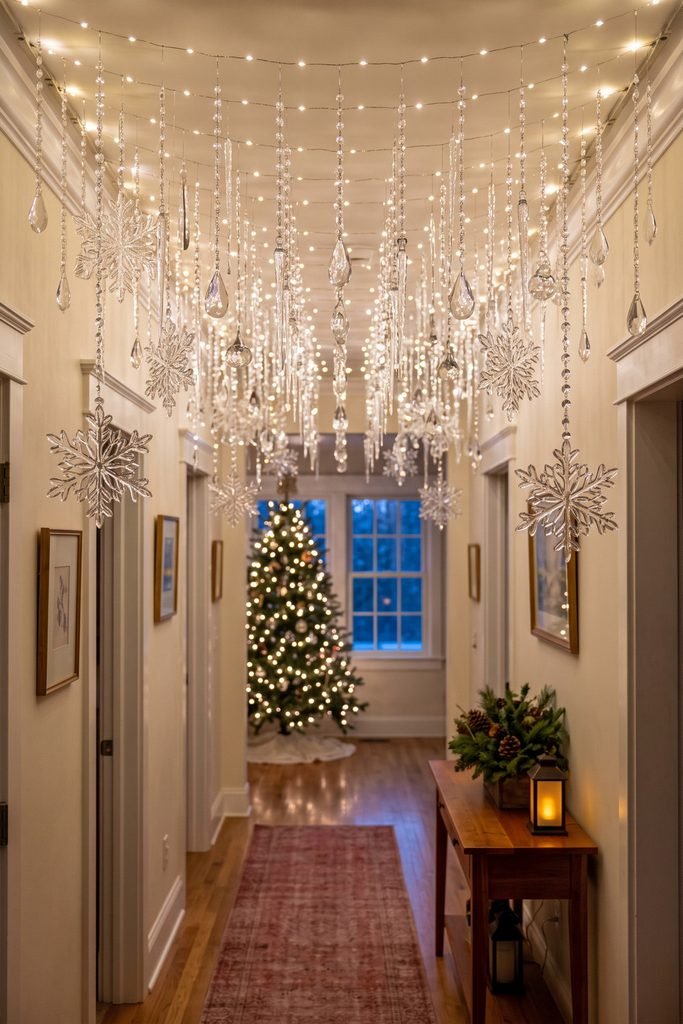
Let a few larger snowflakes establish the foreground. Finer drops can continue farther down the hall, where their smaller scale makes the arrangement seem to recede. Warm lights trace the overhead field, while the empty spaces between strands keep the individual silhouettes clear.
A tree at the end of the hallway gives the whole scene a destination. During the evening, a cooler window beyond it can make the warm ceiling lights feel especially bright. That depth is part of the appeal of Christmas hallway ceiling decor: the decorations belong to a view through the house.
Keep the canopy shallow enough for the passage to remain usable. The strongest version has a generous lower edge of clear air. Snowflakes and icicles provide the detail overhead, and the hallway floor can stay quiet.
Find the Snowflake-and-Icicle Shapes
Broad snowflakes and slim clear icicles give the canopy its alternating silhouettes.
Repeat Garland-and-Bauble Rows Along the Hallway
Repeating a simple arrangement can suit a hallway better than inventing a new treatment at every doorway. Several shallow evergreen bands, each carrying a few baubles, give the ceiling a rhythm that follows the room’s length.
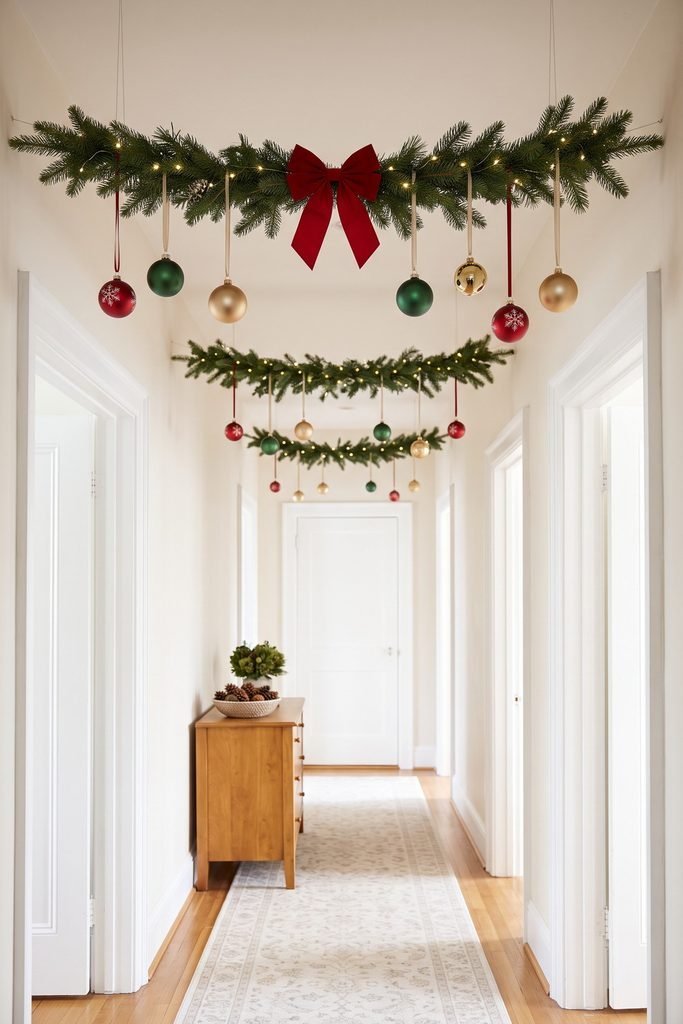
Red, green, and gold make the separate rows feel related. Vary the bauble sizes and finishes within that palette, then let the first row carry the strongest bow or largest ornaments. Smaller details farther along keep the view from becoming equally busy at every point.
Pay attention to the gaps between rows. Those open stretches of ceiling let each band register, and the visible floor below gives the overhead abundance room to breathe. A wood console can add a quiet solid surface beneath all the glossy shapes.
This approach to hallway Christmas decorating is most convincing when the passage stays clear from end to end. The repeated rows should draw you toward the next room, with doors still able to open normally.
Frame a Room Opening With Gingerbread Ornaments
Gingerbread figures have a readable outline even before the tiny details come into view. Brown shapes with pale icing lines can carry a room-opening border, especially when a slim red-and-green bead garland connects them overhead.
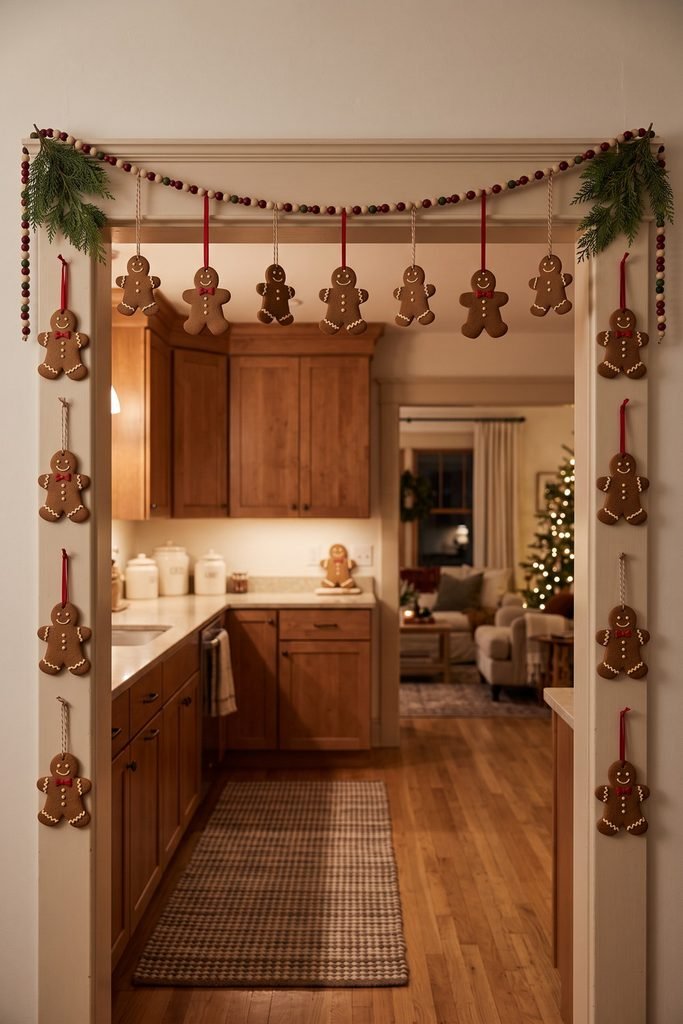
Follow the upper edge of the opening and concentrate longer drops toward its sides. The center stays open, allowing the decorated room beyond to remain part of the composition. Slightly different figure sizes add depth without introducing another theme.
Small bow ties, white cuffs, and icing buttons are enough detail. Repeating one gingerbread accent in the kitchen beyond can connect the rooms, while the hanging figures do most of the storytelling. The bead garland supplies the Christmas color; the figures supply the character.
Suspend Oversized Velvet Baubles With Evergreen Crowns
Velvet changes the feel of a large ornament. An ivory or burgundy sphere has a soft, substantial presence, especially when vertical ribbing breaks its surface into gentle curves.
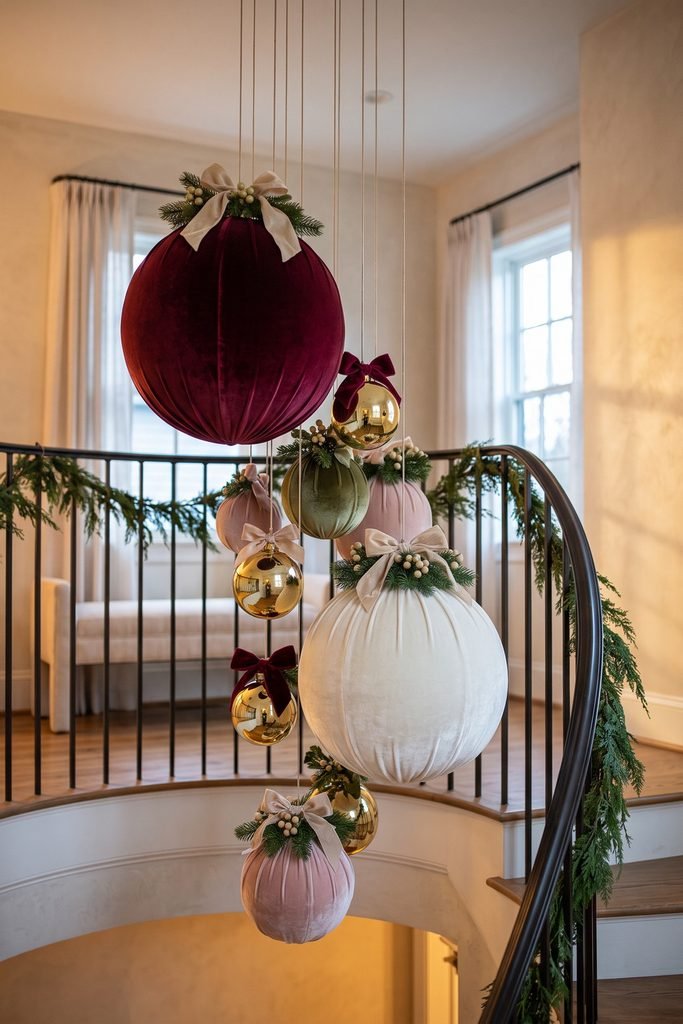
Smaller mirrored-look gold balls give that plush texture a brighter neighbor. Their reflections prevent a group of large matte shapes from feeling visually flat. Olive accents connect the spheres to their evergreen crowns, while a little blush can soften the space between burgundy and cream.
In a tall stair hall, stagger the baubles beside the sweep of the railing. One or two dominant spheres can establish the scale, with smaller forms extending the group upward or downward. Keep each crown proportional: compact greenery, pale berries, and a relaxed bow should leave plenty of velvet showing.
The arrangement needs room around its outline. For a smaller landing, fewer lightweight hollow forms can preserve the material contrast, provided the actual space and support suit them.
Look for Plush and Reflective Finishes
Velvet baubles and smaller gold mirrored-look ornaments create the contrast that gives this cluster depth.
Statement Shapes for Tables and Covered Porches
Above a table or inside a tall covered entry, the overall silhouette becomes especially important. Open circles, paired rows, cones, and transparent domes each organize their ornaments differently.
Layer Crystal-Drop Hoops Above the Dining Table
The empty center of a hoop is part of its beauty. It gives a richly trimmed ornament chandelier somewhere to rest the eye, even when faceted drops and greenery fill the edges.
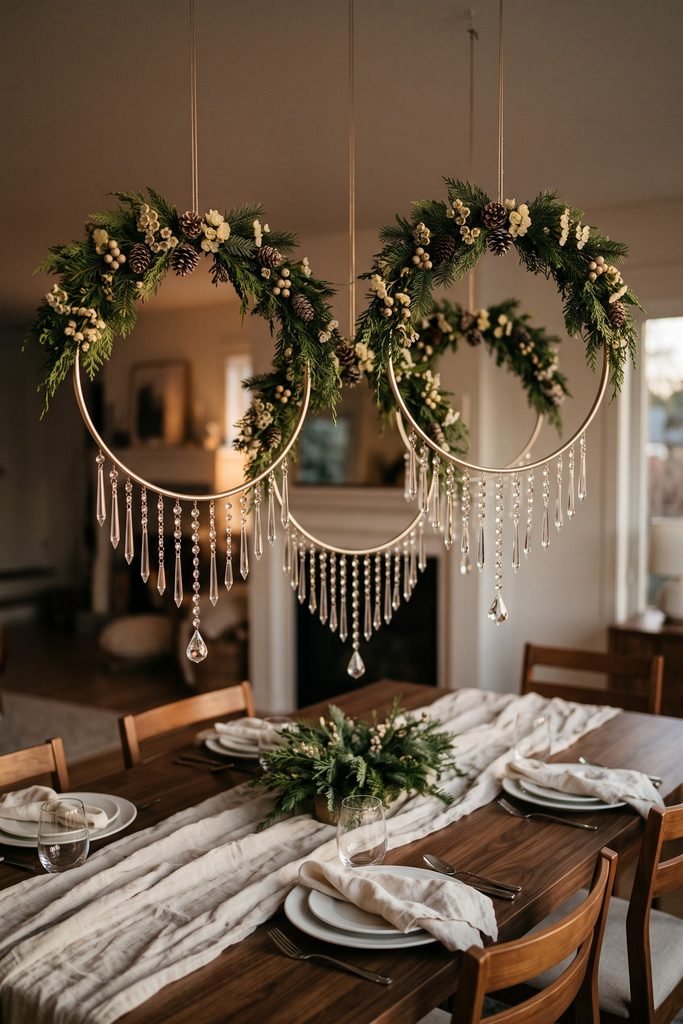
Two or three offset tiers create more depth than a single flat ring. Let ivory flowers and evergreen sit close to the crowns, with crystal-like pendants extending below in varied lengths. A few larger endpoints give the finer strands a clear finish. Champagne berries and small pinecones can soften the transition between foliage and sparkle.
Align the group with the table so the arrangement feels connected to the furniture beneath it. From a seated position, the open centers should allow views through the display. A restrained runner or low Christmas vase centerpiece below repeats the palette without filling the same visual space.
This version of modern Christmas decor relies on transparent highlights and readable structure. Warm evening light can bring out the facets, while the separate decorative frame keeps the composition distinct from the room’s existing lighting.
Find the Crystal-Like Drops
Faceted acrylic drop ornaments bring the sparkling fringe to the open hoop arrangement.
Hang a Mini Christmas Tree Canopy With Stars and Gifts
A small green cone reads as a Christmas tree almost at once. Suspending it above a breakfast table creates an unusual centerpiece, especially when stars and miniature gift ornaments continue below its open lower rim.
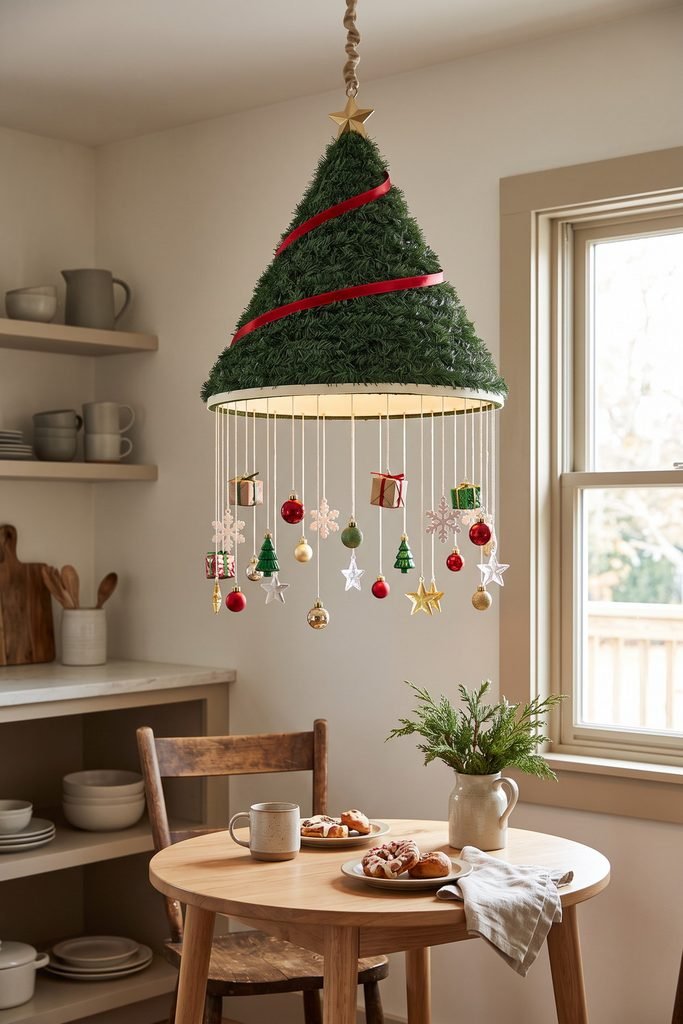
Keep the tree crown visually simple enough for the outline to remain clear. A narrow red ribbon winding around the greenery and one star at the top can establish the main shapes. A few pale snowflakes add detail without covering every patch of green.
Below the rim, the ornament fringe should feel lighter than the canopy. Space little gifts, stars, and baubles along unequal drops, allowing daylight to show between them. The solid upper shape and airy lower half make each other more noticeable.
Treat this as a custom decorative mobile with separate support and verified lighting choices. On the table, a small jug of greenery can repeat the palette while leaving the suspended tree enough attention.
Turn Clear Umbrellas Into Glowing Ornament Chandeliers
Transparent umbrellas give a covered-porch display a silhouette guests will recognize immediately. Their open domes hold the composition together, while the room beyond remains visible through them.
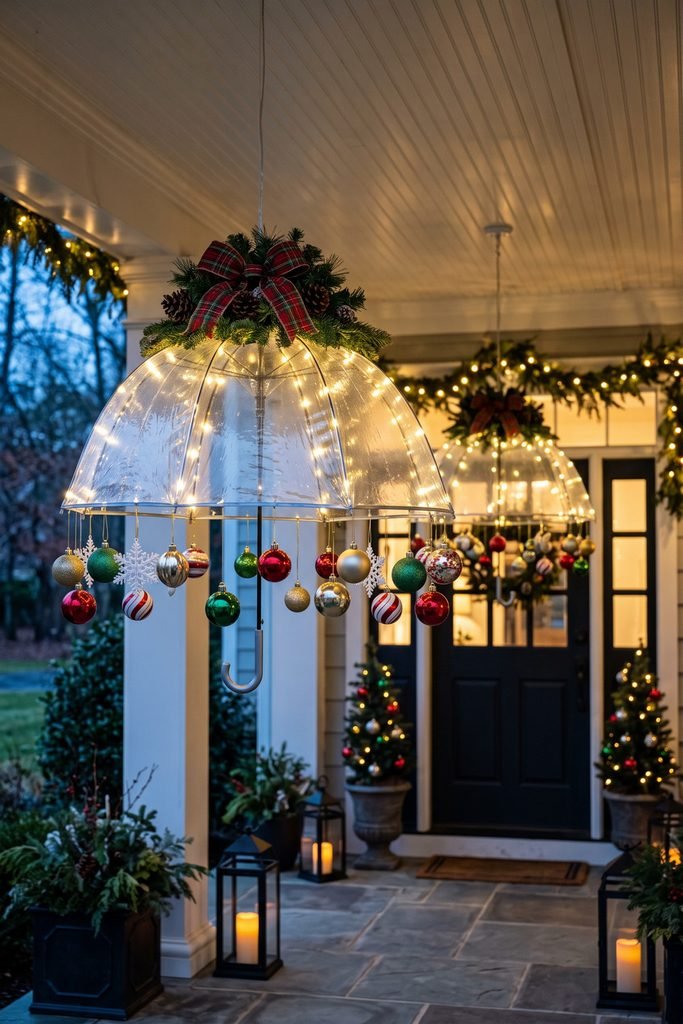
Warm lights following the ribs emphasize the curved shape. Beneath the canopies, red, green, and gold ornaments hang at different levels, interrupted by a few white snowflakes and peppermint stripes. The varied drops make the display feel abundant, and the clear dome keeps that abundance from becoming a solid visual block.
Tartan bows and compact evergreen crowns gather the colors at the top. Two or three staggered umbrellas can fill a tall entry, with the handles deliberately visible as part of their charm. Lanterns near the door repeat the glow lower down; against blue evening light, the warm overhead shapes become especially distinct.
This is a tall-space arrangement that needs suitable supports and stable canopies. Every component must suit its actual exposure, including wind and moisture on a covered porch. The umbrella is a decorative form here; outdoor suitability comes from the materials and lighting selected for the installation.
Candy, Characters, and Christmas Stories
Recognizable shapes give these displays their appeal. A peppermint swirl, continuous spiral, flying sleigh, or angel wing should remain easy to identify among the smaller details.
Hang a Candy-Shop Ornament Curtain Beneath a Beam
Peppermint swirls are bold enough to organize a whole curtain of hanging ornaments. Red and white provide the familiar foundation, with aqua, coral, lime, and amber appearing in selected wrapped sweets and small beads.

The shapes need different jobs. Larger lollipops become landmarks, faceted wrappers add angular detail, and tiny round forms separate the stronger patterns. Alternating those scales gives the strings a rhythm you can follow.
A beam above a side console or counter provides a clear top edge. Unequal endpoints make the bottom feel looser, while gaps between the strings let each sweet remain recognizable. Keep the neighboring room opening usable and the background fairly quiet. In a kitchen-adjacent setting, the display also needs distance from cooking heat. Its color and pattern can carry the scene without a busy surface underneath.
Hang a Wreath-Topped Spiral of Gingerbread and Candy
The spiral should be the first thing you see. A continuous red, green, and white curve gives this hanging feature its movement, with a small wreath marking the beginning overhead.
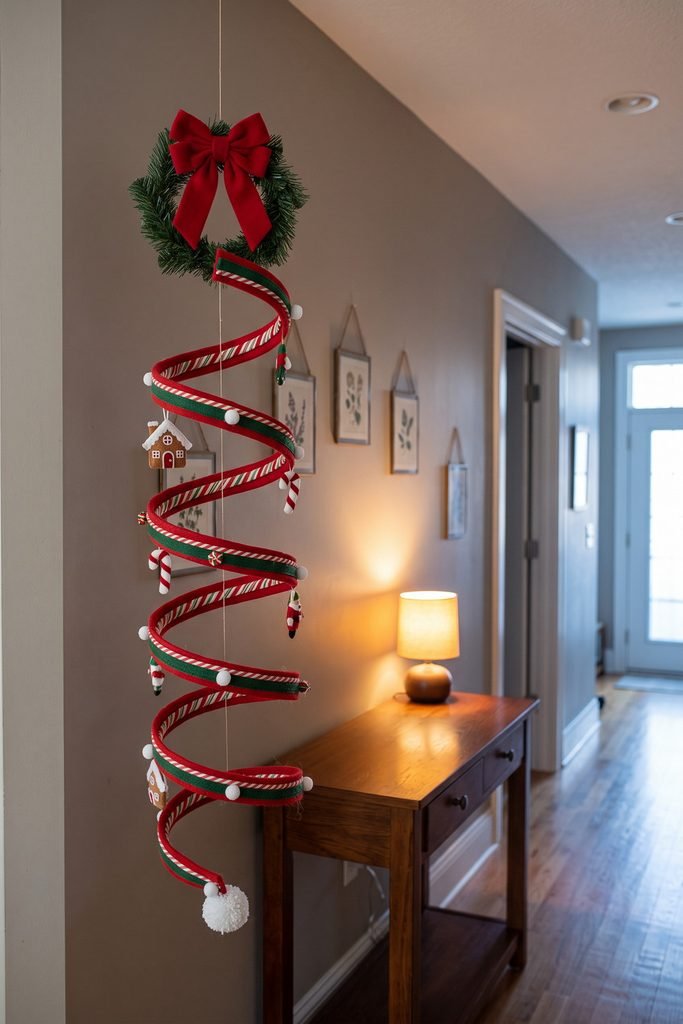
Space character ornaments along the turn so they become moments to discover. One gingerbread house, a few candy-cane shapes, and soft pom-poms offer plenty of detail. Filling every gap with a different character can hide the curve that makes the arrangement special.
Beside a hallway console, warm lamplight gives the soft materials a gentle setting. A plain wall lets the full helix show, from the wreath and red bow to the final pom-pom endpoint. Choose the display’s scale around that complete outline; the lower turns need their own clear space beside the furniture. The result has a lively, almost spring-like shape even while it hangs still.
Float a Santa Sleigh and Reindeer Along the Ceiling
A sleigh procession brings direction to the upper edge of a room. Reindeer spaced along one route suggest forward movement, with Santa’s sleigh and gift sack providing a recognizable ending.

The outline matters more than a crowd of tiny accessories. Visible runners, a few harness details, and clear gaps between the figures help the story read from across the room. Lightweight sculptural figures or flat ornaments can express the same flight path, depending on the look and support the space allows.
Above dark bookcases, antique red, warm brown, and muted gold feel at home with books and a patterned rug below. A reading chair and tree lights extend the storybook mood through the room. Let the route follow its edge so the procession has a strong background and a clear relationship to the furniture. Each piece needs appropriate support; the finished scene should feel suspended in flight, with its shapes clearly separated.
Let a Hanging Angel Trail a Waterfall of Stars
An ivory angel gives a descending star display a calm, recognizable beginning. Leave clear air around the wings so their outline remains distinct, then let the stars form a narrower trail beneath the figure.

Variation in star size creates the sense of a taper. A few larger points draw the eye downward, while smaller gold beads and reflective drops fill selected spaces. Ivory and warm gold keep the different shapes closely related; a nearby evergreen detail can connect them to the rest of the Christmas room decor.
Beside an arch, the arrangement can occupy a tall, quiet strip of wall. Keep neighboring mantel decorations lower and simpler, and position the hanging materials away from any working hearth or flame. Optional decorative lights should support the wing-and-star silhouette. The angel remains the focal point, with the descending stars giving the wall a gentle line of movement.
Pair Ivory Angels With Gold Stars
An ivory hanging angel and separate gold stars keep the winged figure distinct from the descending trail.
Final Toughts
One well-chosen overhead arrangement can give a room a clear Christmas focal point. Let the space guide its width and drop, then repeat a little of its color or texture on the furniture below. Whether you choose a woodland branch, velvet baubles, or a floating village, leave enough room around the shapes to enjoy what makes them special.