





16 Christmas Dough Bowl Decorating Ideas

A candy cane hooked into fir makes a little red arch you can spot from the far end of a kitchen island. At a dining table, the prettiest detail might be much lower, like a glossy orange leaf resting against the scales of a pinecone. Where you’ll see the bowl makes a difference to what belongs in it. These Christmas dough bowl decorating ideas range from low arrangements you can talk across to miniature scenes worth pulling up a chair to see.
Table Of Content
- Quick Takeaways
- Red and White in the Kitchen and Living Room
- Candy-Cane Stripes Along the Kitchen Island
- Gingham Hearts Nestled in Trailing Fir
- A Santa Utensil Crock and a Little Kitchen Tree
- Peppermint Twists at the Coffee Table
- Evergreen Arrangements That Follow the Bowl’s Shape
- Whole Oranges Between Pinecones on a Striped Runner
- An Upright Fan of Citrus Wheels and Fir
- Ivory Candle Spirals in a Snowy Wooden Trough
- An Evergreen Border Around a Tree-Shaped Bowl
- Centerpieces With Height and Shine
- Three Glass Candlesticks Above Burgundy Pinecones
- A Giant Blue Ornament Above a Silver Collar
- Three Black Silhouettes Beneath a Silver Stag
- A Green-Bowed Lantern Opposite a Woodland Stag
- Small Christmas Scenes and Keepsakes
- A Small Nativity on Two Layers of Wood
- Two Scarfed Snowmen Beside a Red Sled
- A White Rocking Horse Facing a Frosted Tree
- A Long Christmas Bowl Across a Green Sideboard
Quick Takeaways
- Before filling a dining-table bowl, sit down across from someone. That’s the view that matters when you decide how tall the center can be.
- Down a long island, repeat a color in different sizes. A broad red stripe can carry all the way to a tiny gingham check.
- For a round bowl, choose the one object you’d most like to see from the sofa. Smaller pieces around its base will give it scale.
- If the wood has a beautiful outline, save some greenery for the table around it. The hollow itself can stay empty.
Red and White in the Kitchen and Living Room
Candy-Cane Stripes Along the Kitchen Island
Big red-and-white ornaments give a long wooden bowl a pattern you can enjoy from the kitchen doorway. Nestle two striped balls at different points in the greenery, with a plain ivory ball near each one. Up close you’ll see the wide bands curve in different directions. Farther away, you’ll see a little red at both ends of the island.
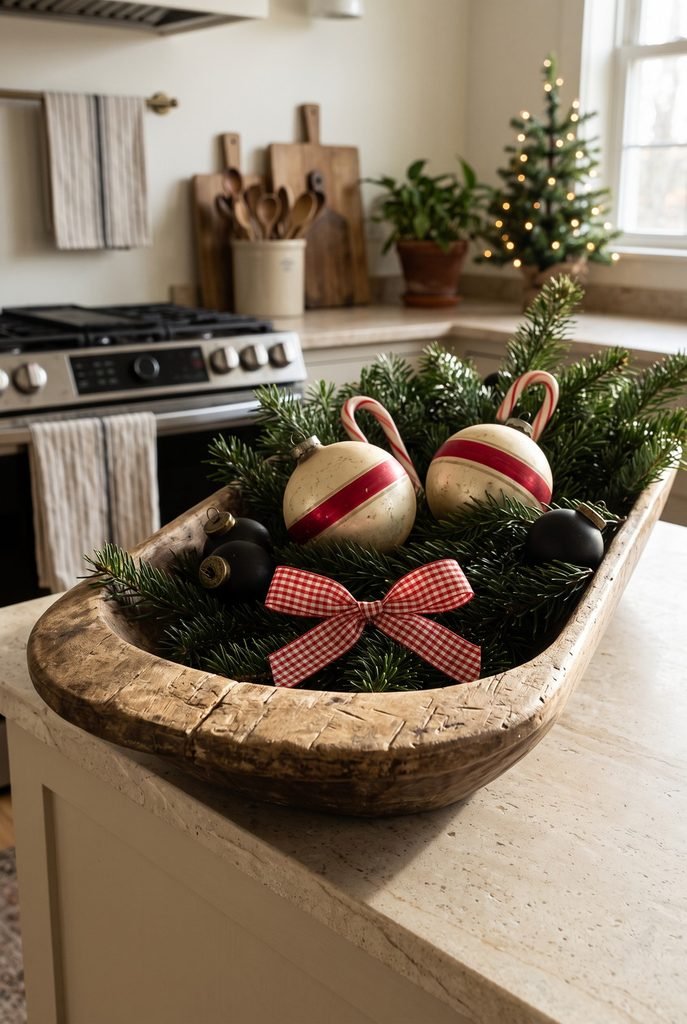
Candy canes carry that stripe above the fir, where their hooks have a clear outline. The smaller checks belong closer to the rim. Turn a gingham bow until both loops rest against a green patch. A bow sitting directly on a striped ball loses some of its shape. A few dark needles between them make both patterns easier to enjoy.
Leave a strip of bare countertop along the working side. A striped dish towel can pick up the red at the back of the kitchen, an idea that also works with gingerbread kitchen decor.
Stripes and checks for the island
Broad stripes on the ornaments stay easy to see beside the smaller checks on the bows.
Gingham Hearts Nestled in Trailing Fir
Stuffed fabric hearts have a slight dip between their rounded tops. That’s the detail to keep above the fir. Nestle some of the hearts fairly deep, then turn one sideways enough to show its pointed tip and plump seam. The row will look a little like a collection of favorite ornaments that found their way to the breakfast table.
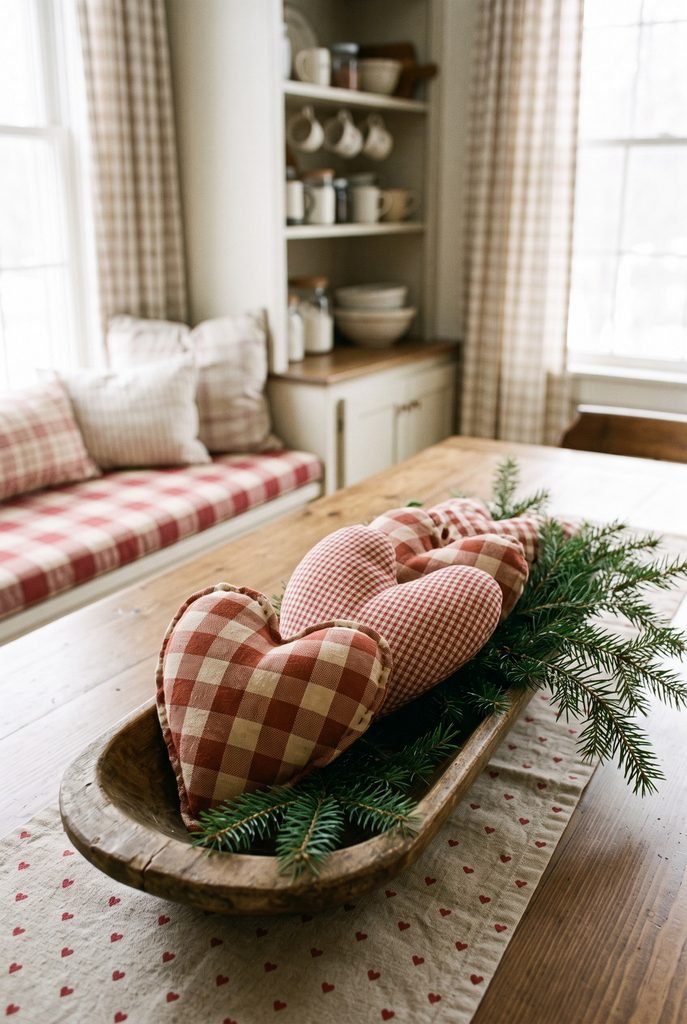
Mix a broad red check with a finer gingham. If there’s already a checked cushion on the bench, borrow its red for one of the hearts. You can use a quieter pattern on the runner underneath. Tiny printed hearts glimpsed through the branches make a lovely detail for the person sitting right beside the bowl.
Let the longest fir tips fall over one edge. Sweep a front branch to the side so a stretch of wooden lip shows through. That little opening lets you see where the hearts are nestled and keeps the branches from hiding the bowl.
Soft hearts for the breakfast table
A stuffed heart holds its shape above the fir, so the dip between its two lobes stays visible.
A Santa Utensil Crock and a Little Kitchen Tree
A Santa-face crock with wooden spoons poking out of his hat earns its space on a busy counter. Set it toward the back of a round dough bowl, angled toward the place you usually stand to cook. The spoon handles give the arrangement height, and Santa’s face gives you a good reason to leave the front low.
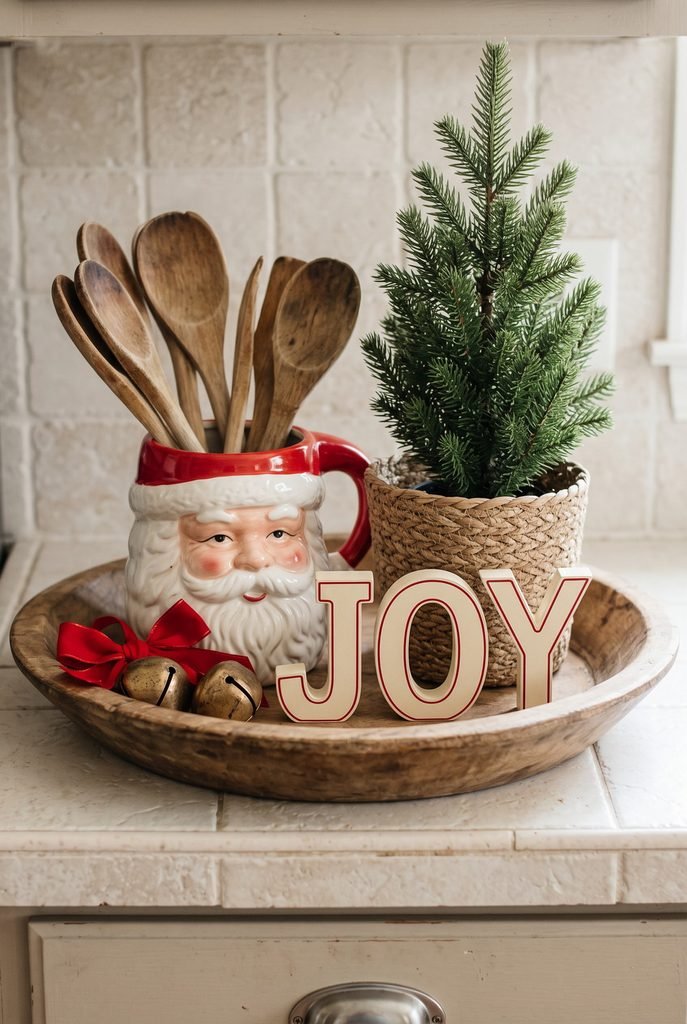
A small potted evergreen can share the bowl. Give it the side with more clearance under the cabinets, and let its branches rise beside the spoons. A rough, basket-like pot cover makes a pleasing neighbor for the smooth Santa face. Keep enough space around the handles to lift out your favorite spoon without brushing the little tree.
Set red-edged JOY letters just inside the near rim and slide them to one side until the beard shows above the word. A red bow and a couple of brass-colored bells can settle into the smaller space beside the crock.
A Santa crock for wooden spoons
Look for a Santa face that will still peek over the bowl when the spoon handles rise behind it.
Peppermint Twists at the Coffee Table
The charm of a peppermint twist is in its ends. Each little twist points a different way, so a loose pile of red-and-cream candy shapes has plenty of detail even in a small bowl. Heap them a little higher on one side, where the dark wood makes the pale wrappers easy to pick out.
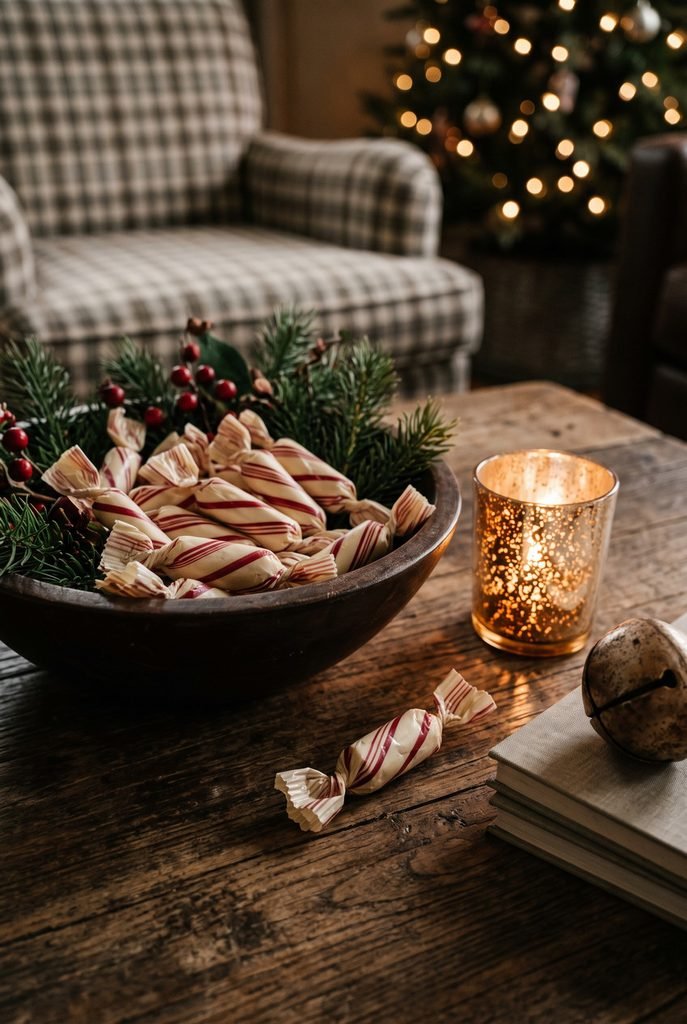
Carry a few decorative twists onto the coffee table. One can sit near the lip and another just beyond it, with bare wood around the ends. From the sofa, that small break lets you see the shape of an individual sweet. A low stack of books nearby gives the grouping an edge and leaves the rest of the table open for mugs.
For evening, tuck a battery-operated votive into speckled glass beside the pile. Its light will catch in the wrapper folds. The U.S. Fire Administration’s holiday guidance recommends considering flameless candles, a useful choice around wrappers, ribbon, and dry greenery.
Peppermint for the coffee table
Striped candy shapes with twisted ends are easy to recognize, even when only a few spill over the rim.
Evergreen Arrangements That Follow the Bowl’s Shape
Whole Oranges Between Pinecones on a Striped Runner
Set a long oval dough bowl lengthwise on a pale ticking-stripe runner. The lines in the cloth will carry your eye from one end of the dining table to the other, which gives you some freedom with the fruit. A close pair of oranges near one end and a single orange a little farther along feel more relaxed than evenly spaced dots of orange.
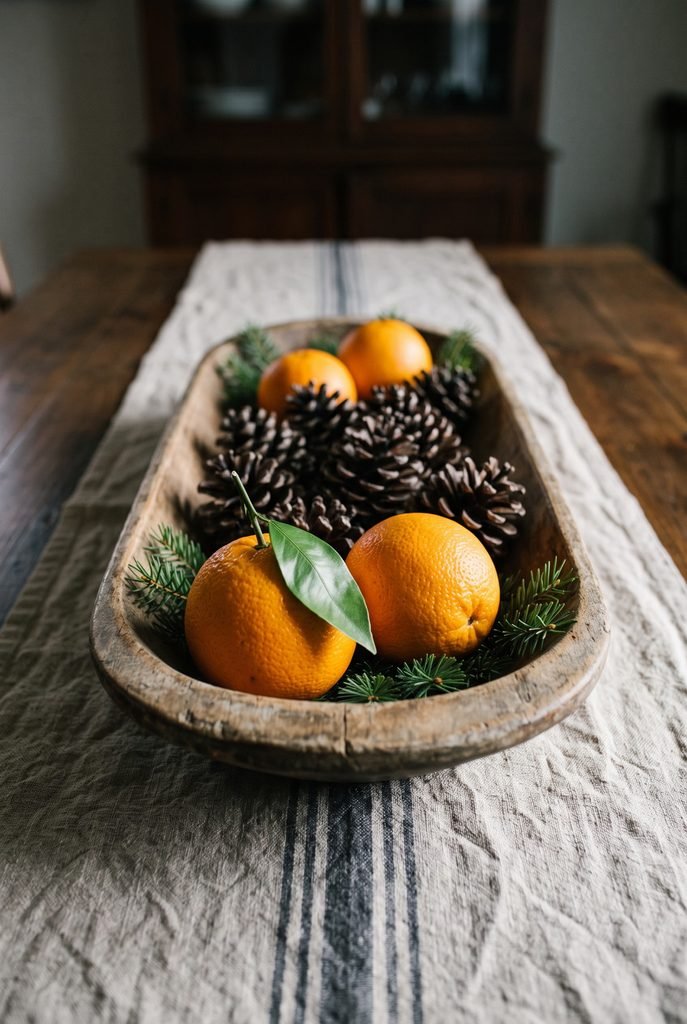
Let the pinecones show in the intervals. Their open scales have deep little shadows that make a smooth orange peel look especially bright. Keep a glossy leaf on display where you have one, or turn a sprig so its needles lie along the rim. You only need enough green to join the small groups.
Look across the arrangement from your chair. With most of the fruit and cones nestled in the hollow, you can still see the person opposite. It’s a Christmas dining table centerpiece that can stay put when dinner is served.
A runner to follow the grain
Fine ticking stripes extend the long lines of the wooden bowl past the oranges at either end.
An Upright Fan of Citrus Wheels and Fir
A dried orange slice has two good features that disappear when it lies flat in a deep bowl: the fine spokes through its middle and the bright ring of peel. Stand a couple of citrus wheels just inside the near lip of a short bowl. Near a window, turn one slightly toward the daylight until the segments glow amber.
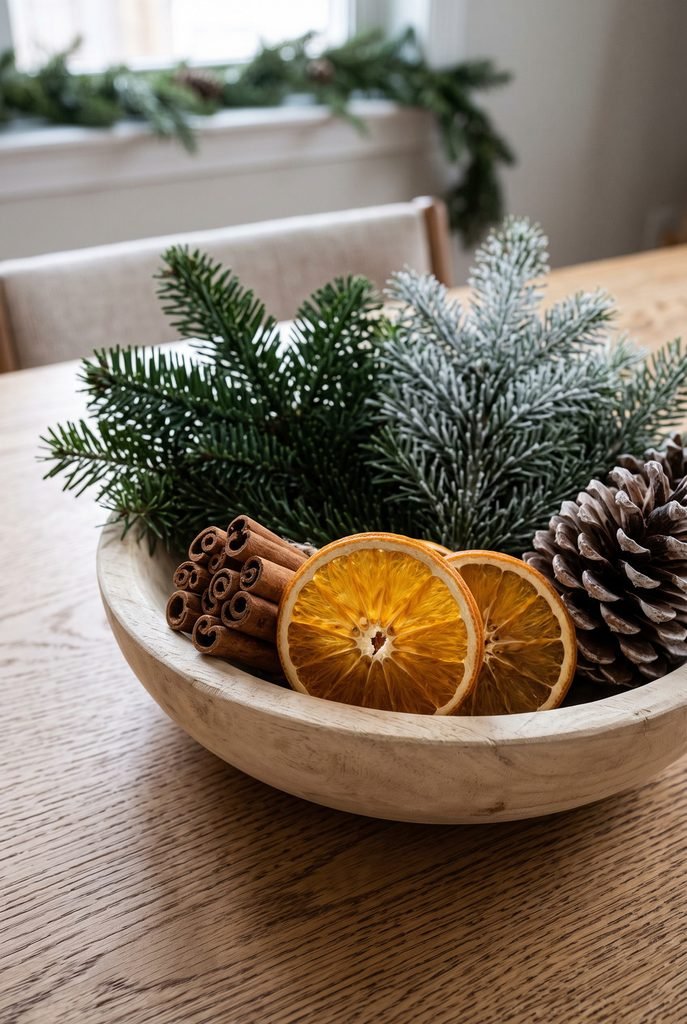
Build up the back with short fir tips. A frosty sprig behind one wheel gives the rind a pale edge, while a darker branch behind another shows off the inside of the slice. A few cinnamon sticks tucked upright alongside the wheels repeat their warm color in a narrower shape.
One open pinecone on the fuller side gives this small arrangement some weight. Leave a little tabletop visible around both ends. You’ll be able to see the whole fan at once, even on a compact table where a longer trail of citrus would take up too much room.
Citrus for a window-side bowl
A whole dried wheel shows its amber segments when it stands upright with daylight behind it.
Ivory Candle Spirals in a Snowy Wooden Trough
Two ivory candle forms can almost disappear into a bed of decorative snow. Their sculpted edges are what make the combination worth trying. Set the trough where daylight comes across it from one side. A thin crescent of shadow under each fold will reveal the spiral, even when the candle and the snowy filler are close in color.
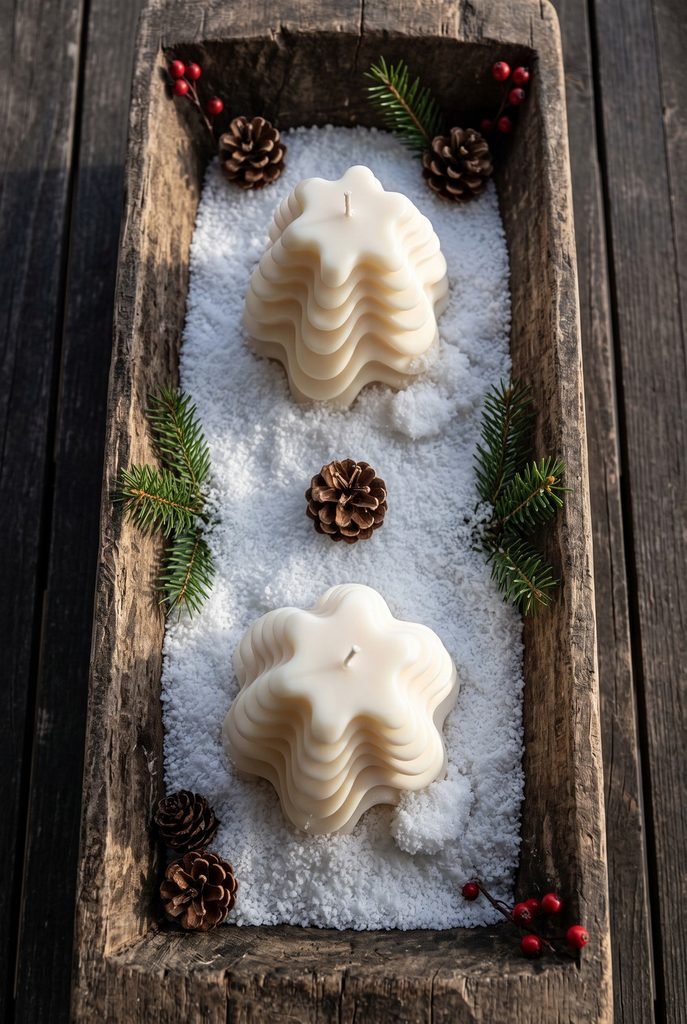
Keep these sculptural candles unlit. Set them at different points along the hollow, with a brown cone in the interval. Short fir tips can follow one inside edge, leaving little patches of the white surface visible around each candle. Too much fir in front of the spirals will hide the folds you wanted to see.
A small red berry sprig near each end is enough color for the whole piece. From above, the uneven dark rim looks almost like a frame around the white. This is a good arrangement for a table you often walk past and look down on.
Sculpted spirals for a snowy bowl
Deep folds give an unlit ivory candle enough shadow to stand out against the white filler.
An Evergreen Border Around a Tree-Shaped Bowl
An empty wooden bowl can make a surprisingly festive centerpiece when the bowl itself has branches and a trunk. A tree-shaped hollow gives you a broad sweep of grain through the middle and a little staircase of edges down each side. Those edges deserve a clear outline. Put the evergreen on the tabletop around the tree and keep the hollow open.
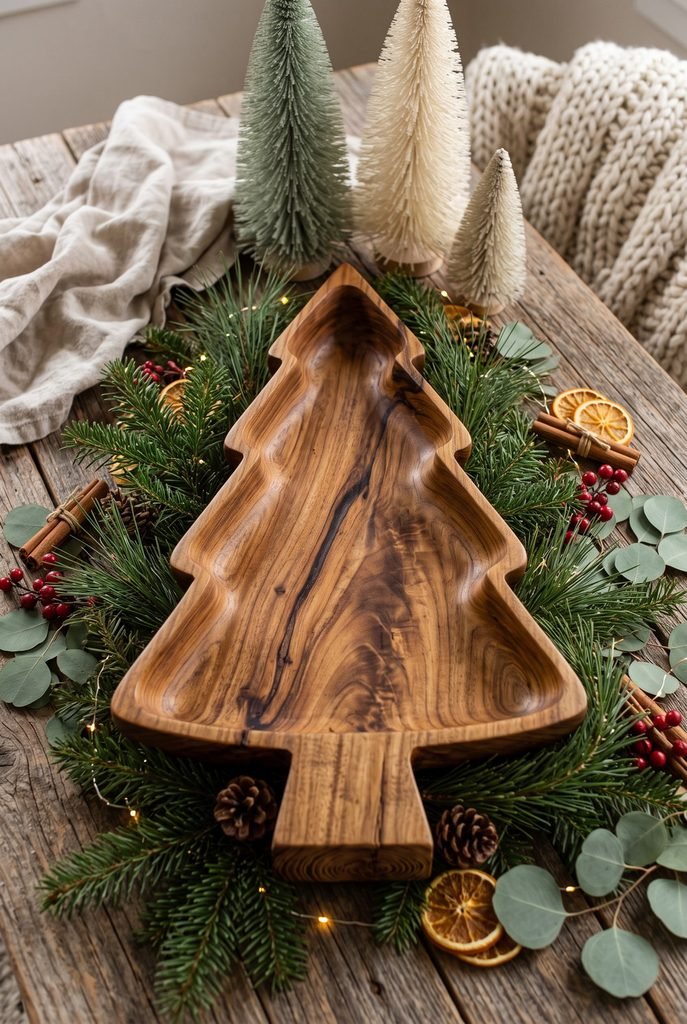
The most important spaces are the small notches where one wooden branch meets the next. Draw the fir back slightly at each notch. A glimpse of tabletop there lets you follow the shape from the tip all the way down to the trunk. Cinnamon sticks and dried citrus wheels can sit a little farther out among the greens, where they’ll still be visible.
Stand sage and ivory bottlebrush trees beyond two different edges of the bowl. Their bristled outlines echo the wooden tree from another angle. A few warm points of light around the outside will pick up the berries and citrus while leaving the grain in the center quietly on show.
A wooden tree with room around it
A stepped wooden bowl gives the table its tree outline, and small bottlebrush trees repeat the shape beyond its branches.
Centerpieces With Height and Shine
Three Glass Candlesticks Above Burgundy Pinecones
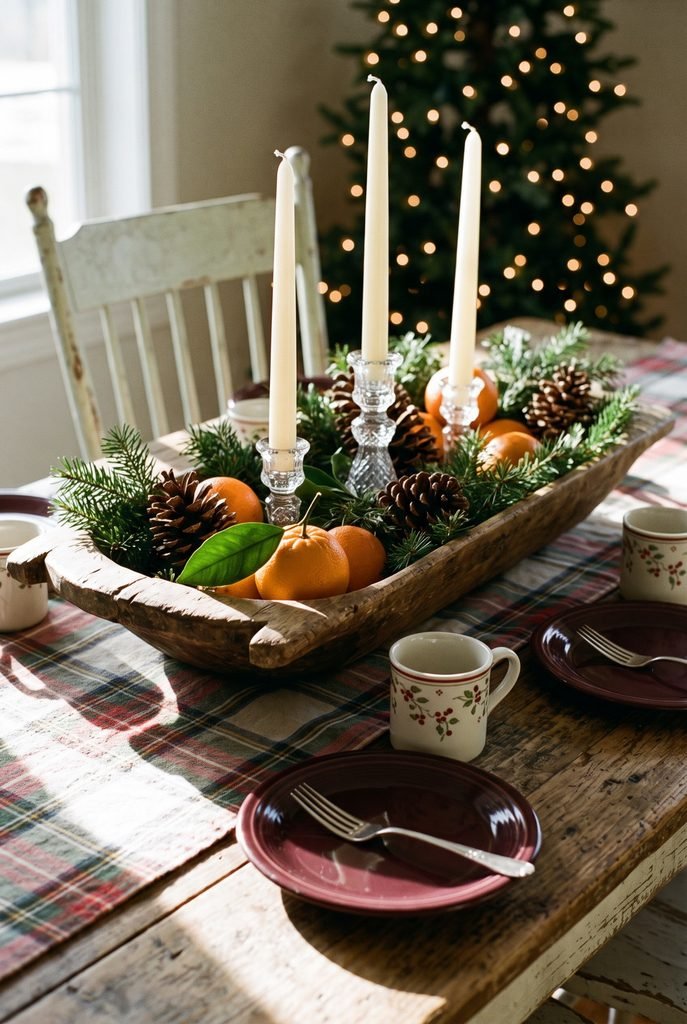
Three clear candlesticks give a Christmas table some height while leaving glimpses of the people and dishes beyond them. Let the middle ivory taper rise highest and set the other two a little apart. From the end of the table, you should be able to follow each glass stem down to the burgundy cones and evergreen in the bowl.
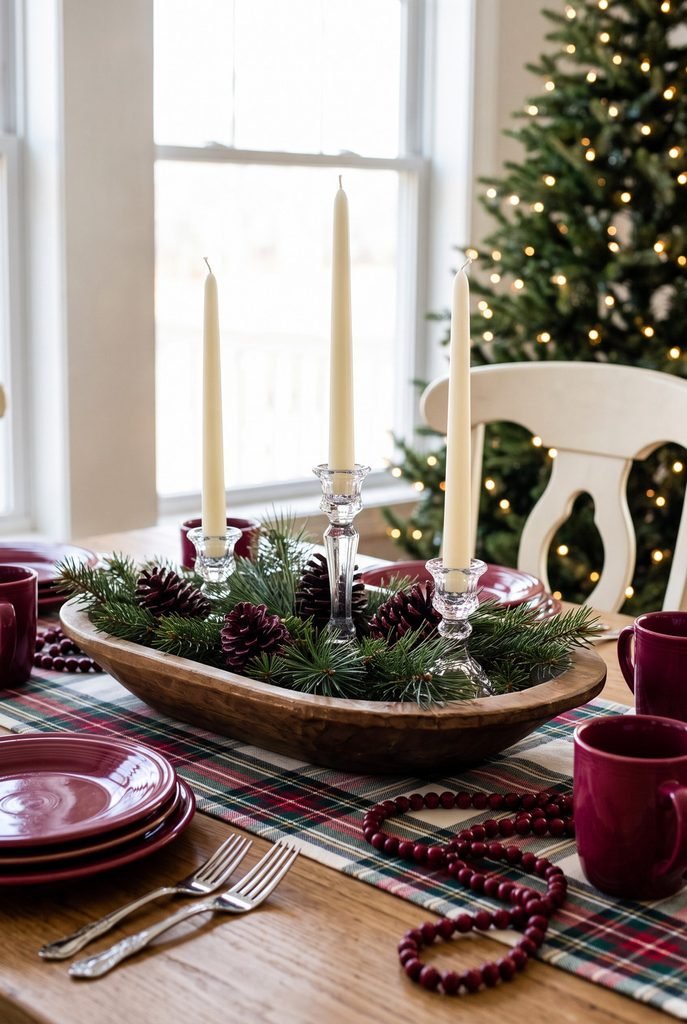
Pressed or ribbed glass is especially pretty near a window. See how the stems look from a place setting. One might disappear against a bright windowpane and come into focus again just a little to the side. Keep the tapers unlit among the greens, or choose flameless tapers if you want a glow.
Carry the burgundy onto the table in a smaller measure. A berry motif on a mug, a strand of red beads across the plaid, or a short stack of dark red plates will pick up the cone color. There’s room for plain silverware and a simple white chair to stand out alongside all that pattern.
Clear stems above the pinecones
Clear holders in staggered heights let you see the burgundy cones between the ivory tapers.
A Giant Blue Ornament Above a Silver Collar
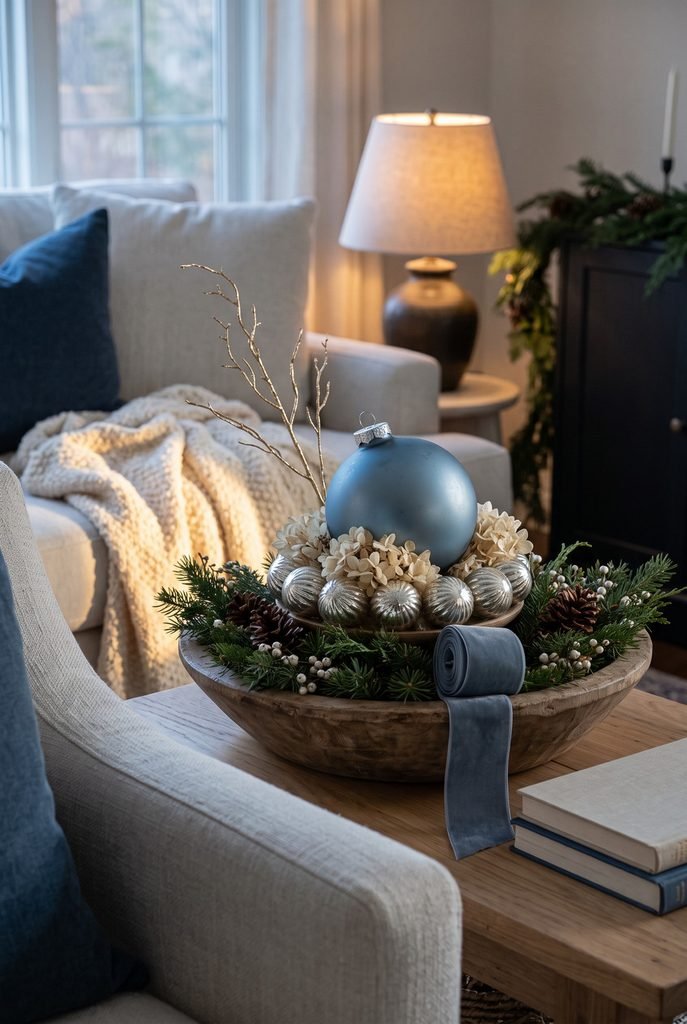
Give the ornament you’d hate to lose at the back of the Christmas tree a place of its own. A round wooden bowl suits a single oversize blue ball particularly well. Its curved lip follows the curve of the ornament, and the difference in scale becomes clear when you gather much smaller silver and pearl-colored balls around its base.
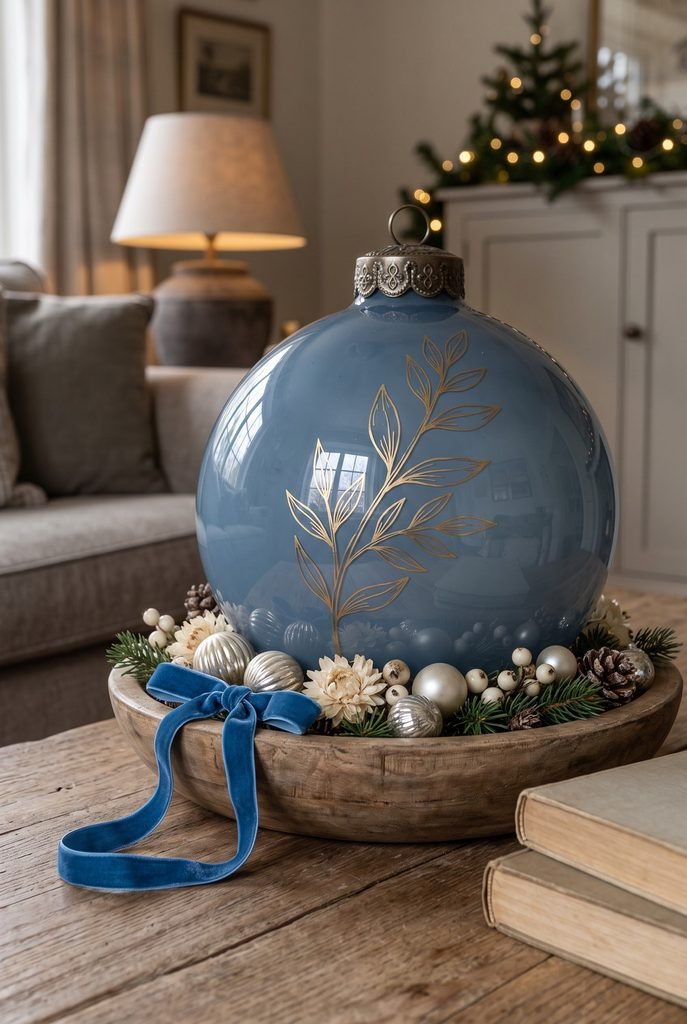
Choose a lightweight ornament that rests securely. Turn its gold botanical pattern toward the light, then check it from the sofa. Seeing one gold branch from stem to tip is more satisfying than catching bits of two branches around the sides. Keep the cap visible at the top and the cream flower heads low around the bottom.
A blue velvet ribbon loop hanging over the rim brings that rich color down to the coffee table. Its soft surface gives your eye a rest beside the bright globe. Let a ribbed silver ornament peek out beside the loop, where the narrow glints are easiest to see.
Blue for the centerpiece, silver at the rim
An oversized blue ball sets the scale, while small ribbed silver ornaments catch the light around its base.
Three Black Silhouettes Beneath a Silver Stag
Three glossy black figures with pointed tops make a wonderfully odd little group at the near end of a wooden trough. From a dining chair, the tips are the first things you notice. Turn or separate the figures until each peak has a slim strip of pale background beside it. Even a small adjustment will let you count all three shapes.
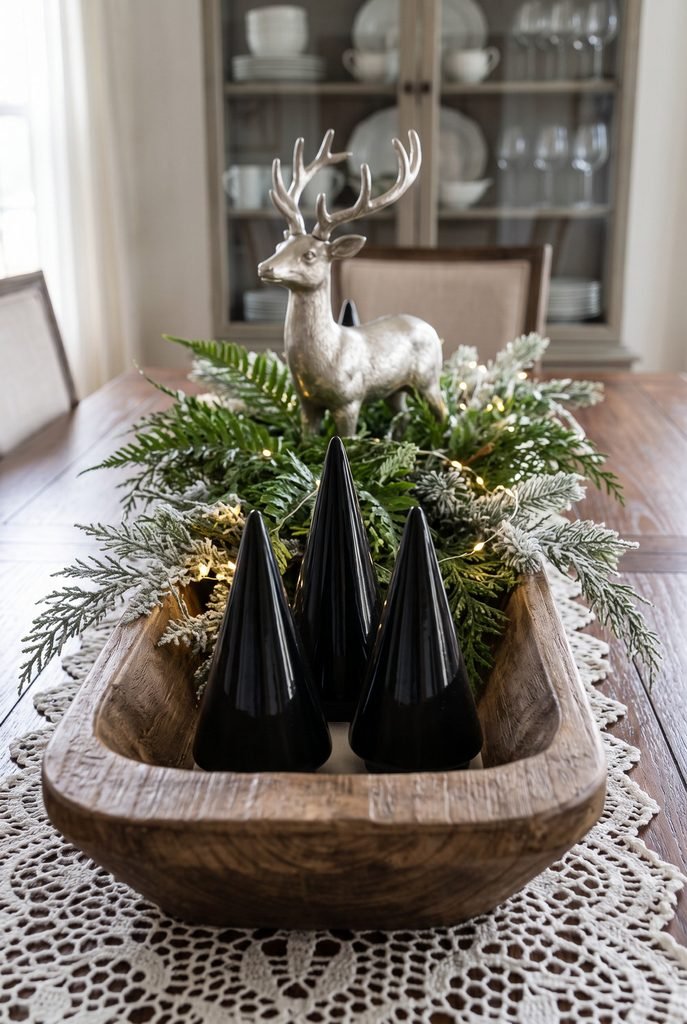
Set the silver-toned stag toward the far end, high enough for the antlers to show above the frosted greenery. Its pale body picks up daylight differently from the black figures. A fine strand of warm lights can run low among the fern-like sprigs, catching an edge on the dark glaze here and there.
Underneath, a white openwork runner does more than dress the table. You can see warm wood through its little openings and again along the rim of the trough. Let one frosted stem hang over that rim to meet the cloth.
Openwork beneath the black figures
The openings in a white lace runner let the tabletop show through beneath the dark silhouettes.
A Green-Bowed Lantern Opposite a Woodland Stag
On a long, shallow bowl, a little lantern at one end and a brass-toned stag at the other give you two places to linger. Tie a dark green ribbon on the lantern so one tail falls alongside its frame. The loop and tail have enough substance to balance the stag’s body across the bowl, even though the antlers reach higher.
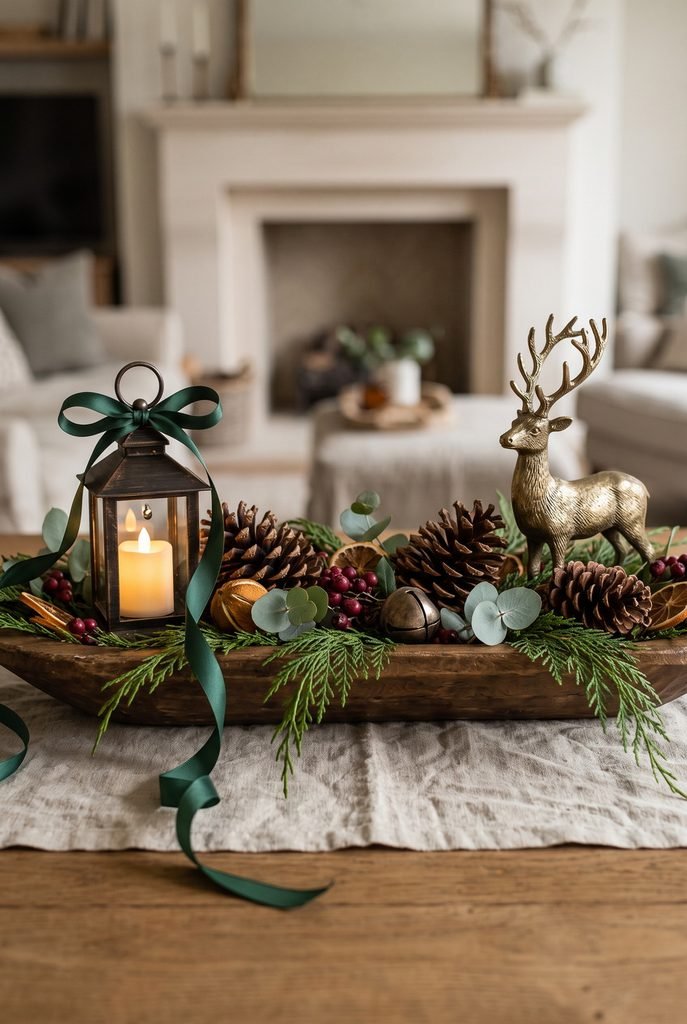
Fill the distance between them with a low bed of trailing cedar and open pinecones. A muted round leaf among the needles or a glimpse of dried citrus will reward a closer look. Leave open air above the middle so you can still see both the bow and the outline of the stag when you sit down.
If the table faces a fireplace, take a look from your usual seat. The antlers will be easier to enjoy against a quiet stretch of pale surround. A flameless light inside the tiny lantern can pick up the hearth’s glow at the opposite end of the arrangement.
Two landmarks for a woodland bowl
A brass-toned stag gives one end a tall outline, and a small lantern carries the green bow at the other.
Small Christmas Scenes and Keepsakes
A Small Nativity on Two Layers of Wood
For a small Nativity, work out where the manger will be visible before arranging the standing figures. A shallow bowl gives you a low front edge to look across. Turn the taller figures slightly inward and keep the nearest sprig below the manger. The direction of the figures’ faces will draw attention to the smallest piece in the scene.
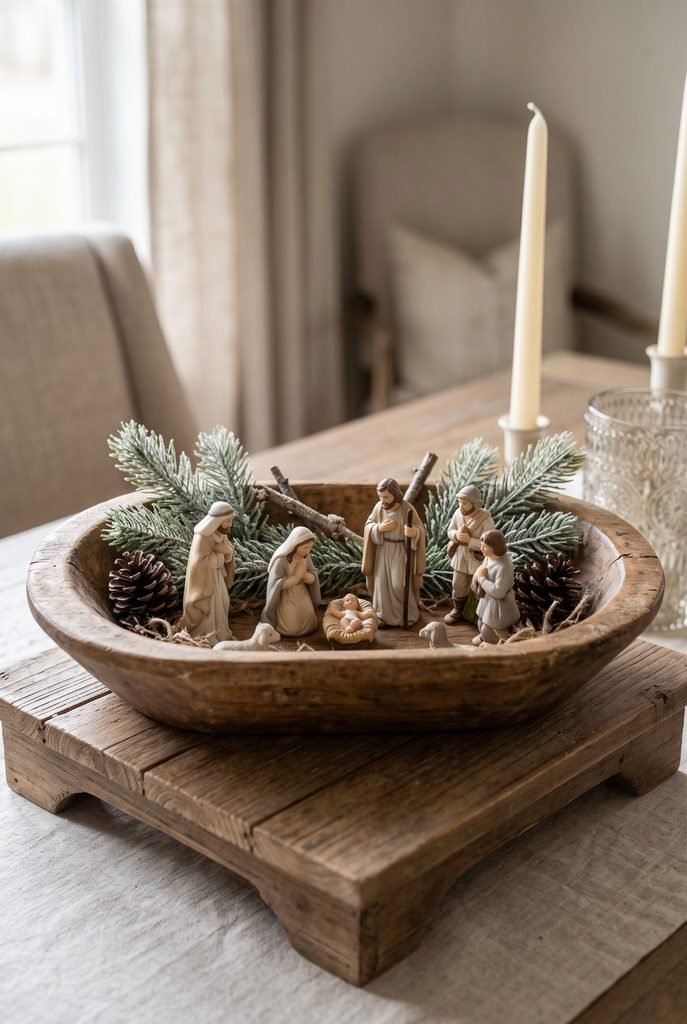
Pale robes pick up the same soft daylight as the frosted tips behind them. A dark pinecone on either side of the opening makes a gentle break in all that ivory. Those cones are especially useful on a busy wood tabletop, where the smallest pale figures might otherwise blend into the grain.
Slip a square wooden riser under the bowl with its front corners showing. The straight edges give the curved vessel a distinct base and lift the scene a little closer to someone sitting nearby. A tall ivory taper farther back can stay unlit and quiet above the figures.
A shallow setting for the Nativity
Small neutral figures gather around the manger, while a square riser leaves its corners visible beneath the oval bowl.
Two Scarfed Snowmen Beside a Red Sled
A red knit cap and a black top hat give two scarfed snowmen different personalities before you even get close enough to see their faces. Set the pair side by side in a broad bowl and lean the red sled off to one side. A gap between its rails and the nearest scarf makes the little sled recognizable from across the room.
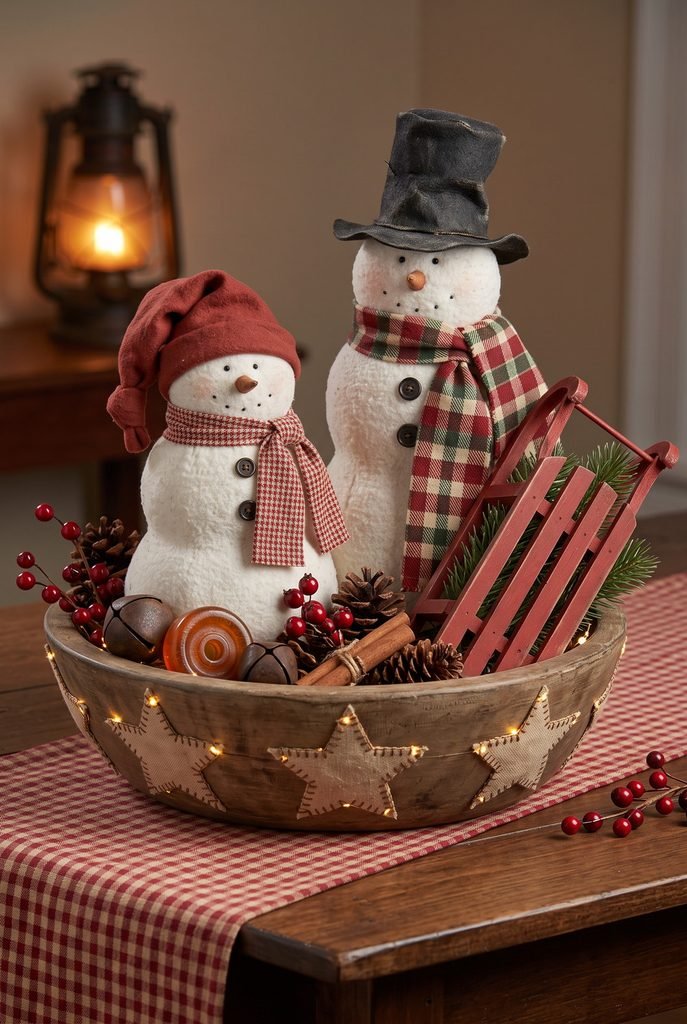
Let the smaller pieces settle around their feet. A stitched star has a soft, uneven edge that looks right beside a worn bell. An orange wheel tucked among the berries brings in a little amber to break up the red. Keep the fir low in front so the snowmen’s buttons still show.
A gingham runner picks up the checks in their scarves. Let a little of it show past the bowl, especially at the sled end. If the stitching and weathered finishes are your favorite parts, they also turn up in these primitive Christmas decorating ideas.
A little sled for the snowman pair
Open slats give the red sled a recognizable outline beside two scarfed figures.
A White Rocking Horse Facing a Frosted Tree
A small white rocking horse looks at home on a dresser beneath shelves of white dishes. What can get lost against all that pale crockery is the curved line under its feet. Set the horse on a stable spot at one end of a long bowl, with brown pinecones just behind the rocker. Nudge it forward until you can trace the runner from end to end.
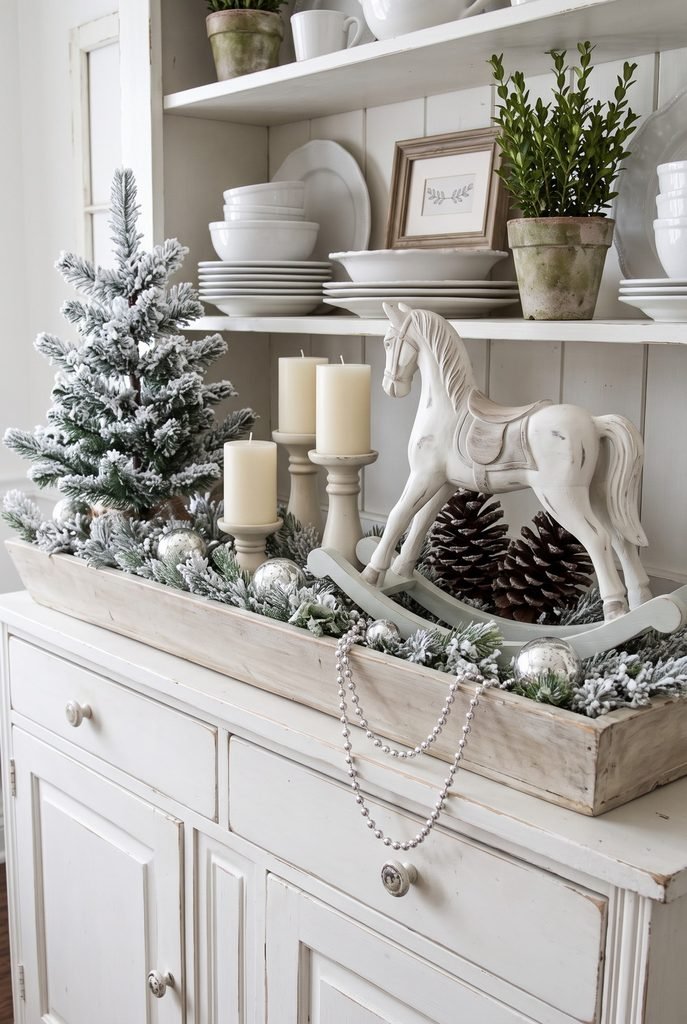
A frosted miniature tree gives the horse something to face across the bowl. Three ivory pillars at different heights fill the interval. Keep them unlit and leave a little room around the horse’s nose and the edge of the tree. From the doorway you’ll see two distinct shapes with the candles stepping between them.
The front edge is a good place for a little sparkle. A strand of silver drops draped over the pale wooden lip hangs below the cones, where each drop can catch the light against the dresser.
The rocking horse on the dresser
A white horse brings the color of the dishes down into the bowl, where dark cones set off its curved rocker.
A Long Christmas Bowl Across a Green Sideboard
A sideboard gives a long Christmas bowl room to stretch, especially when the dining table is already set for guests. Let a plaid runner fall over one end of the cabinet, with a little cloth showing around the tip of the bowl. That glimpse tells you where the vessel ends and makes its full length easier to appreciate above the green drawer fronts.
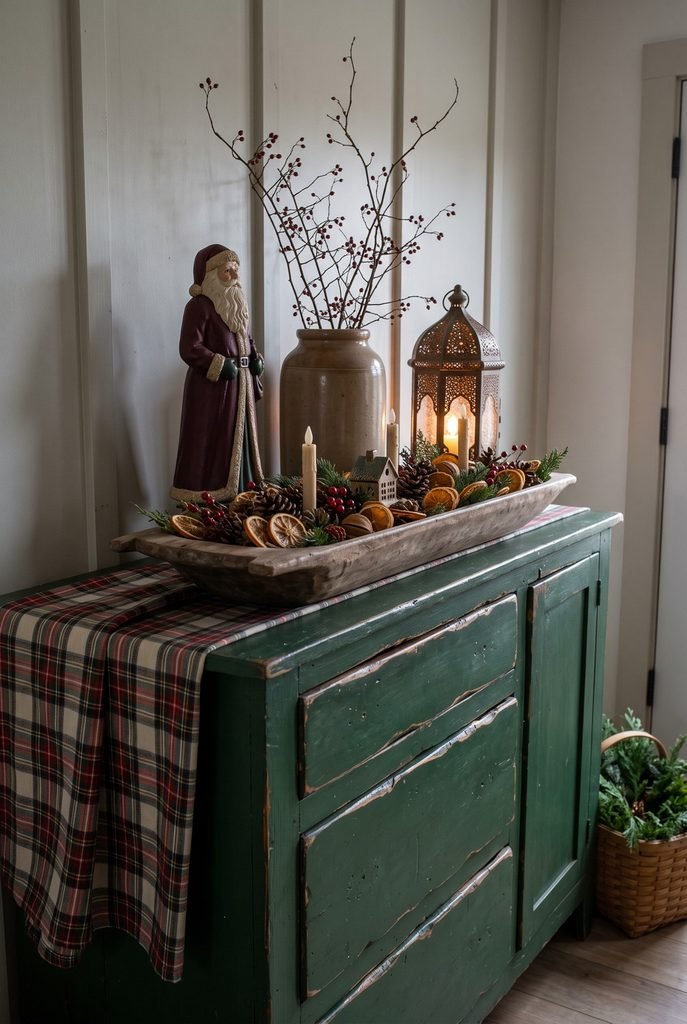
Keep citrus wheels, pinecones, and a little house low among the greenery inside the bowl. Save the height for the back. A standing Santa, a crock of berry branches, and a glowing flameless lantern each have a distinct outline. Leave a patch of wall visible between the branches and Santa’s cap. For more ways to shape that taller layer, see these Christmas vase arrangements.
A long bowl for the sideboard
An elongated bowl carries the greens across the cabinet, with plaid showing just beyond the wooden tip.
When you choose a bowl for your own home, look at it from the place where you’ll enjoy it most. That might be a breakfast chair, the sofa, or the doorway as you come in. Bring your favorite detail into view from there, whether it’s a tiny sled rail, a bright peel, or the grain of the wood itself.