





16 Bathroom Ceiling Ideas With Color, Pattern, and Texture

Stand in your bathroom doorway and look at the line where the shower tile ends. A strip of white might be all you notice. Now picture forest green above that line, with the showerhead silhouetted against it. The same tile has an entirely different presence. These bathroom ceiling ideas start with details you can see from the door, whether that’s a curve above a tub, a mirror that catches the ceiling, or a long aisle with room for flowers overhead.
Table Of Content
- Quick Takeaways
- Ceiling Color and Trim in Small and Light-Filled Baths
- Carry Forest Green From One Wall Across the Shower Ceiling
- Curve a Rose Ceiling Down to a White Cornice
- Give a White Ceiling Definition With Shallow Panels
- Wood, Beams, and Loft Texture
- Warm a White Cottage Bath With Honey-Toned Planks
- Leave Bright White Bays Between Pale Wood Beams
- Frame Weathered Ceiling Boards With Dark Crossbeams
- Pair a Concrete-Look Ceiling With Brick and Daylight
- Three Ways to Bring Florals Overhead
- Frame a Fine Blue Floral Print With White Crown
- Wrap Blue Woodland Wallpaper Onto the Upper Walls
- Stretch Oversized Wildflowers From the Vanity to the Towel Bench
- Illustrated Ceilings for a Family Bath
- Scatter Illustrated Fish Above a Narrow Tub
- Set a Starry Navy Sky Above Blue-and-White Stripes
- Turn a Ceiling Light Into the Surface of an Underwater Mural
- Metallic Finishes and Reflected Light
- Sweep Black-and-Gold Marbling Above a White Double Vanity
- Edge Copper-Toned Ceiling Squares With Warm Light
- Trace a Rounded Ceiling Recess With a Warm Cove Light
- What to Check Before Choosing a Bathroom Ceiling Finish
- Choose the Detail You Want to See From the Door
Quick Takeaways
- Look for a natural stopping point. A white cornice can frame a print, while an unbroken corner gives a branch or a wash of color room to continue down the wall.
- Repeat one ceiling color somewhere you use every day. A towel over the tub rim can do as much for a rose ceiling as a matching cabinet.
- Check the view in the mirror. A sliver of a beautiful pattern may be visible from the sink even when you’re looking straight ahead.
- Before settling on a finish, check whether the specific product suits both a ceiling and the conditions in your bathroom.
Ceiling Color and Trim in Small and Light-Filled Baths
Carry Forest Green From One Wall Across the Shower Ceiling
Deep forest green gives a square, gold-toned showerhead a beautiful backdrop. The green continues down one wall, where a towel rail nearly disappears into the color. On the other side of the shower, cream tile draws a sharp line beneath the ceiling. From the doorway, you can tell exactly where the green turns the corner and where it stops.
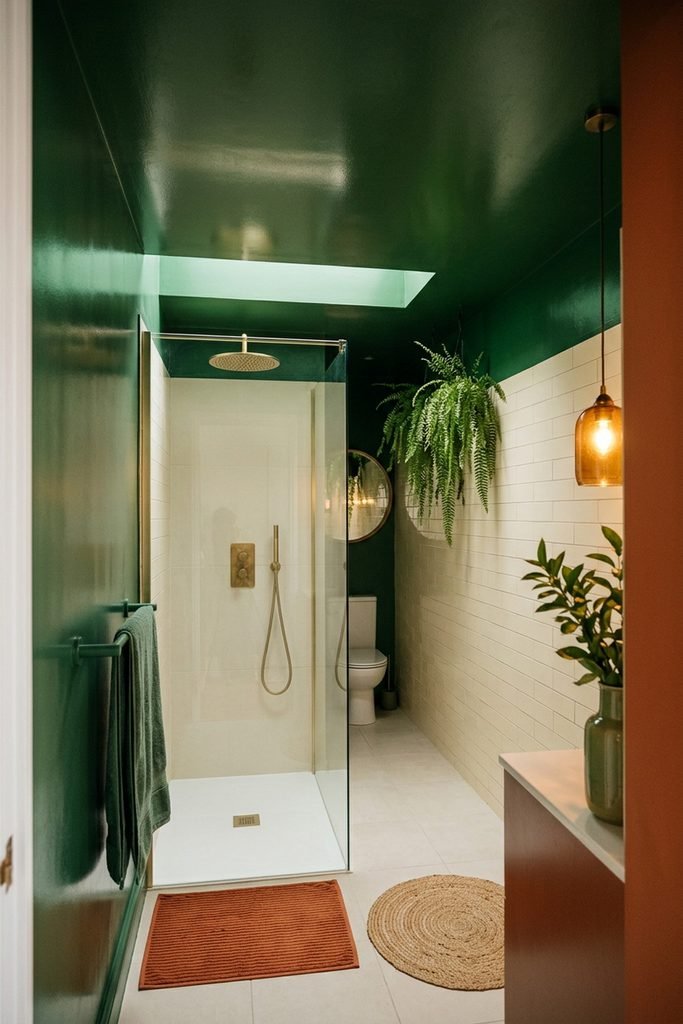
An amber pendant and a burnt-orange mat give this compact bathroom a warmer side. The mat is particularly effective because you see it and the green overhead in one glance. A soft reflection across the ceiling gives the dark color some variation, much like the differences between the leaves trailing beside the glass. When choosing a green for a room like this, look at it beside your tile and metal fittings. Both will influence which undertones you notice.
A little orange underfoot
A burnt-orange mat picks up the warmth of the amber pendant where it shows best against the pale shower tile.
Curve a Rose Ceiling Down to a White Cornice
The prettiest part of this rose ceiling is the few inches where it bends toward the window. Daylight catches the broad, flat area overhead, then the pink deepens as it rounds the curve. A slim white cornice ends the color just above the pale, veined walls. The change from blush to clay takes place within a single color.
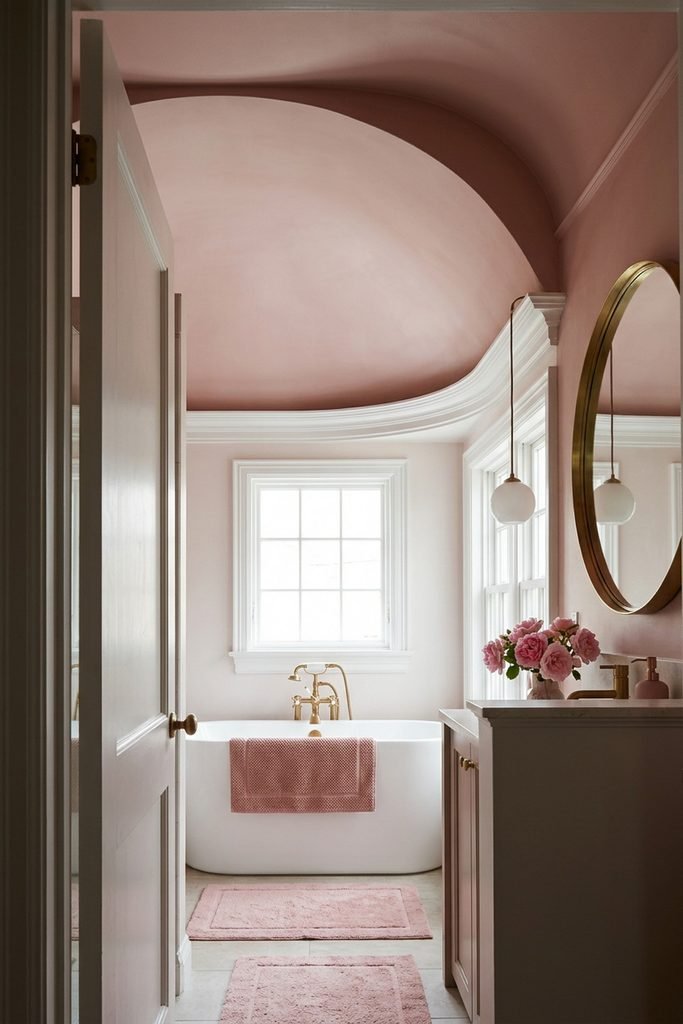
A rose towel folded over the rim of the white tub makes the ceiling feel like it belongs there. A pair of pink mats picks it up again underfoot, in a texture that looks softer than the surrounding stone. If your bathroom has a curved ceiling, try viewing a paint sample near the turn at different times of day. From the vanity, check the round mirror, too. It offers another glimpse of that pink edge while you’re standing at the sink.
Bring the rose shade down to the tub
A dusty rose towel folded over a white tub rim gives the ceiling color a soft edge at eye level.
Give a White Ceiling Definition With Shallow Panels
In a small white bathroom, the shadow along a molding can be enough to draw your eye up. Narrow stepped outlines form rectangles above a curved glass shower. Each outline casts a fine shadow. Several panels remain visible behind a round ceiling light, so the pattern is easy to follow from the doorway.
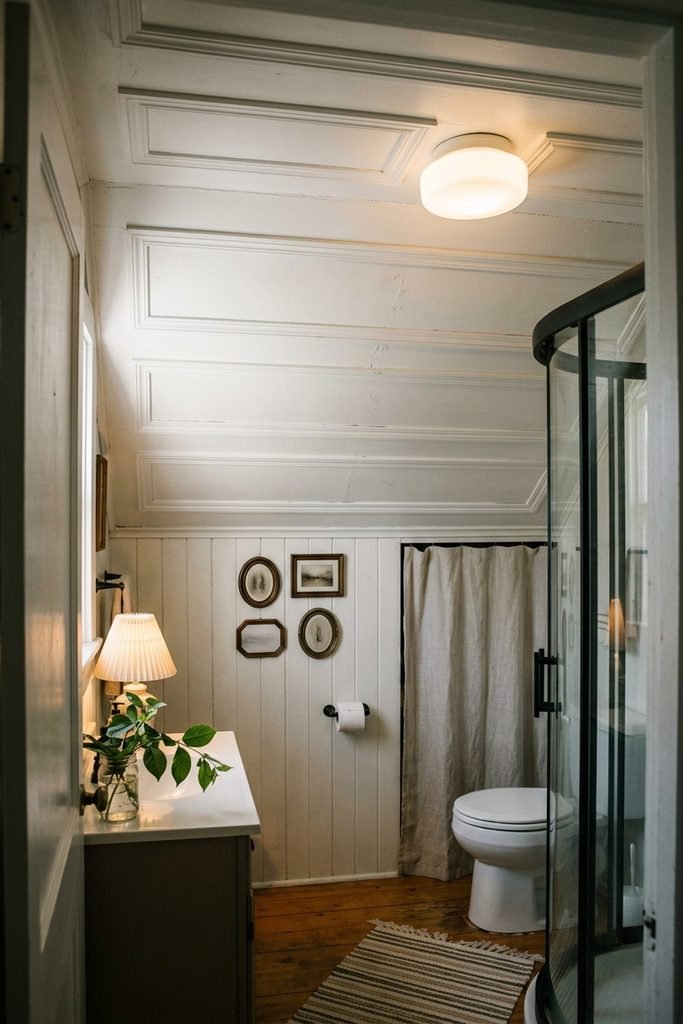
The little wall gallery beside the shower is what makes the room feel personal. Four pictures sit close together, with oval and angular frames that pick up both the rounded enclosure and the straight lines overhead. Their darker outlines give your eye somewhere to settle below the white panels. If you like this look, pay attention to a sample in ordinary daylight. A profile that still shows a fine edge on a cloudy morning will have a presence even while the ceiling light is off.
Four little frames beside the shower
A mix of oval and rectangular frames echoes the curved shower enclosure and the straight ceiling panels in one small gallery.
Wood, Beams, and Loft Texture
Warm a White Cottage Bath With Honey-Toned Planks
A long white bathroom gives honey-toned ceiling boards room to show their differences. Some boards read as gold and others as amber. Their ends meet at different points above the basins. Window light catches those changes on the way toward the towels at the far end of the room. Against the white cabinetry and clawfoot tub, even a pale stretch of grain is easy to see.
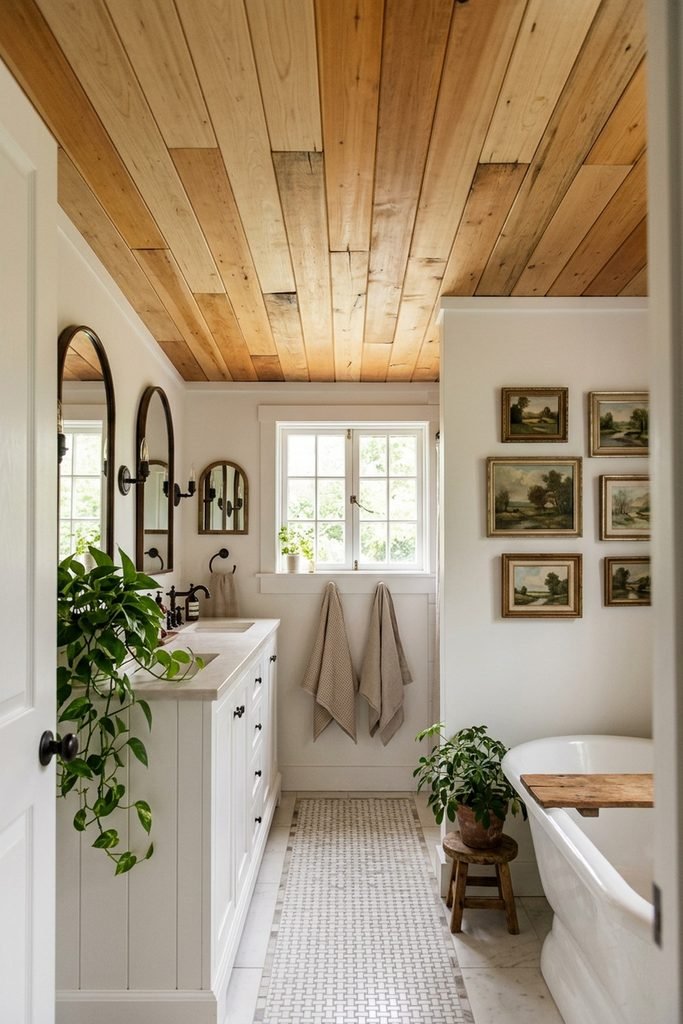
There’s a lovely difference in rhythm between the ceiling and the vanity. The boards vary with every few feet, while a row of arched mirrors repeats the same gentle curve. A mixed group of pictures above the tub loosens things up again. To borrow the room’s warmth, start with one wood detail close to the bath, such as a tray across the rim. It gives the honey-colored ceiling a companion while leaving plenty of white around it.
A wood accent across the tub
A wooden tray resting across the white tub picks up the honey tones of the planks overhead.
Leave Bright White Bays Between Pale Wood Beams
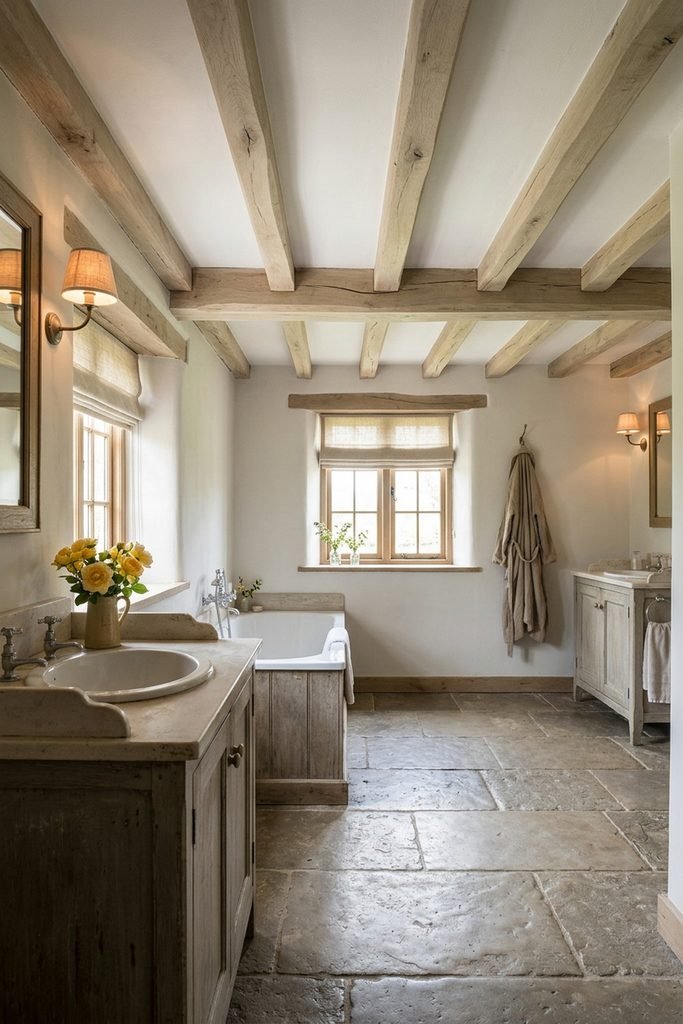
From the tub, the pale timber faces come into view with generous intervals of white between them. Side light puts a narrow shadow along each beam. That shadow reveals its depth, while the white that remains visible keeps daylight moving across the ceiling.
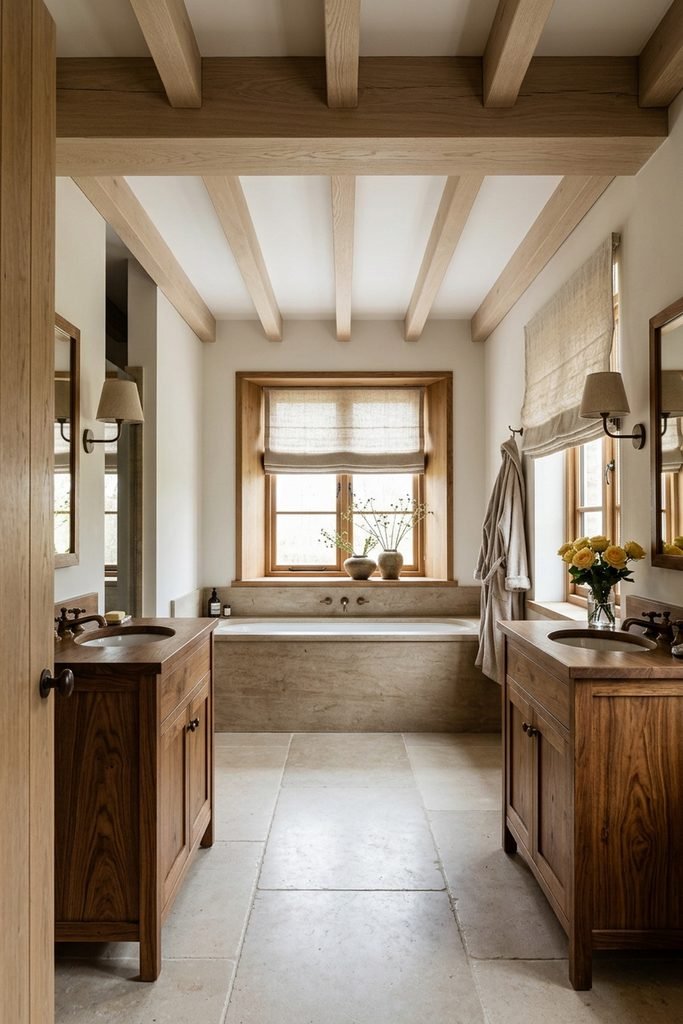
The wood window casings make this combination especially satisfying. Your eye follows the beams toward the window over the bath, then finds a similar tone around the glass. The window gives the wood a reason to be there even though the walls and tub surround are pale. At the sides, Roman shades and a hanging robe break up all those straight lines with fabric folds. For a bathroom with existing wood trim, use that trim as your first color reference. A close relative of its tone overhead is enough to connect the two.
Soften the window between the beams
A light-filtering Roman shade leaves the wood casing in view and puts a soft fold beneath the rows of pale beams.
Frame Weathered Ceiling Boards With Dark Crossbeams
In this cabin bathroom, weathered boards fill the space between dark beams. The boards run toward the back of the room, and the beams cross their seams. You can read the depth of each bay where the end of a lighter board slips into shadow behind a beam. It’s a richer, more enclosed look than pale wood spaced across a white ceiling.
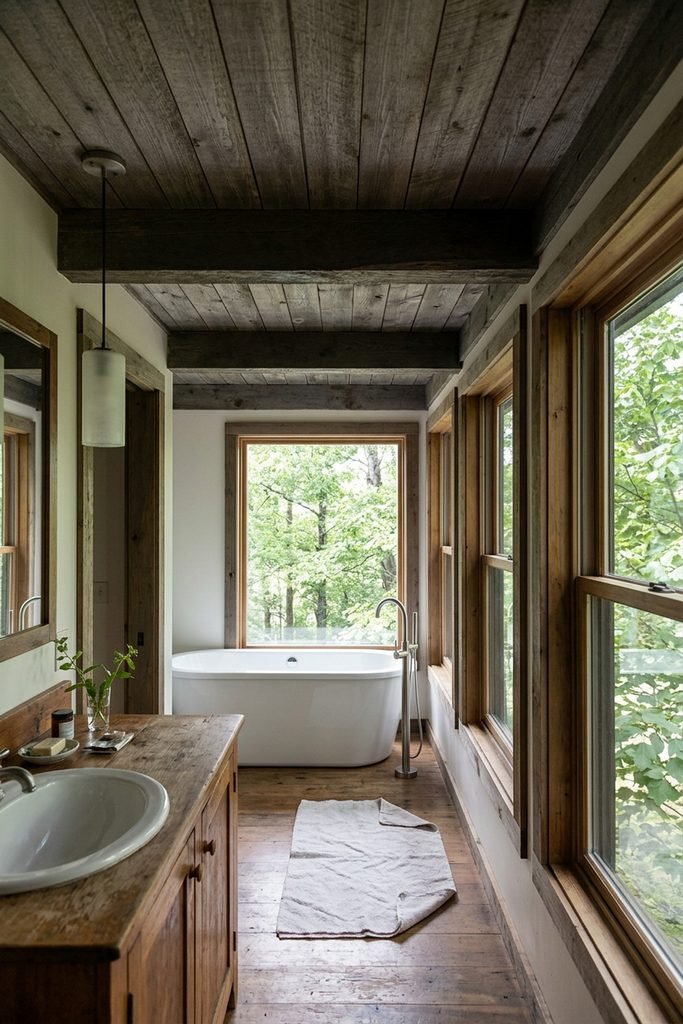
The view opens up again at the far end. A white tub stands beneath a timber-framed window, and a small pale rug brings some of the tub’s brightness onto the darker floor. From the vanity, that rug also marks the short walk to the bath. If a room already has wood above, below, and along one side, this is a good place to be selective with textiles. One light rug beside the tub can give all that varied grain a place to come to rest.
Pair a Concrete-Look Ceiling With Brick and Daylight
A ceiling with a cloudy gray finish looks particularly good beside the straight joints of exposed brick. In this loft-style bathroom, a broad window divided into squares gives the eye an even finer grid to compare with the gray overhead. Daylight reaches across the ceiling in patches. Around the caged light, you can pick out changes in the surface that would disappear in a single flat shade.
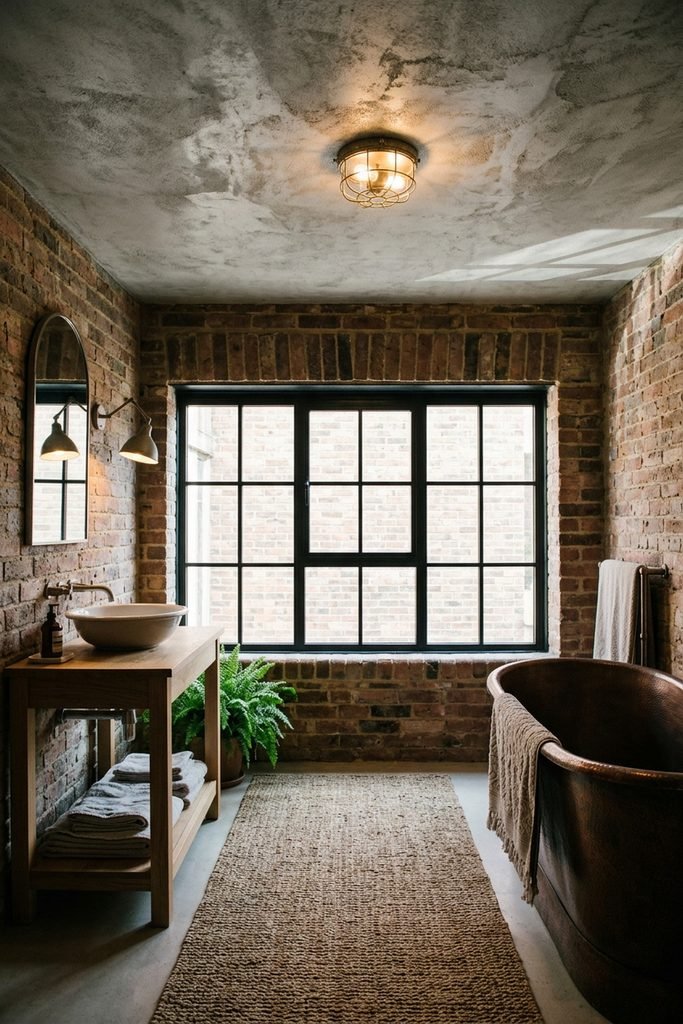
At bath level, a textured runner stretches toward the window and a towel hangs over the edge of the dark tub. Those folds make a useful difference in a room with so many hard surfaces. You get to enjoy the roughness of the brick and the concrete-like finish, with something soft underfoot on the way to the basin. When considering a mottled finish, look at a broad sample in side light. That’s where you’ll see how strongly the light and dark areas vary.
A pool of light at the loft vanity
An adjustable metal task lamp brings the warmth of the caged ceiling light down beside the mirror.
Three Ways to Bring Florals Overhead
Frame a Fine Blue Floral Print With White Crown
Small cream flowers crowd together on a blue ground, filling the ceiling right up to the white crown. At the corner above the windows, two runs of molding meet. That clean white angle gives the eye a way to take in the boundaries of the print before getting lost in the individual petals. Below it, the narrow grooves in the wall panels run straight down to the vanity.
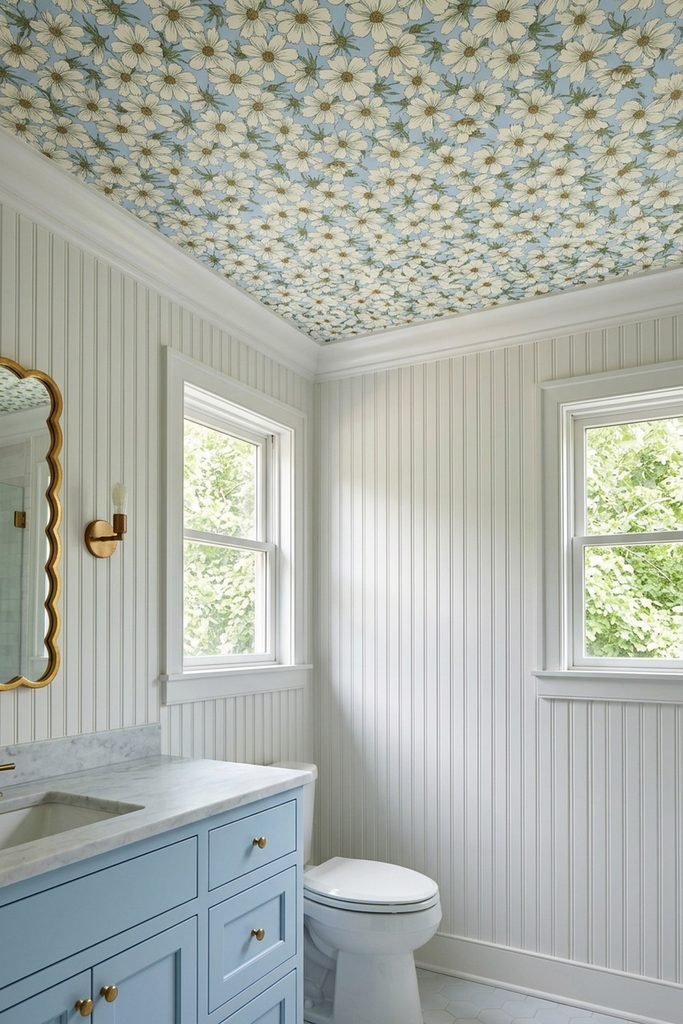
Which blue belongs on the drawers? Look between the flowers. A blue drawn from those little gaps feels familiar beneath the print, even if the cabinet has a softer finish. The scalloped edge of the vanity mirror picks up the shape of the petals in a different way, through its outline alone. Leave a little breathing room around a mirror like this. The pale wall and unadorned windows help you enjoy the two curves together.
Cream petals and a scalloped edge
Look for a blue ground that echoes the vanity drawers and a scalloped mirror that picks up the curves of the petals.
Wrap Blue Woodland Wallpaper Onto the Upper Walls
A leafy blue pattern can also carry right over the corner. Follow one forked branch from the wall toward the ceiling and you can see how the two surfaces meet. The eye keeps traveling through blue leaves until it finds the solid blue rail farther down the wall. In a narrow bathroom, that brings much more of the pattern into the view from the door.
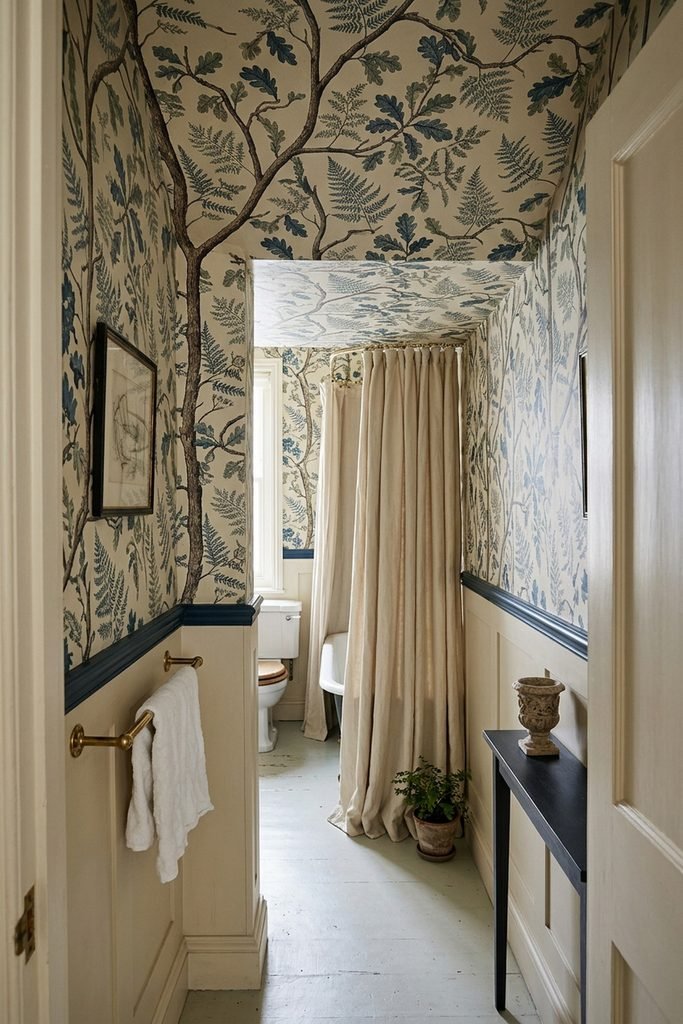
There’s a reason the cream shower curtain looks so good here. Its deep, plain folds make a quiet patch beside all the tiny branches, and its light color relates to the open spaces in the print. A framed drawing on one side and an urn on the other give the room a sense of scale. When comparing leafy patterns, look for one branch you can recognize from across the room. For more ways a print can follow the corners of a room, explore these ceiling wallpaper ideas.
A quiet break in the woodland print
A branching blue print gives the eye a shape to follow around the corner, while a plain cream curtain gives it a place to rest.
Stretch Oversized Wildflowers From the Vanity to the Towel Bench
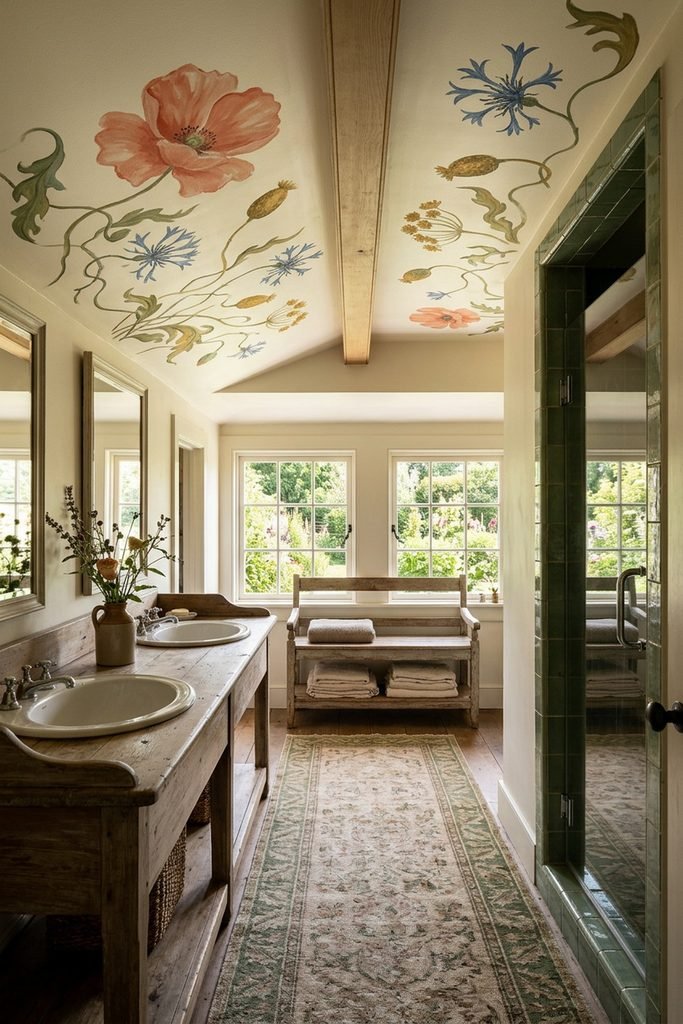
One big pink bloom catches your eye as you enter this long bathroom. Beyond it, smaller flowers, leaves, and curling stems carry on across the ceiling, even on the other side of a crosspiece. The flowers have enough space between them to show the ivory underneath. You can enjoy the sweep of the whole canopy from the door, then discover little buds and berries from the sink.
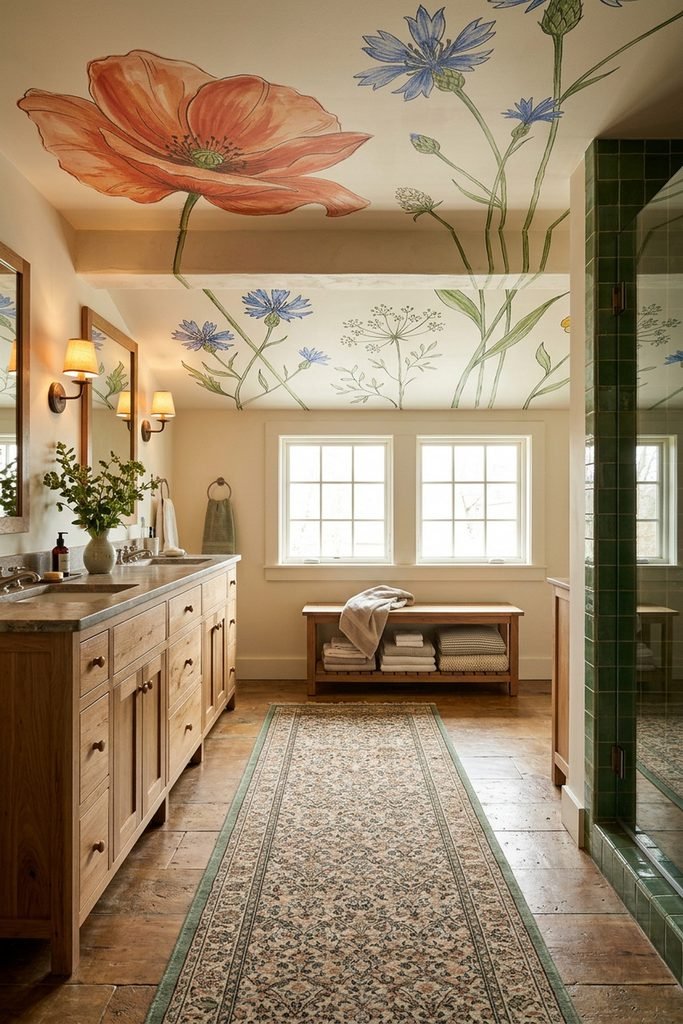
On the floor, a patterned runner travels much the same distance, ending at a low bench beneath two windows. Folded towels on the seat and linens tucked underneath make that far end feel like a place you’d actually walk to. Try picking up the muted green of a leaf in the border of the runner. A thin line of green can lead you from the near edge of the rug to the flowers overhead without asking two busy patterns to match.
Beside the vanity mirror, a few stems in a vase bring the scale back down again. Their small silhouettes look especially good against the warm light of the sconces.
Follow the flowers to the towel bench
A green border carries a leaf color along the floor to a low bench with space for folded towels underneath.
Illustrated Ceilings for a Family Bath
Scatter Illustrated Fish Above a Narrow Tub
Fish illustrations can give a ceiling the charm of an old natural-history book. Each fish has its own shape and patch of pale background. From the door, a broadside fish with a distinct fin is easy to spot. Farther along, the smaller illustrations give someone in the tub a different part of the design to enjoy.
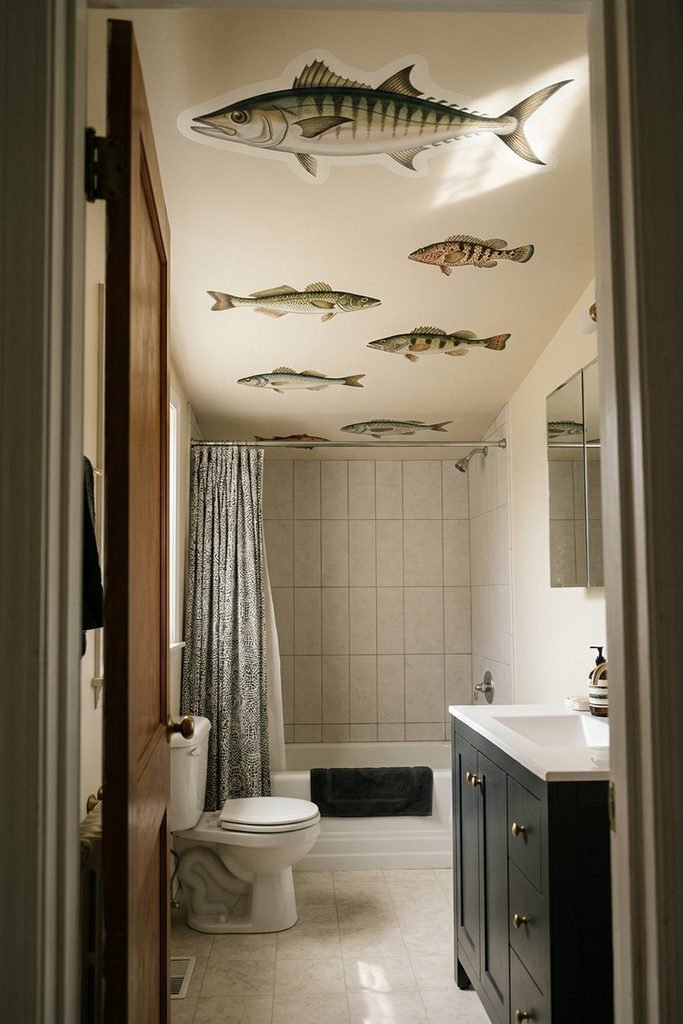
The dark vanity gives this little bathroom a solid base. Across from it, a patterned shower curtain gathers beside a hand towel draped over the tub. The curtain’s quieter colors leave the bright fish easy to pick out. For a particularly narrow ceiling, consider where one whole fish would land above the aisle. An open patch around its nose and tail lets you read the illustration at a glance, even where the nearby door, cabinet, and curtain are all in view.
Set a Starry Navy Sky Above Blue-and-White Stripes
A slim crescent peeks through soft cloud banks on this navy ceiling. Below, the blue has a much sharper edge. Mosaic stripes run across the shower surround and repeat on the floor as a series of bands leading toward the back wall. Following those stripes into the room makes the shift to a night sky overhead feel all the more surprising.
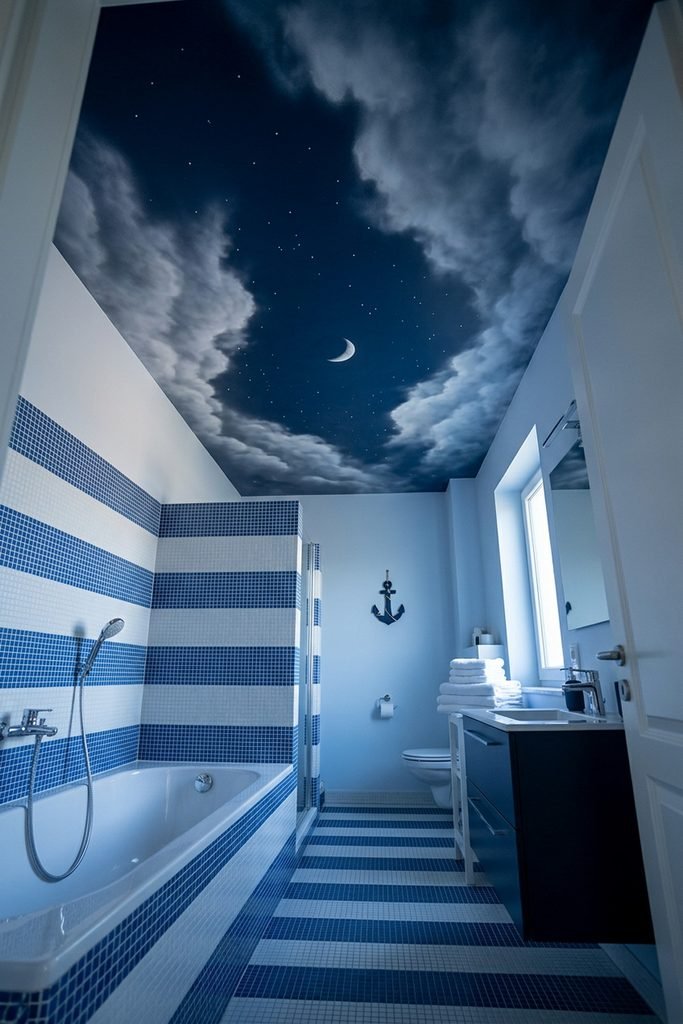
A small anchor on the pale rear wall is enough to suggest the sea. Folded white towels beside the basin leave some quiet space between that little wall detail and the dark vanity. If you’re choosing a sky design, look at the area around the moon as closely as the moon itself. A clear opening in the clouds lets the crescent keep its fine shape. The smaller stars can scatter elsewhere, where they’ll be a discovery for someone looking up from the bath.
One anchor beneath the stars
A small navy anchor on the pale wall repeats the blue stripes and leaves the crescent overhead in the spotlight.
Turn a Ceiling Light Into the Surface of an Underwater Mural
Imagine standing at the basin and looking up through water toward a patch of daylight. An underwater mural can give a small bathroom that view when the scene changes with height. Rocks sit near the top of the pale lower tile. Plants and aquatic silhouettes stretch up two walls and bend onto the ceiling. Above them, blue-green rings circle a round ceiling light right where you’d expect sunlight to break through the surface.
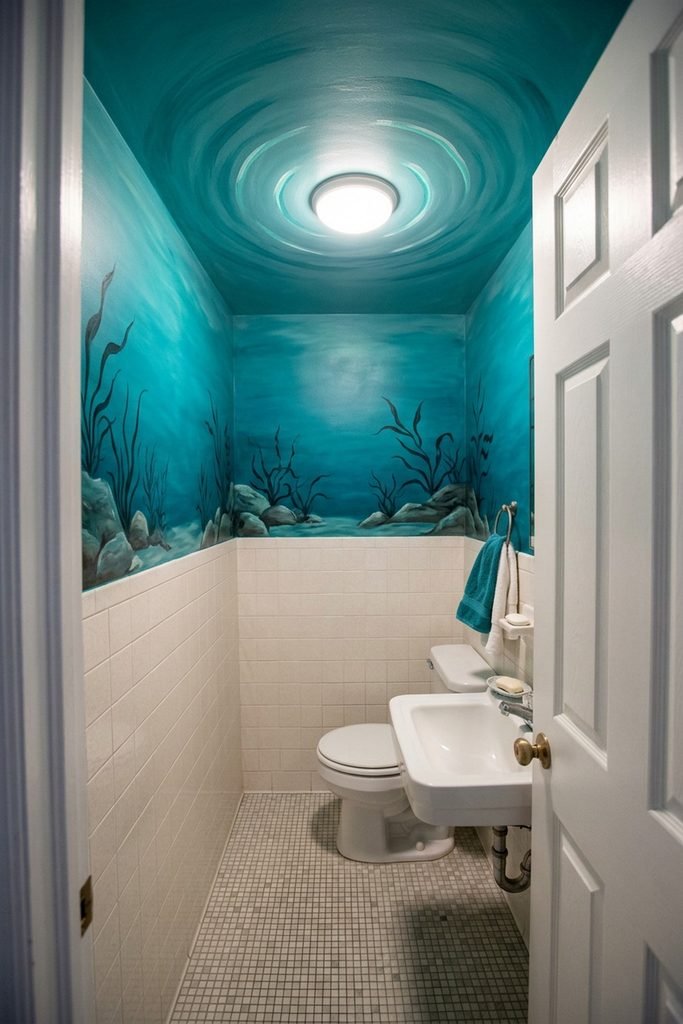
For the clearest effect, try a narrow pale-aqua highlight on the two ripples closest to the light. Your eye can follow the bright curves out into deeper water and down toward the darker leaves. The paneled white door, white basin, and toilet make the underwater colors particularly vivid by comparison.
A teal hand towel layered over a white one beside the door is enough color below the mural. It brings a little of that water color within reach and lets the open floor feel restful underneath a roomful of movement.
Metallic Finishes and Reflected Light
Sweep Black-and-Gold Marbling Above a White Double Vanity
A broad sweep of black and gray makes a striking ceiling above pale bathroom tile. Fine gold-colored lines ride along the edges of the dark areas, splitting and coming together again. The scale matters. From the tub, you can see the direction of the whole sweep. At the double vanity, the upper edge of a mirror catches just a little of it.
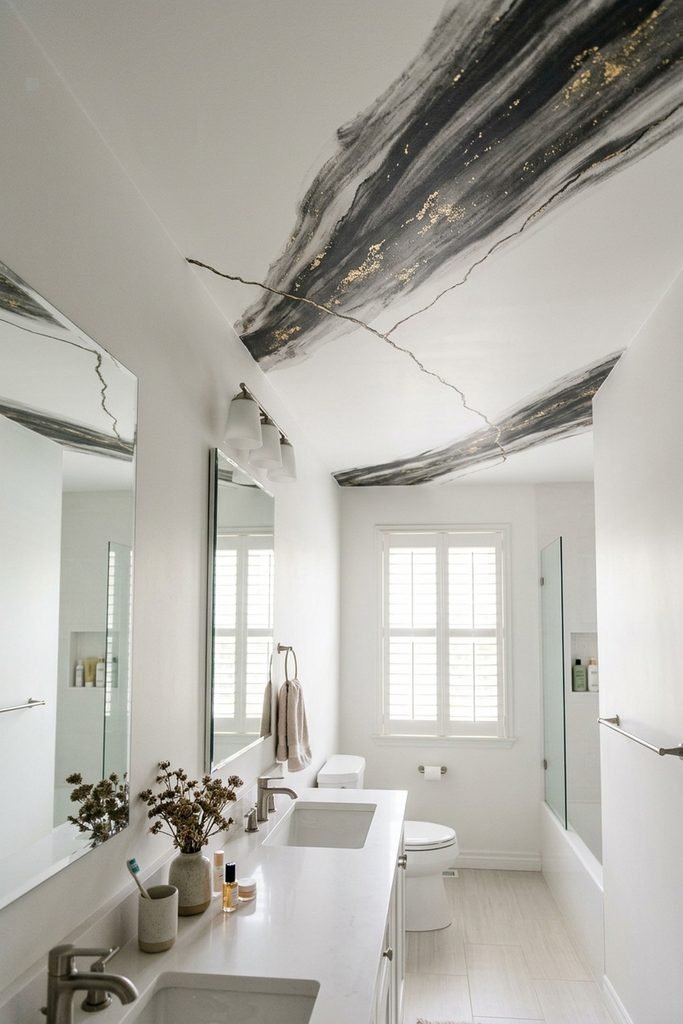
If you’re comparing patterns for a bathroom like this, pay attention to which part will fall within that reflection. A fork in a gold vein is recognizable both overhead and in the mirror. A featureless stretch of gray will give you a very different view from the sink. Low dried stems on the counter leave the mirror edge open, even with toothbrushes and soap within reach. If you’d like to extend that combination beyond the ceiling, these black and gold bathroom decor ideas explore the palette around other fixtures.
Leave room for the reflection
A short bud vase holds a few dried stems low on the counter, leaving the mirror free to catch the gold veining overhead.
Edge Copper-Toned Ceiling Squares With Warm Light
Follow the fine joints across a copper-colored ceiling and you’ll see how differently neighboring squares catch the light. One looks deep brown through the center, while the next has a warm, mottled gleam. A narrow wash of light along the wall brings out those variations. Keeping the brightest edge soft enough to see the joints preserves the grid all the way to the corner.
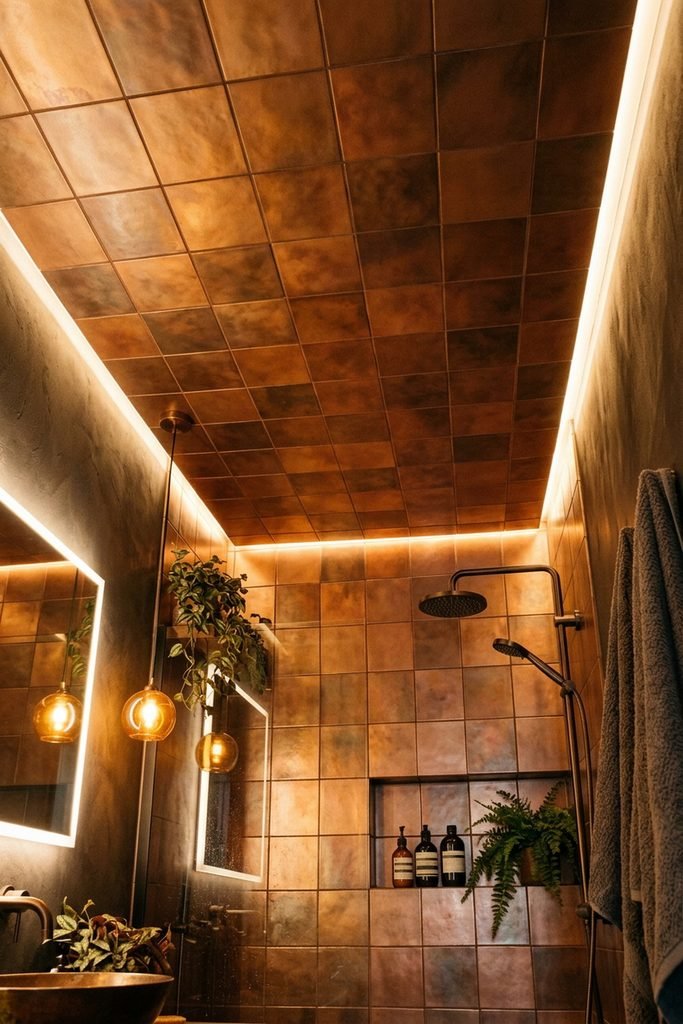
Down by the vessel basin, small globe pendants give the copper tone a second home. They also let you appreciate the difference between a light you can see and a surface that reflects its glow. With pale walls behind the basin and shower fittings, the squares are the richest area of color in the room. For a small sink-and-shower space, try viewing a finish sample in evening light as well as daylight. A warm reflection can change how much of its surface pattern you see.
A pair of globes by the basin
Small glass globe pendants repeat the warmth of the copper-toned ceiling at face height beside the basin.
Trace a Rounded Ceiling Recess With a Warm Cove Light
In a long bathroom, a softly lit ceiling edge gives the eye a path from the freestanding tub to the shower. The line turns a rounded corner overhead. Across the aisle, a mirror has a gentler halo, and another soft band of light appears at the base of the floating vanity. From the end of the runner, you can see the glow at all three heights.
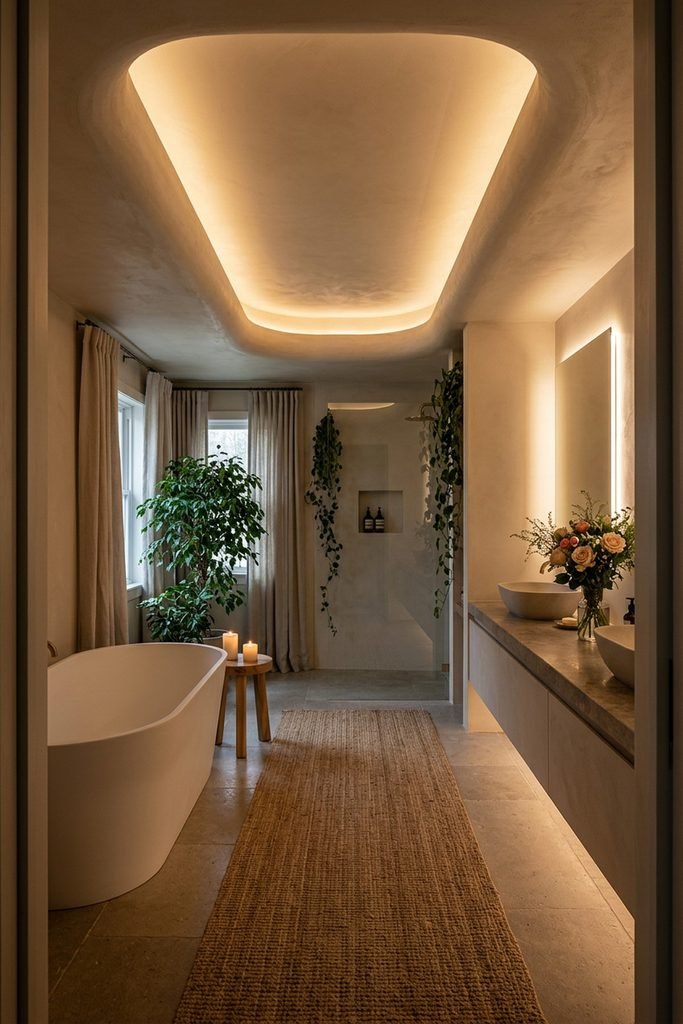
Their relative brightness makes the difference. Let the ceiling carry the clearest line, with the mirror a little quieter and the lowest glow soft enough to pick out the floor. Three equally bright outlines would leave the eye bouncing from one to the next. A woven runner between the fixtures gives the center of the room a stretch of matte texture. Beside the tub, a small table with two candles makes the wide curve overhead feel surprisingly intimate from the water.
A candle table within reach of the tub
A small round table gathers the two candles beside the tub, below the long curve of the ceiling light.
What to Check Before Choosing a Bathroom Ceiling Finish
A powder room with a sink, a full bath that steams up, and a low ceiling within reach of shower spray ask different things of a finish. When you find a color, print, or panel you love, tell the supplier where it will go overhead and how much moisture reaches that spot. Ask for the product instructions that cover that use.
Two examples show why the wording matters. York advises against using its peel-and-stick wallpaper on ceilings because the adhesive is designed for walls. Armstrong’s bathroom guide limits the wood-look planks it discusses to half baths without a tub or shower. Other products have their own specifications. York Wallcoverings FAQ · Armstrong bathroom ceiling guide
It’s also worth considering where the steam goes after a shower. The EPA recommends bathroom exhaust that vents directly outdoors. If moisture regularly lingers overhead, address the ventilation as part of the finish decision. EPA bathroom remodeling guidance
Choose the Detail You Want to See From the Door
Back at your doorway, pick one detail you’d like to notice every day. It might be the pink above a white tub or a gold vein caught in the mirror. Once you know where that detail belongs, it’s easier to decide which surfaces around it can stay quiet. For the rooms beyond the bath, explore more ceiling ideas for the rest of your home.