





14 Ceiling Wallpaper Ideas That Bring the Room Together
Ceiling wallpaper ideas work best when the pattern has a clear connection to the room below. A crane print can pick up the warmth of mustard bedding, while a floral border can frame a quiet patch of teal above the bed. The choice is as much about placement as it is about the paper.
Table Of Content
- Quick Takeaways
- Patterned Ceilings That Set the Room’s Palette
- 1. Pair a Crane-Print Ceiling With Olive Walls and Mustard Bedding
- 2. Set a Dark Floral Ceiling Above Deep Blue Built-Ins
- 3. Frame a Quiet Teal Center With a Floral Ceiling Border
- 4. Float Soft-Focus Wildflowers Above a Neutral Living Room
- Ceiling Murals That Create an Overhead View
- 5. Open a Light Living Room to a Tropical Canopy Mural
- 6. Place a Classical Sky Mural Above Quiet Cream Seating
- 7. Scatter Soft Clouds and Yellow Stars Above a Pale Nursery
- 8. Bring a Deep Blue Galaxy Ceiling Into a Calm Bedroom
- Graphic Wallpaper That Follows the Architecture
- 9. Frame Pale Medallion Wallpaper With Cream Molding
- 10. Fill Dark Beam Bays With Black-and-White Botanical Wallpaper
- 11. Set Black-and-Gold Marble-Effect Wallpaper Inside a White Frame
- 12. Radiate Multicolor Ceiling Stripes From a Simple Pendant
- Wallpaper Placements That Define a Room Zone
- 13. Fold a Bed-Width Wallpaper Canopy Down the Headboard Wall
- 14. Turn a Wallpaper Ribbon From the Entry Toward the Dining Table
- Before You Choose Ceiling Wallpaper
- Choose the Ceiling Look That Belongs to Your Room

These 14 looks explore color, scale, and texture across bedrooms, living rooms, and shared spaces. For a broader mix of treatments, explore these ceiling ideas.
Quick Takeaways
- Repeat one or two colors from the ceiling in the room below. Every cushion and curtain does not need to match.
- Judge the size of the motif within the area it will cover, whether that is a full ceiling, a narrow bay, or a bed-width panel.
- Give a busy print some quieter company through plain walls, soft upholstery, or a clear ceiling border.
- Check the exact wallpaper’s suitability for ceilings, then confirm the pattern layout and mural crop before ordering.
Patterned Ceilings That Set the Room’s Palette
Birds, flowers, and soft photographic color can give the furnishings below a shared starting point.
1. Pair a Crane-Print Ceiling With Olive Walls and Mustard Bedding
Olive walls give sweeping crane silhouettes a solid background to sit beside. Above them, cream and blush birds can stretch across the ceiling, their dark wing markings adding definition. Mustard bedding brings the strongest warm color down to the bed, so the pattern feels connected to the room.
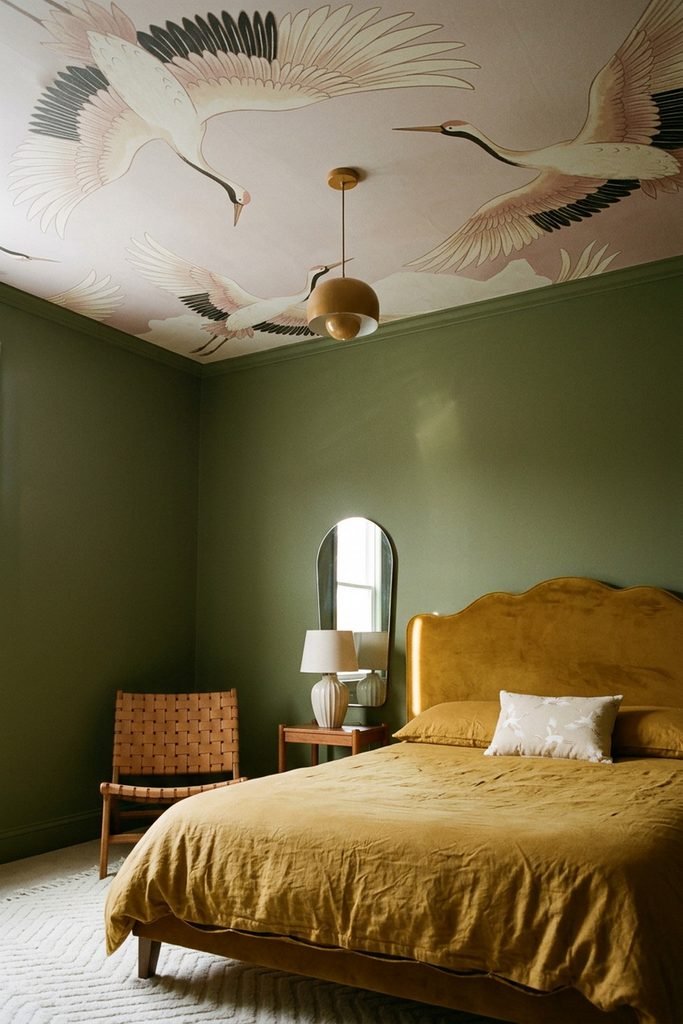
Cream is the useful bridge here. A pale lamp or a little cream in the bedding echoes the birds without asking every textile to carry another print. A scalloped headboard adds a softer outline beneath the angular wings.
Texture makes this bedroom ceiling wallpaper feel less like a flat decorative layer. Velvet upholstery, a wool rug, and one woven leather chair offer different surfaces around it. Leave enough space around the larger bird shapes for their movement to read, and check where the repeat will meet the ceiling edges.
Bring Mustard and Cream Below the Ceiling
Mustard bedding adds warmth beside olive walls, while a cream ceramic lamp picks up the pale birds overhead.
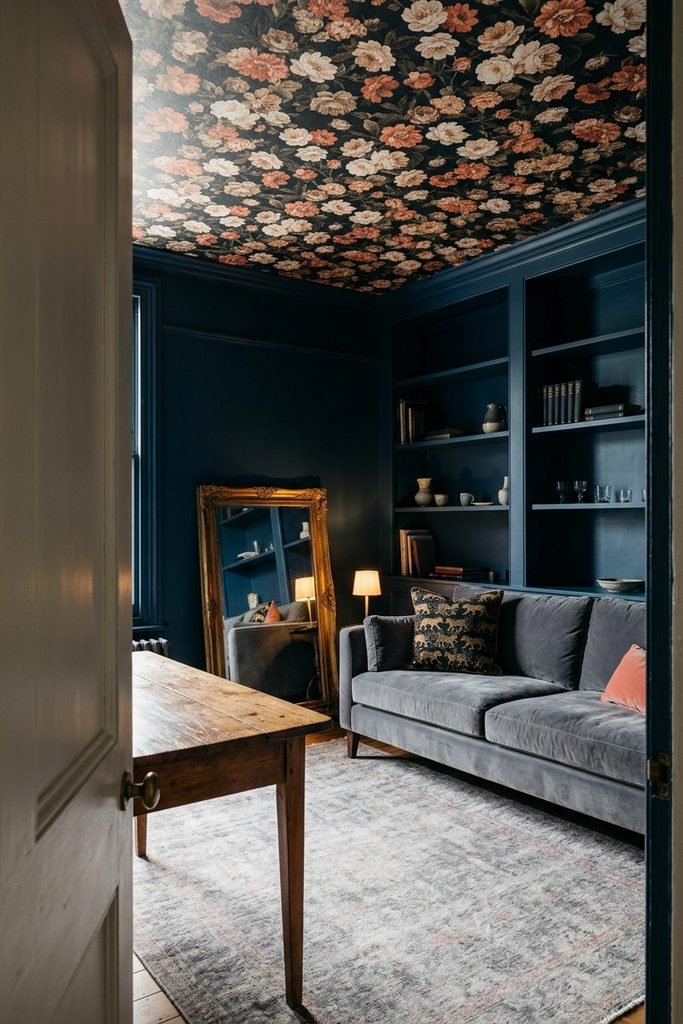
2. Set a Dark Floral Ceiling Above Deep Blue Built-Ins
Deep blue built-ins can give a dense floral ceiling a place to belong. Their broad, solid surfaces hold the room steady while coral and cream blossoms spread overhead. Carrying the blue across the walls and shelves makes the ceiling’s edge feel settled rather than abruptly cut off.
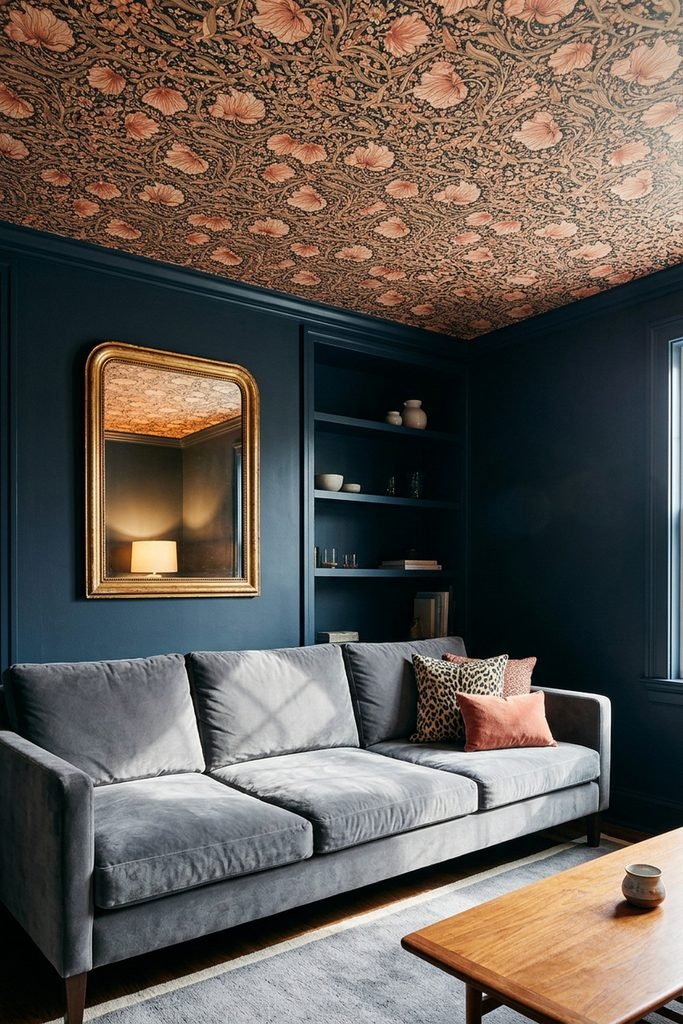
A gray sofa offers a pause beneath that much pattern. Its softer surface also makes a gilded mirror and a few glass objects stand out. The mirror earns its place by catching a second glimpse of the flowers, so another busy wall treatment would contribute little.
Bring coral or cream down in one cushion or a small ceramic piece. The rest can stay quieter. This approach to ceiling wallpaper in a living room depends on the relationship between a crowded print and generous areas of solid color; filling every shelf would weaken that contrast.
3. Frame a Quiet Teal Center With a Floral Ceiling Border
An open center changes how a floral ceiling reads. Instead of spreading flowers evenly across the whole surface, gather oversized blooms around the edges and let them thin toward a broad teal opening. The room gains a floral frame with a quieter place for the eye to rest.
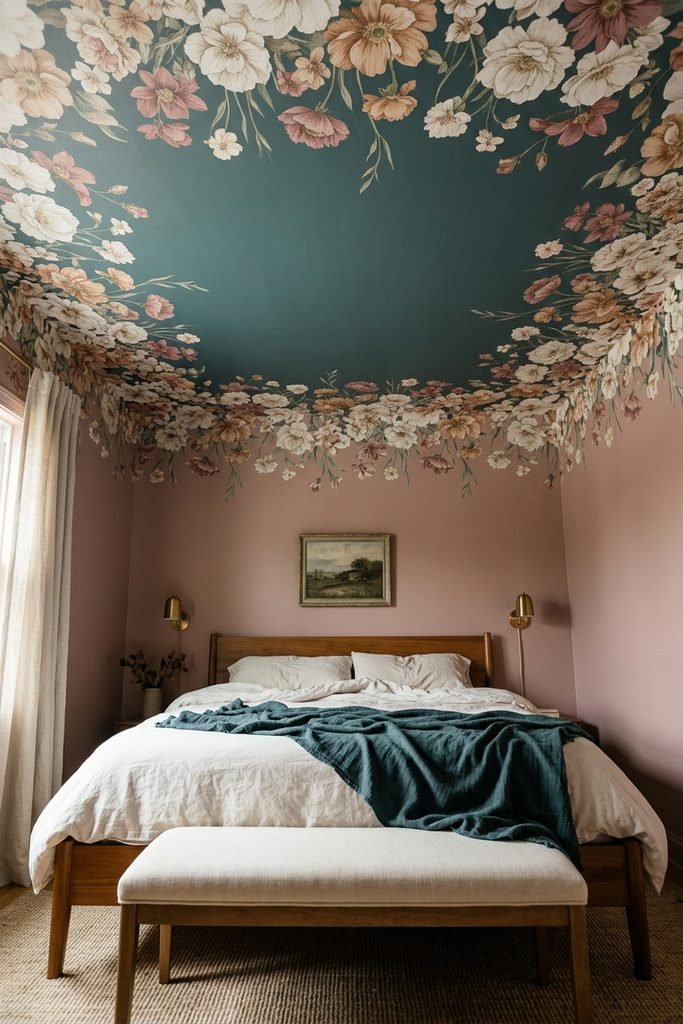
Dusty rose walls draw color from the petals, making the border feel connected at the corners. A teal throw repeats the center lower down, while white bedding leaves the flowers as the most detailed part of the bedroom.
The amount of clear space matters more than adding extra blossoms. It should feel generous above the bed, with the fixture considered as part of that opening. A custom mural crop is useful for preserving this arrangement; an evenly repeated floral roll would give a different result.
4. Float Soft-Focus Wildflowers Above a Neutral Living Room
Photographic flowers offer a softer alternative to a tightly packed floral repeat. Fine white stems can drift across a peach-to-lilac background, with some petals sharp and other areas blurred. That change in focus gives the ceiling image depth without relying on a large central flower.
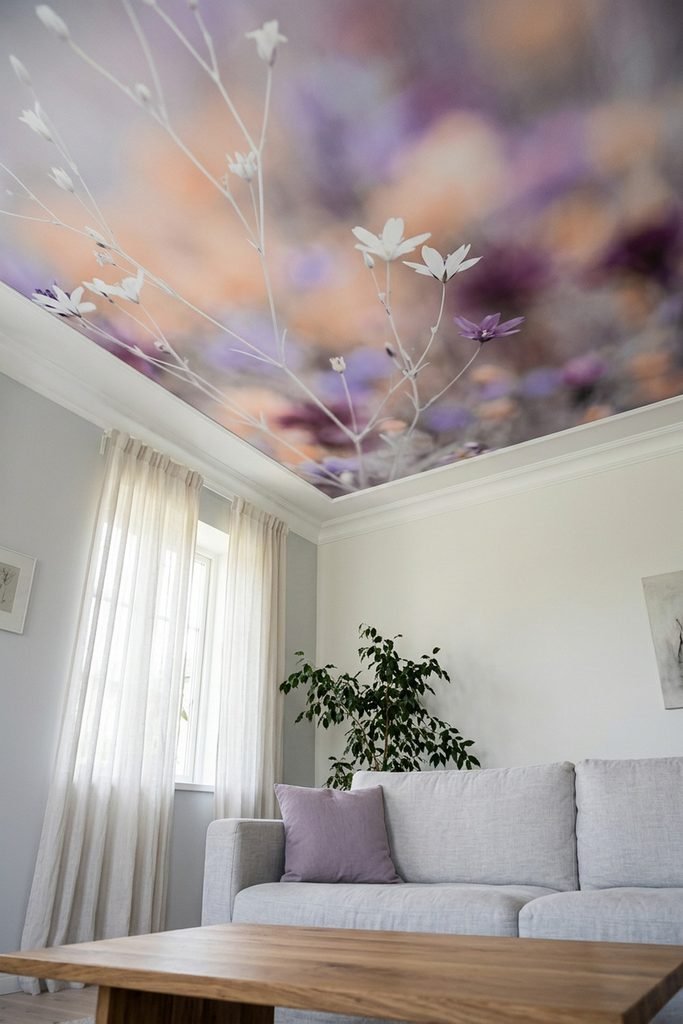
A pale gray sofa and sheer curtains leave room for the subtle color shifts. One lavender or peach accent below is enough to acknowledge the mural. Warm wood can carry the peach tones into the furniture without copying the flowers themselves.
A narrow white ceiling border gives this airy image a clean ending. Keep nearby wall art restrained so the delicate stems remain readable. When choosing the print, look at a sample at its intended scale: deliberate photographic blur should still contain clear detail where the flowers are meant to be sharp.
Ceiling Murals That Create an Overhead View
Scenic wallpaper gives the ceiling a view of its own, from layered palms to a deep blue night sky.
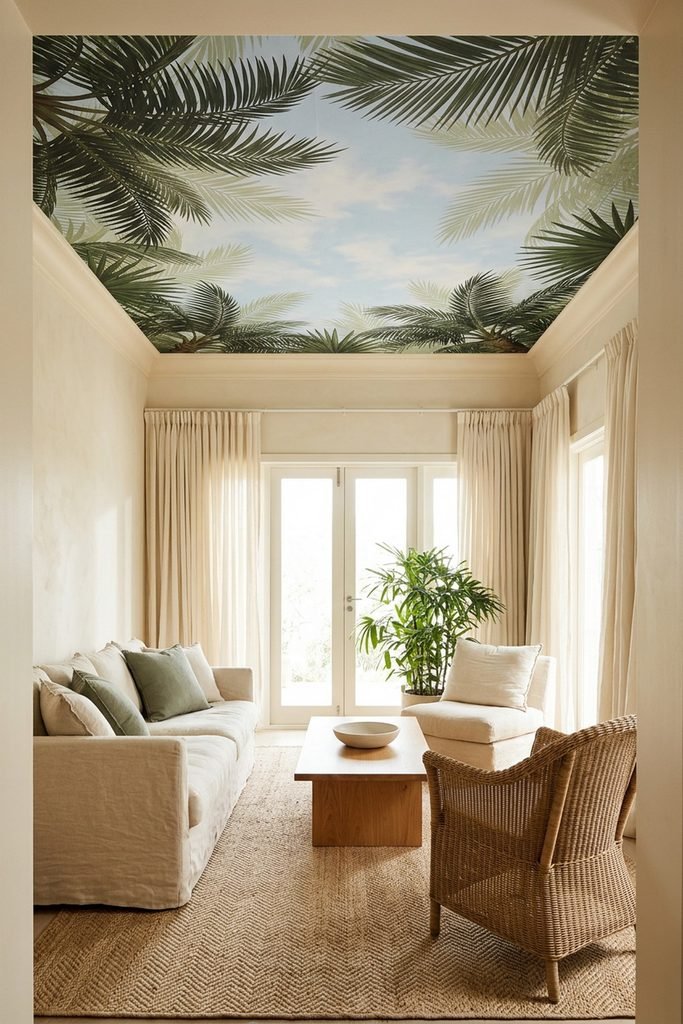
5. Open a Light Living Room to a Tropical Canopy Mural
A palm canopy makes the most sense when the room below shares its relaxed, natural character. Green fronds can reach inward from the ceiling edges, leaving patches of soft blue sky between them. Pale walls keep that overhead foliage from becoming a continuous green enclosure.
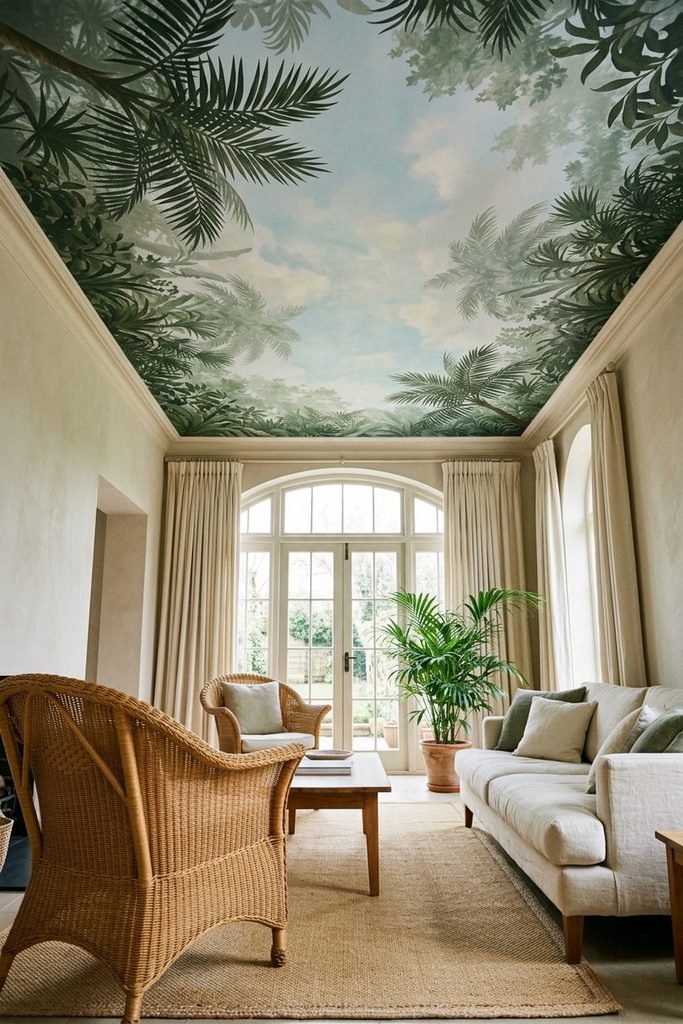
Wicker seating and a woven rug give the printed landscape a tactile counterpart. One real plant near a window carries the leaf shapes down into the room; there is little need for a tropical motif on every cushion.
Cream linen curtains support the lighter areas of the mural and soften the window’s outline. Let the paper’s foliage vary in depth, with some leaves closer and others fading toward the sky. That layered composition supplies the sense of an overhead view. The effect comes from the printed scene and the room’s light palette, so it does not depend on adding themed accessories.
Find the Linen and Woven Layers
Cream linen curtains and a neutral woven rug keep the room beneath the palms light and textured.
6. Place a Classical Sky Mural Above Quiet Cream Seating
Treat a classical sky mural as the main artwork in the room. Figures and architectural fragments can gather around the perimeter, leaving a blue opening overhead. The clear center gives the detailed edges somewhere to lead.
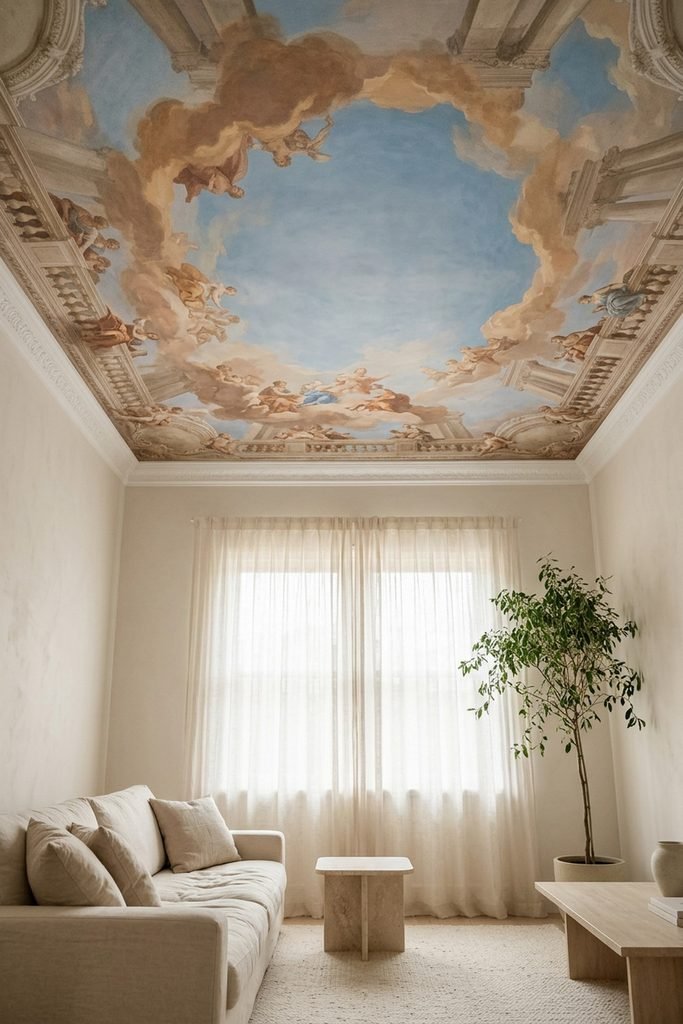
Below, a low cream sofa, sheer curtains, and a small stone table keep the room from competing with the scene. A leafy tree can interrupt the pale walls with a simple organic shape. There is already plenty to study above, so a second gallery of elaborate artwork may be unnecessary.
Warm ochre and soft brown within the mural help it sit beside cream upholstery. Choose an original or properly licensed composition, then review its crop at the ceiling’s proportions. This is printed wallpaper acting as ceiling art; the surrounding room can remain comfortable and current.
7. Scatter Soft Clouds and Yellow Stars Above a Pale Nursery
Clouds and butter-yellow stars give a muted teal ceiling a gentle rhythm. Make the clouds broad and rounded, with smaller stars scattered between them. The difference in scale leaves the illustration easy to read from across the nursery.
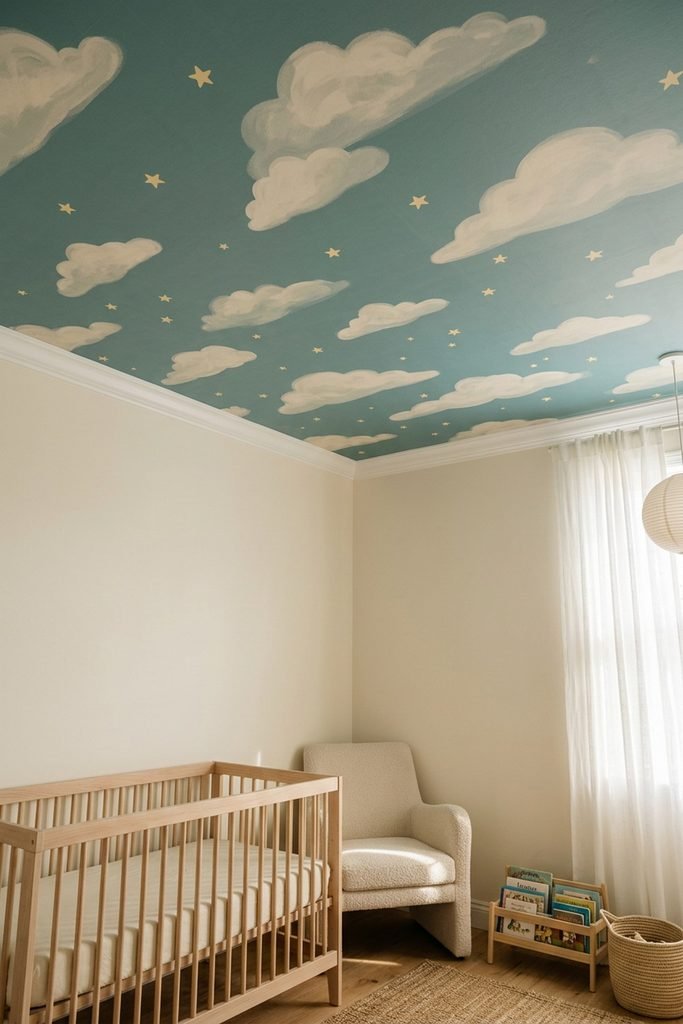
Cream walls and pale oak furniture let the cloud ceiling remain the playful surface. Rounded upholstery and a softly shaped pendant repeat its curves, while sheer curtains echo the pale cloud shapes. Books and toys can supply small amounts of color elsewhere rather than another wall-sized pattern.
Keep the decoration outside the crib itself. The CPSC recommends a bare sleep space with only a fitted sheet, so the ceiling can carry the storybook detail while the crib stays clear. A reading chair and woven basket provide enough texture around the quieter lower half of the room.
8. Bring a Deep Blue Galaxy Ceiling Into a Calm Bedroom
A galaxy ceiling needs a clear focus. One luminous nebula area, surrounded by darker blue and scattered stars, gives the room more direction than several oversized celestial objects competing overhead. Let the brightest portion lead the eye through the mural.
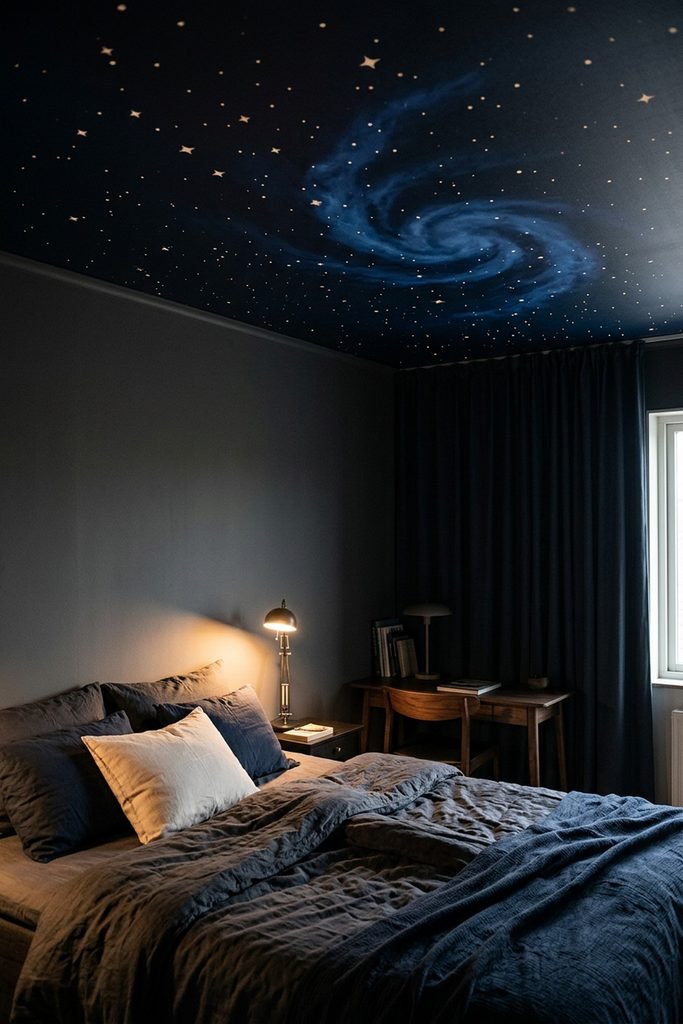
Charcoal walls and dark curtains can soften the boundary around that night-sky image. Linen bedding keeps the lower part of the room tactile, while a warm reading lamp introduces a small contrast to the cobalt and navy above. A few books and an understated desk are enough to make the bedroom feel lived in.
The stars are part of the printed artwork; their appearance does not establish a lighting effect. For an adult bedroom, the strongest choice may be to let that single overhead scene carry the theme, with the furnishings staying familiar and restrained.
Graphic Wallpaper That Follows the Architecture
Frames, beams, and fixture positions can shape where a print begins, ends, or changes direction.
9. Frame Pale Medallion Wallpaper With Cream Molding
Delicate medallions bring detail to a ceiling without requiring strong color contrast. Fine pale blue and muted gold lines can repeat across an ivory ground, bordered by cream molding. The ornament stays intricate, but the overall color field remains light.
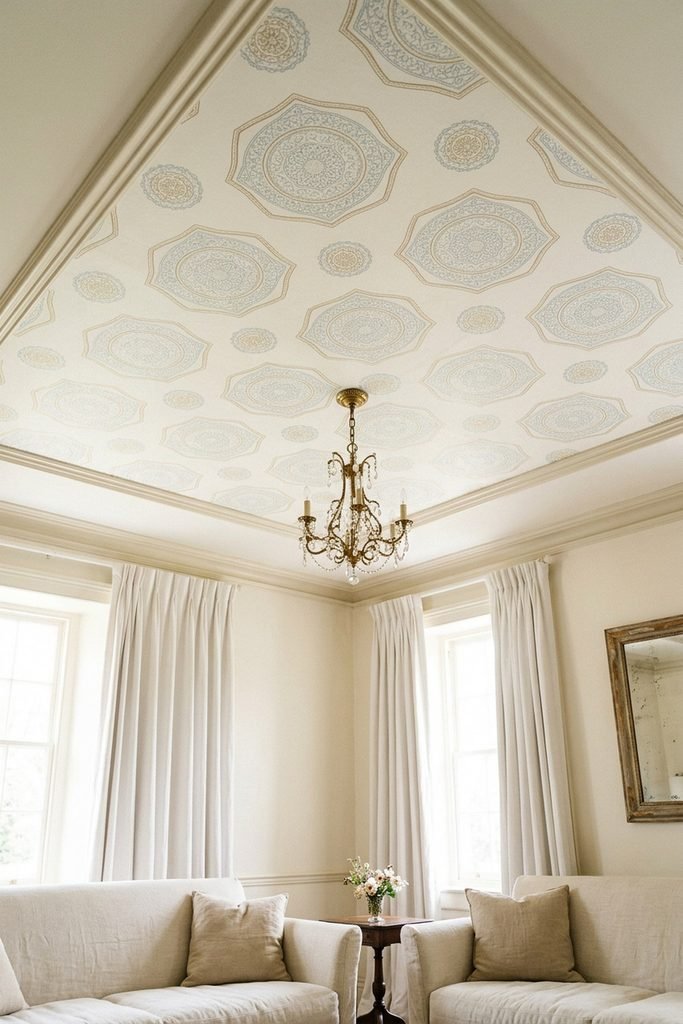
Plain curtains and linen seating give the small pattern room to register. A compact brass chandelier repeats the warmer lines overhead without covering a large portion of the print. The same restraint works for a mirror or a small flower arrangement below.
This treatment relies on an orderly repeat and a clear edge. Consider how complete medallions will sit against the border rather than treating the paper as a pattern that can be cropped anywhere. Existing shallow molding can provide the frame; the room does not need a more elaborate ceiling structure.
10. Fill Dark Beam Bays With Black-and-White Botanical Wallpaper
Existing beams already divide a ceiling into separate fields. Filling those spaces with black-and-white botanical wallpaper makes the structure part of the decorating scheme. Fine dark stems relate to the beams, while the ivory background keeps each bay from reading as a solid dark panel.
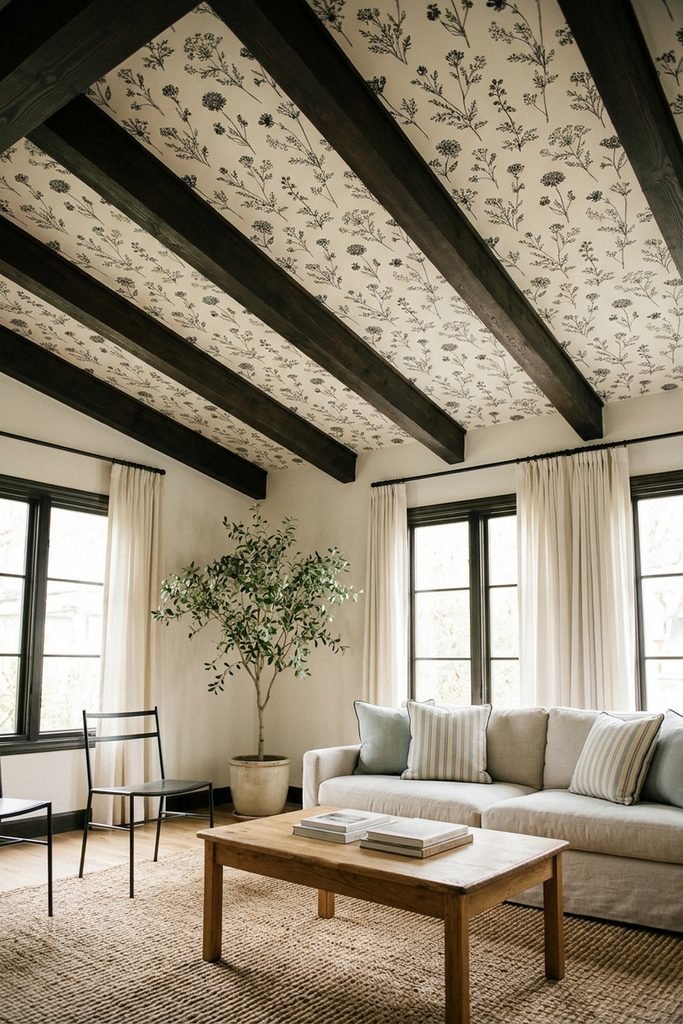
The size of the flowers should make sense within those individual spaces. A print chosen only for its appearance on a large sample may lose its shape when divided among narrow bays. Look at the motif beside the actual beam spacing.
Below, slim black furniture outlines can repeat the grid more lightly. Linen seating and a woven rug add softer surfaces, and a low oak table gives the room a broad, simple anchor. Leave the beams exposed so the relationship between the print and its frame remains clear.
Compare Botanical Prints for the Beam Bays
Look for black-and-white botanical patterns with a motif size that works within your bays, and confirm the paper’s ceiling suitability before ordering.
11. Set Black-and-Gold Marble-Effect Wallpaper Inside a White Frame
Black-and-gold marble-effect wallpaper is strongest when its veins have room to travel. A broad sweep across a charcoal field gives the ceiling one large movement. Many tiny veins would create a busier surface with less of that expansive shape.
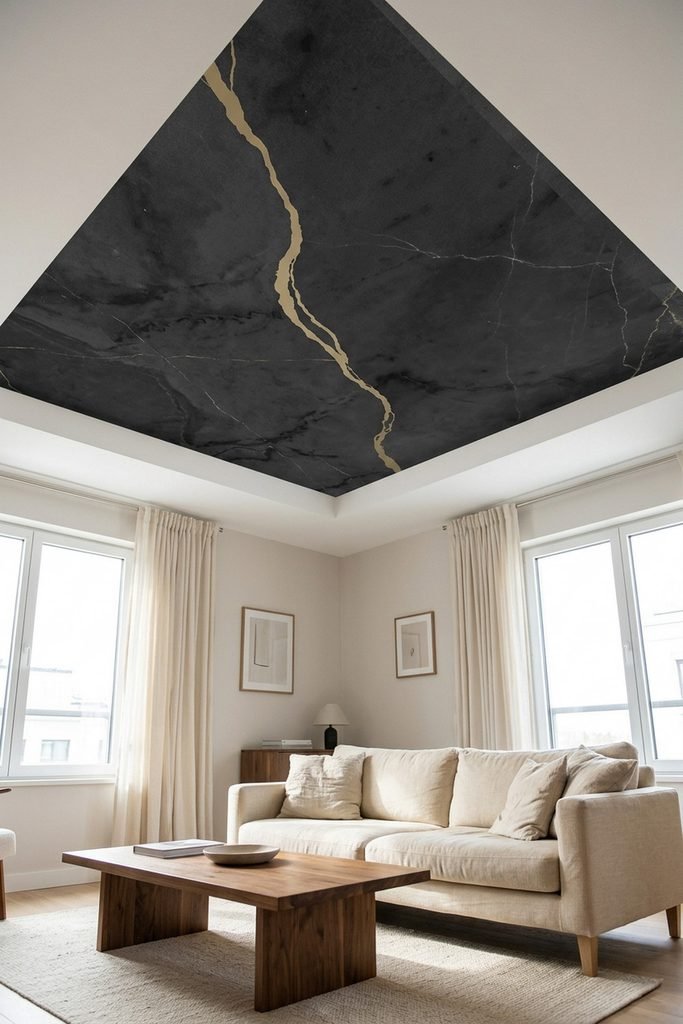
A clean white frame separates the dark inset from the walls. Cream seating continues the lighter surroundings below, while a low walnut table gives the room another substantial shape without repeating the ceiling’s pattern. Plain cushions allow the mineral image to remain the most active surface.
Choose the mural crop with the whole inset in mind, especially where its largest vein will begin and end. The gold is a printed color unless the selected material specifies another finish. The look does not require a real stone ceiling or an added metallic effect.
12. Radiate Multicolor Ceiling Stripes From a Simple Pendant
The point where the stripes meet is the defining decision in this bedroom. Coral, ochre, blue, green, and cream wedges radiate from the pendant canopy, turning a rectangular ceiling into a single graphic composition.
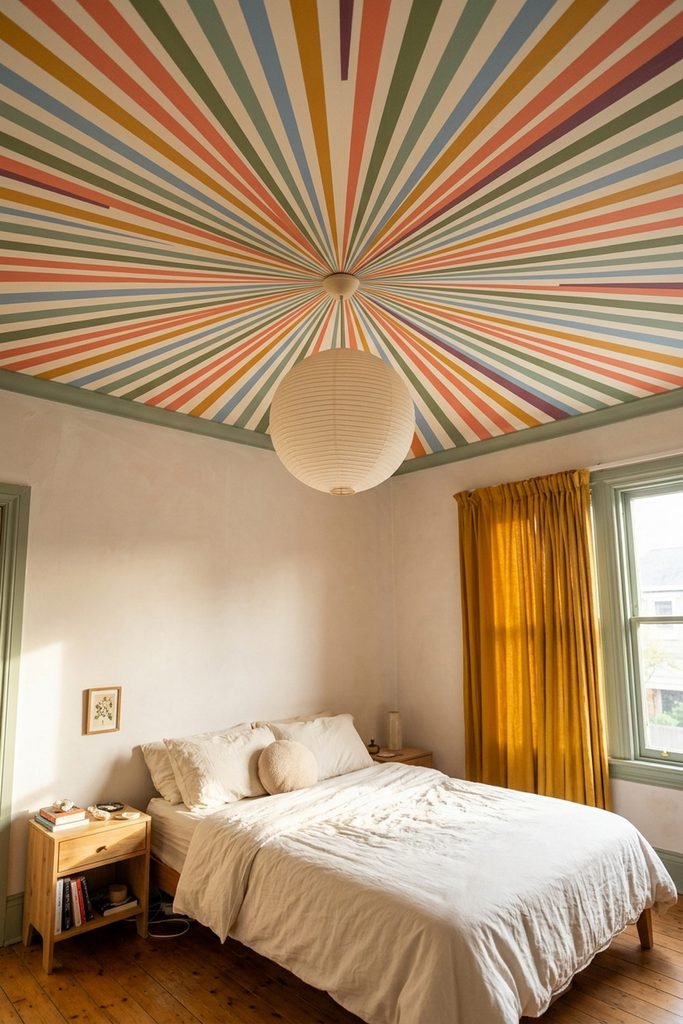
A paper globe gives that busy center a simple shape. Muted green trim can pick up one of the stripe colors around the room’s edge, while a yellow curtain carries another into a larger fabric surface. The bed can stay mostly plain, with a rounded cushion or a botanical picture contributing smaller details.
Soft cotton bedding matters here because it gives the sharp geometry a more relaxed setting. Plan the radial artwork around the actual fixture position; ordinary parallel-striped wallpaper will not create the same convergence. Repeating only a few of the colors below lets the ceiling keep its lively range without asking the entire bedroom to match it.
Wallpaper Placements That Define a Room Zone
A limited wallpaper area can give a bed or dining table its own place within a larger room.
13. Fold a Bed-Width Wallpaper Canopy Down the Headboard Wall
A bed can have a visual canopy made entirely from wallpaper on the existing surfaces. Picture a botanical panel behind the headboard that continues across the ceiling directly above it. The panel stays roughly aligned with the bed’s width, with plain wall and ceiling visible on either side.
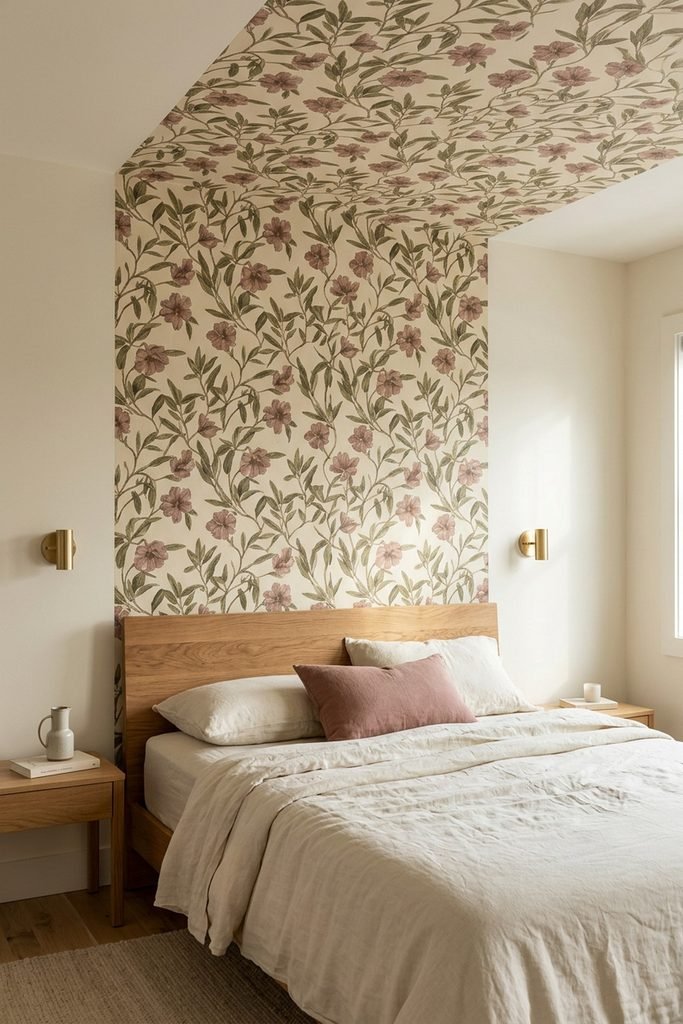
That connected corner is what gives the arrangement its shape. The eye follows the print up the wall and overhead, so the sleeping area reads as one sheltered zone. In a studio, this can mark the bed’s place while leaving the rest of the room open. Broader small bedroom style ideas can help guide the furniture around it.
An ivory ground with muted olive leaves and dusty rose flowers pairs naturally with oak and plain linen bedding. Keep the headboard low enough for the wall portion of the pattern to remain visible. Small wall lights can sit outside the strongest motifs.
The artwork needs a coordinated layout across both planes. Ask the supplier and installer to plan how the image meets at the corner; visual continuity does not require one uncut sheet. A plain margin beside the panel keeps its bed-width shape readable.
14. Turn a Wallpaper Ribbon From the Entry Toward the Dining Table
In an open layout, a ceiling pattern can connect the route into the room with the place where you stop. Imagine a narrow wallpaper ribbon above the entry that makes a right-angle turn, then widens into a larger field over the dining table. Plain ceiling surrounds the entire shape.
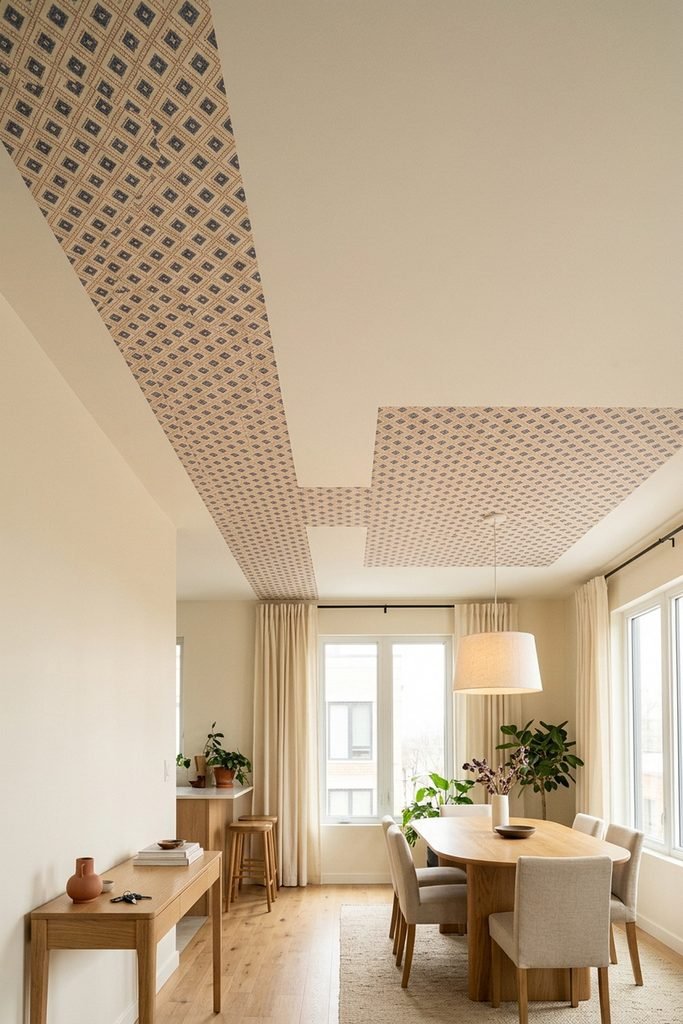
The change in width gives the arrangement its purpose. The narrow section follows circulation, while the wider end marks the dining area. Positioning the table beneath that endpoint helps the ceiling treatment relate to the furniture. These living room and dining room layout ideas offer more context for arranging the adjoining spaces.
A small geometric print in ivory, muted indigo, and terracotta keeps the route readable. Oak furniture and linen seating can remain simple, with one pendant centered over the wider dining section. Several separate patterned rectangles would lose the sense of a continuous path.
This proposal needs a suitable continuous ceiling plane and a measured custom layout. A shorter entry leg can adapt it to a compact room while retaining the turn and wider endpoint. Confirm the printed joins and edges with the supplier before committing to the shape.
Before You Choose Ceiling Wallpaper
Look at the paper’s technical guidance as closely as its pattern. Ceiling suitability is product-specific: some manufacturers exclude their peel-and-stick wallpaper from ceiling applications, while others list ceilings among uses for specific removable panels. The label “removable” alone does not settle the question.
The ceiling’s condition matters, too. Manufacturer ceiling guidance calls for a smooth, clean, dry surface. Have the chosen material and preparation assessed for your actual ceiling rather than expecting a print to conceal every defect.
Then review the layout: the direction of a repeat, the largest flower or bird, the clear center of a mural, and the position of existing fixtures. A sample helps you judge color; a layout proof helps you judge where the image will land. For radial stripes, a floral border, or a connected wallpaper zone, confirm the custom crop and panel arrangement before ordering. These choices protect the look you liked in the first place.
Choose the Ceiling Look That Belongs to Your Room
Begin with the relationship you want to emphasize: flowers against solid blue walls, pale ornament within cream molding, or a printed path above a dining nook. Let that choice guide the colors and textures below. One clear ceiling treatment, supported by a few thoughtful repeats around the room, can give the whole space a stronger visual direction.