





24 Ceiling Ideas That Make the Fifth Wall Worth Saving
The most compelling ceiling ideas give you a reason to look up, then make sense of everything below. A botanical print can lend direction to a pale sitting room. A wood grid can connect an open layout. Even one deep green plane can change how cream upholstery and walnut furniture read together.
Table Of Content
- Painted and Reflective Ceilings That Set the Mood
- 1. Paint a Flat Ceiling Deep Green Above Warm White Walls
- 2. Wrap a Terracotta Ceiling Ribbon Around an Existing Beam
- 3. Give a Narrow Hallway a Burnished Bronze Ceiling
- 4. Make a Mineral-Swirl Ceiling the Bedroom’s Main Artwork
- Wallpaper and Murals That Transform the Fifth Wall
- 5. Frame Botanical Ceiling Wallpaper With Cream Molding
- 6. Cover a Pale Living Room Ceiling With a Fine Geometric Repeat
- 7. Turn a Dark Reading Nook Into a Woodland Canopy
- 8. Carry Nursery Florals From the Ceiling Into a Crib Alcove
- 9. Scatter Oversized Blue Butterflies Across a Child’s Ceiling
- 10. Set a Soft Cloud Mural Inside an Ornate Ceiling Frame
- 11. Open a Living Room Up With a Bare-Branch Ceiling Mural
- 12. Turn a Recessed Ceiling Into a Quiet Starry Sky
- Molding and Ornamental Ceilings With Architectural Character
- 13. Outline an Ivory Ceiling With Raised Molding and a Soft Cove
- 14. Give a White Kitchen a Crisp Coffered Ceiling
- 15. Anchor a Dining Room With an Oversized Ornamental Medallion
- 16. Center a Moroccan-Inspired Ceiling Pattern Above Low Seating
- Wood, Beams, and Brick for Warm Overhead Texture
- 17. Warm an Open Living Area With a Timber Grid Ceiling
- 18. Extend a Wood Headboard Into an Illuminated Ceiling Canopy
- 19. Set a Warm Wood-Slat Inset Above a Stone Bathroom
- 20. Pair a Brick-Faced Vault With a Soft Dining Room
- 21. Set Embossed Ivory Panels Between Dark Ceiling Beams
- Sculpted and Soft Ceilings That Define a Room
- 22. Light a Sculpted Butterfly Ceiling Above a Cream Living Room
- 23. Drape a Small Bedroom Ceiling With Airy Patterned Fabric
- 24. Float Staggered Felt Waves Above a Curved Dining Nook
- What to Check Before Choosing a Ceiling Treatment

These 24 looks explore color, pattern, molding, texture, and light across different rooms. Look for the relationship you want to borrow: a framed focal point, a softer sleeping area, a richer hallway, or an overhead treatment that gives a dining nook its own place.
Quick Takeaways
- Decide whether you want to decorate the existing ceiling surface or add a treatment with physical depth.
- Relate the ceiling to a room anchor, such as a table, bed, seating area, or architectural opening.
- Repeat a few ceiling colors or materials below through furniture, textiles, or lighting.
- Give detailed ceilings enough quiet surrounding space; let richly layered rooms keep their depth.
- Check the actual material, attachment, lighting, and room conditions before committing to a ceiling treatment.
Painted and Reflective Ceilings That Set the Mood
Color and sheen can change the ceiling’s role while keeping its basic shape. These treatments range from one uninterrupted painted plane to a color route that follows an existing beam.
1. Paint a Flat Ceiling Deep Green Above Warm White Walls
A dark green ceiling gives a living room a distinct overhead color while warm white walls keep the surrounding space light. Choose an emerald shade with enough depth to stand beside walnut furniture, then soften the lower half of the room with a cream linen sofa and a broad woven rug.
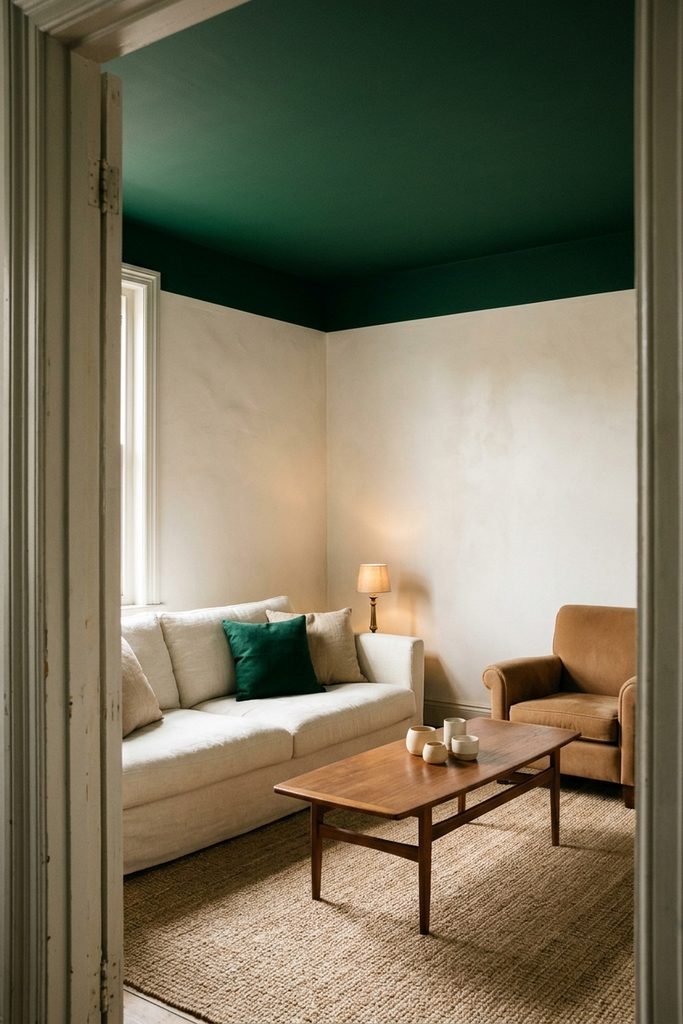
The contrast works best when green has a clear boundary. A crisp edge where ceiling meets wall lets the entire painted plane read as one feature. Repeating the shade in a single cushion carries it into the seating area without surrounding the sofa in matching accessories.
Caramel leather or upholstery can bridge the green and walnut. Check the ceiling color in daylight and under your evening lamps; the shade you enjoy overhead should work with both.
2. Wrap a Terracotta Ceiling Ribbon Around an Existing Beam
An awkward bulkhead can become the most distinctive part of the room when color follows its actual shape. Imagine a broad terracotta band crossing the upper ceiling, continuing down the beam’s face and across its underside, then resuming on the lower ceiling plane above a dining table.
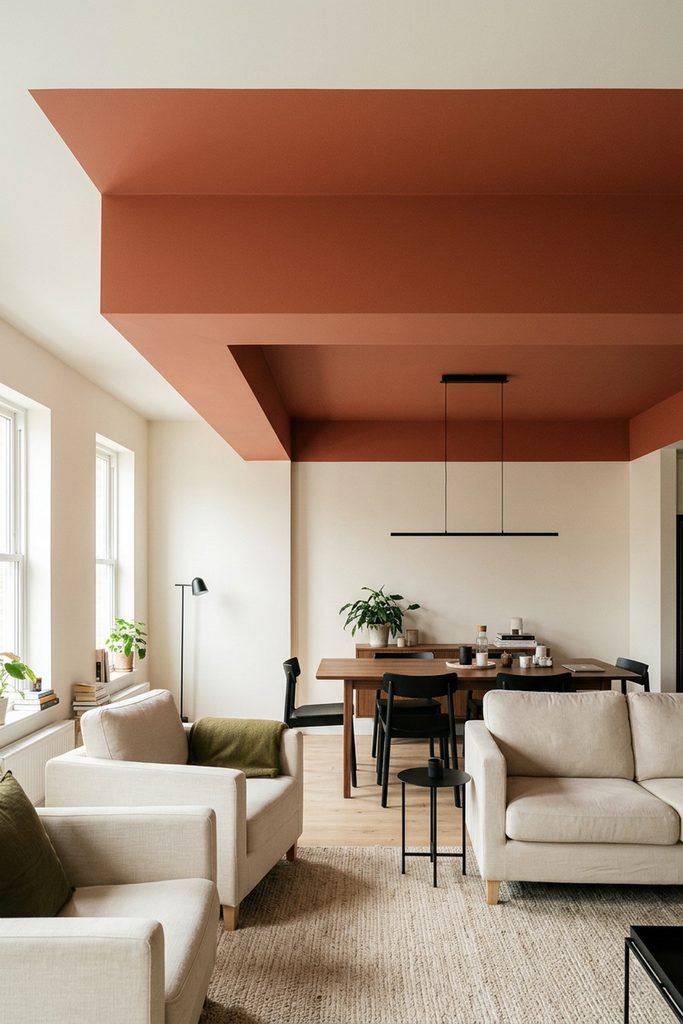
That continuous route makes the level change look like a fold in the color. The table gives the band a destination, so it feels connected to the layout rather than placed overhead at random. Warm white around the ribbon keeps its edges readable; walnut furniture and an olive accent give the earthy shade company below.
Keep the change in height visible. The appeal comes from seeing the color travel over several real surfaces, including the beam’s face and underside. A narrower band can preserve that relationship in a smaller room.
This proposed treatment uses the existing architecture. Have the painted route mapped to the room’s actual surfaces, with the beam and any required access points intact.
3. Give a Narrow Hallway a Burnished Bronze Ceiling
Bronze overhead can make a passage feel like a small, richly finished room. A burnished-looking surface catches the glow of glass lanterns, while cream crown molding gives the dark ceiling a clean edge.
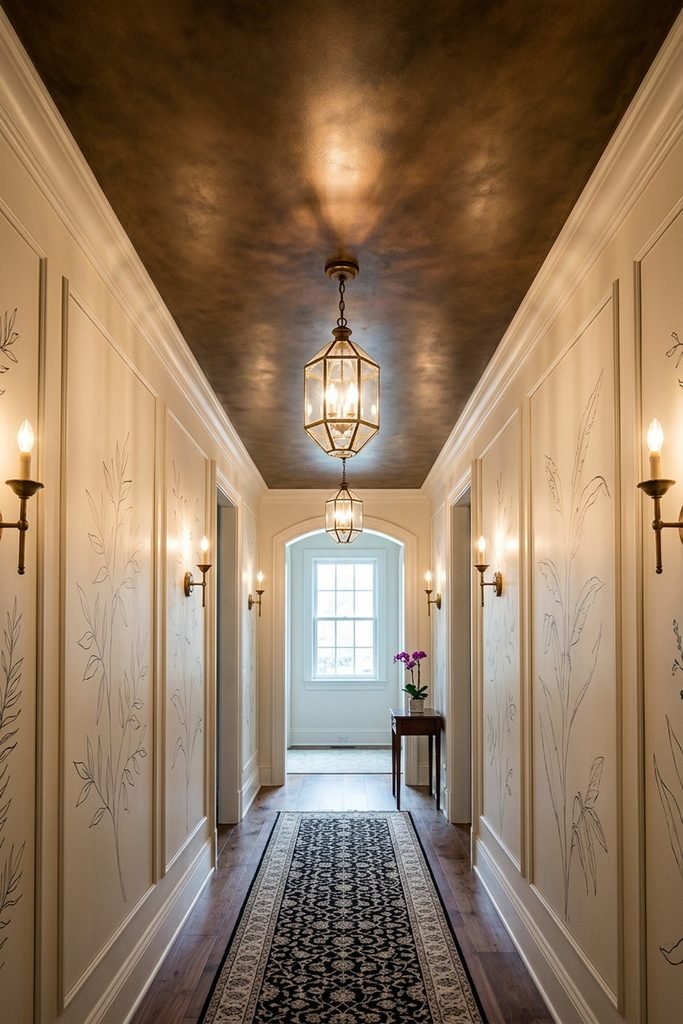
Restraint in the finish matters. Soft, uneven reflections suit this look better than a mirror-like surface competing with every object below. Repeated lanterns establish a rhythm along the hall, and a black-and-ivory runner carries that rhythm toward the far doorway.
Walnut flooring and aged brass sconces keep the palette warm. One flowering accent near the end introduces a small color surprise without interrupting the long view. Ask for a sample of the proposed ceiling finish so you can judge its sheen beside your actual lights and trim.
4. Make a Mineral-Swirl Ceiling the Bedroom’s Main Artwork
Let a sweeping gray spiral do the work usually given to a large painting. Across a bedroom ceiling, a mineral-like swirl introduces movement that feels especially striking beside straight bedding edges and a neatly gridded wall.
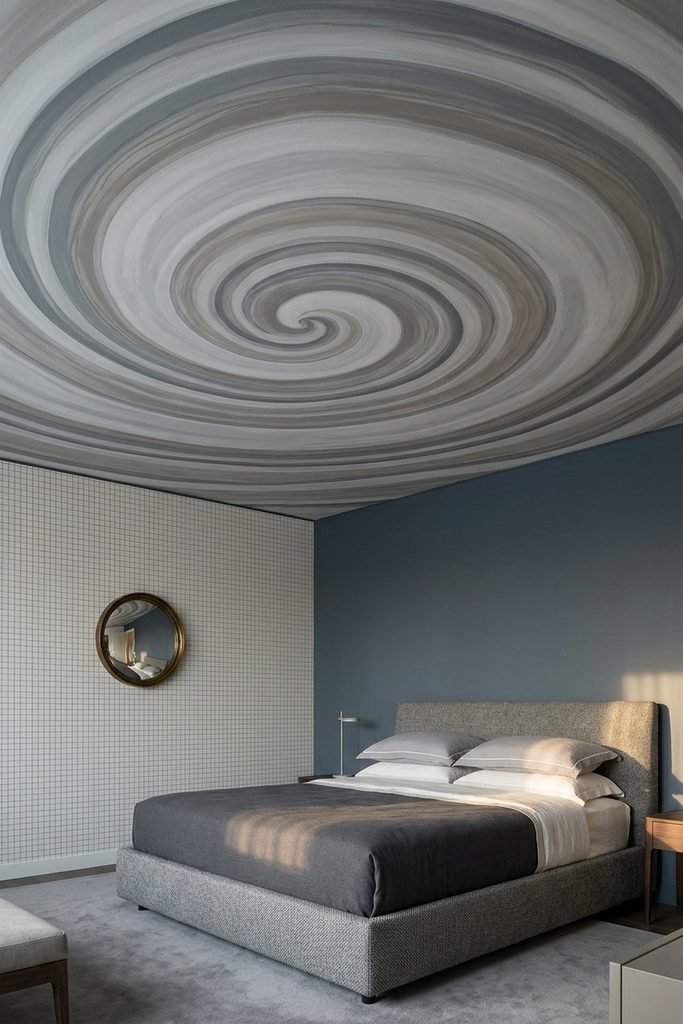
Slate blue provides a grounded backdrop for pewter, chalk gray, and charcoal. Keep the bedding mostly solid so the eye can follow the broad curves overhead. A smaller round mirror offers a quiet echo of the spiral; several circular accessories would dilute that relationship.
The surface can be a specified printed or decorative finish that suggests mineral texture. Its appeal comes from scale and movement, so there is no need to assume actual stone or exposed concrete. Soft woven upholstery and a plain rug keep the bedroom comfortable beneath such a strong focal point.
Wallpaper and Murals That Transform the Fifth Wall
Pattern overhead can feel airy, immersive, playful, or romantic. The scale of the imagery, the surrounding border, and the room’s quieter surfaces determine how much attention it receives.
5. Frame Botanical Ceiling Wallpaper With Cream Molding
A framed botanical inset gives floral wallpaper a clear place to live. Pale blue, moss, dusty rose, and muted gold can spread across the ceiling while an ivory molding border separates the print from the rest of the room.
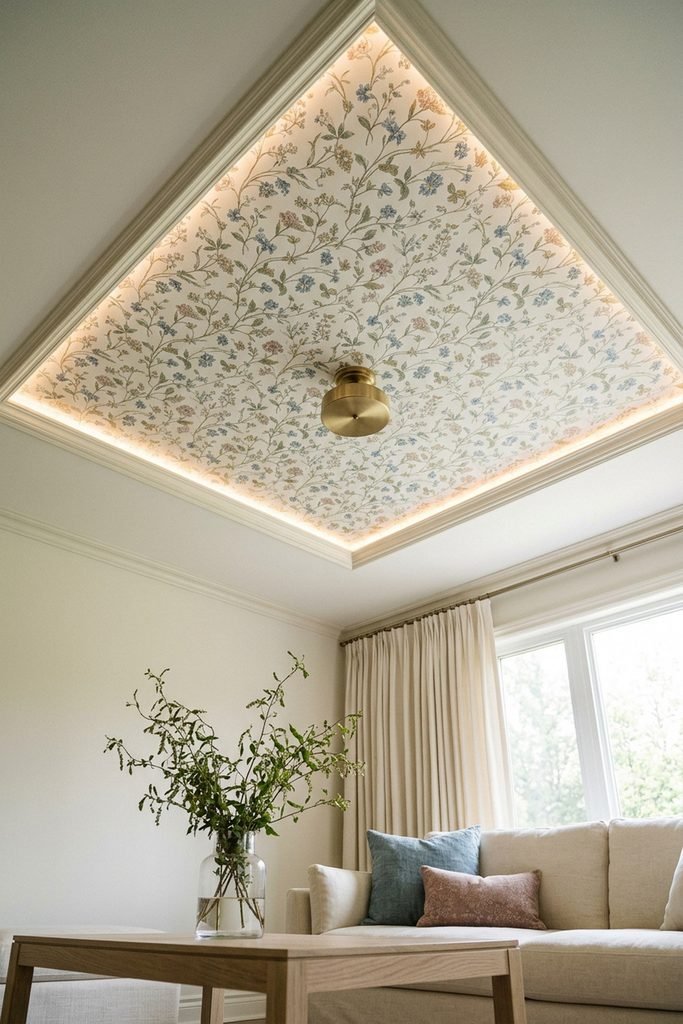
That frame is especially useful above plain cream seating. Linen and pale oak let the finer leaves and flowers remain visible, while a small brass fixture picks up the print’s warmer notes. Pull one soft color into a cushion rather than repeating the entire pattern throughout the room.
A branch-filled vase can echo the wallpaper’s movement at eye level. Keep its arrangement loose and the surrounding curtains quiet. If you include concealed perimeter lighting, let it reveal the edge of the inset gently; the botanical field should remain the feature that catches your attention.
Find a Soft Botanical Print
Look for pale blue botanical patterns with muted green or rose details to complement the cream frame and quiet upholstery.
6. Cover a Pale Living Room Ceiling With a Fine Geometric Repeat
Fine geometry can give an entire ceiling texture without introducing a large, dominant picture. A small gray-blue repeat against ivory feels particularly graceful in a room with tall windows, plain curtains, and oatmeal upholstery.
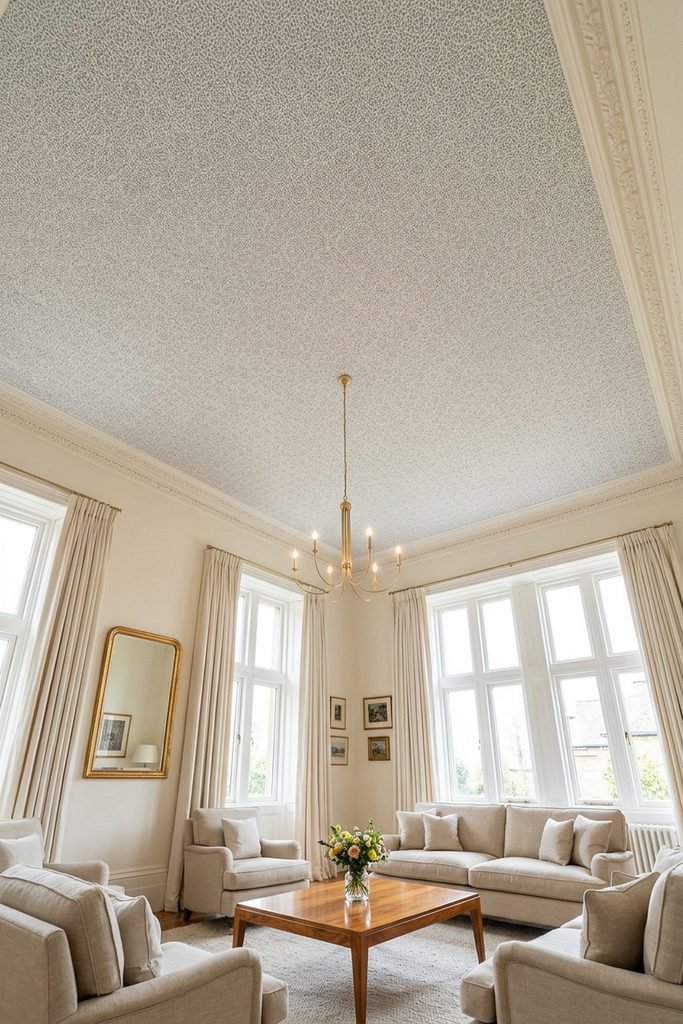
Here, consistency carries the effect. An uninterrupted pattern field makes the ceiling feel considered from one side of the room to the other. The cornice provides a strong outer boundary, while the smaller repeated shapes supply the detail within it.
Keep the chandelier slender enough that the pattern remains visible around it. A little gold in the light fixture or mirror can warm the pale palette. Wallpaper and decorative ceiling panels can create different versions of this look; their suitability and pattern alignment need to be planned for the selected system.
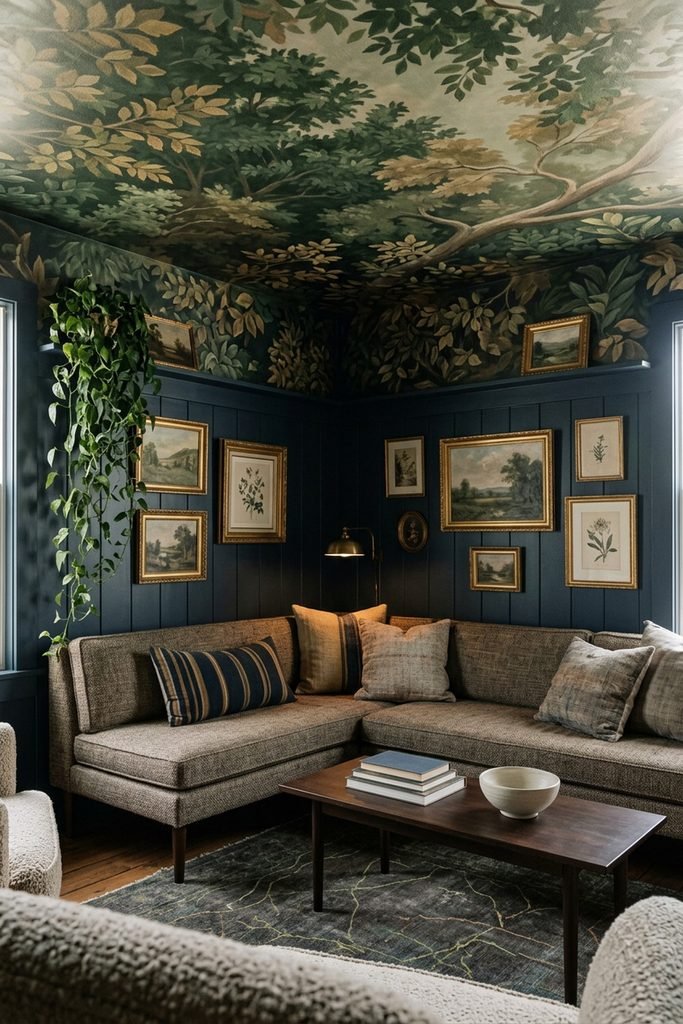
7. Turn a Dark Reading Nook Into a Woodland Canopy
An inky reading corner can carry more visual abundance than a bright, open sitting room. Deep navy paneling and a dark upholstered banquette give leafy woodland imagery a place to unfold overhead, with forest green and muted ocher adding depth to the canopy.
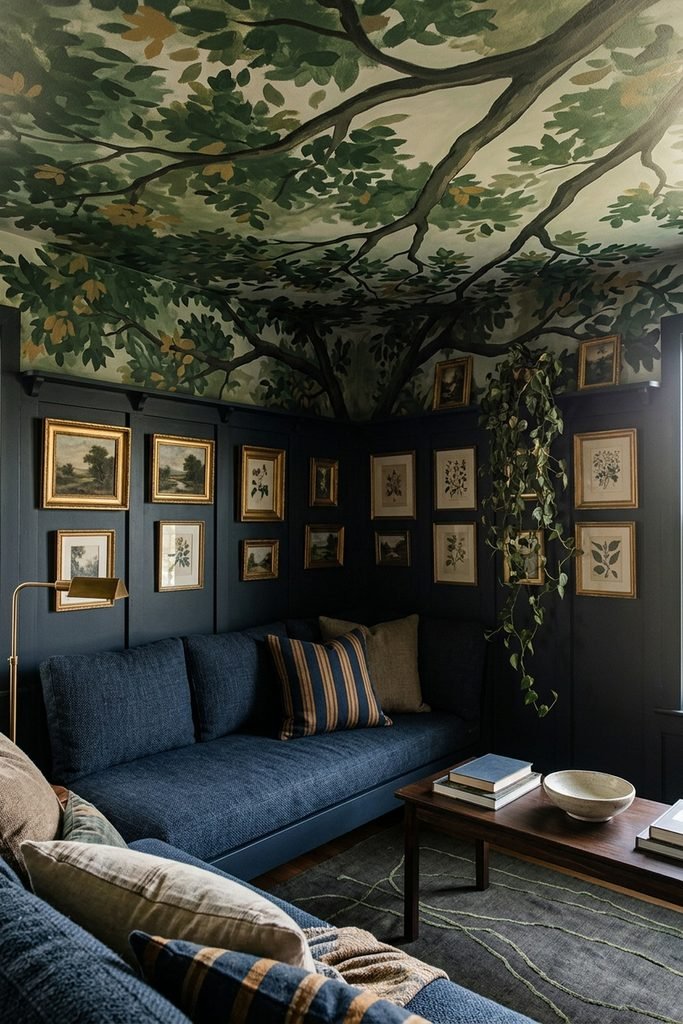
A collected gallery wall belongs in this version. Antique gold frames introduce small warm edges against the navy, and their varied sizes keep the arrangement from feeling overly formal. Leave some dark wall visible between them so the pictures retain their individual shapes.
One striped cushion gives the seating a simpler pattern beside the leaves and art. Trailing greenery can extend the woodland feeling, while a low table needs only a few books and a clear spot for a cup. Include a useful reading lamp: the ceiling creates the atmosphere, but the chair still needs light where you open a book.
Build the Gallery-and-Stripe Layer
Antique gold frames and a navy striped cushion carry the collected feeling from the woodland ceiling into the reading corner.
8. Carry Nursery Florals From the Ceiling Into a Crib Alcove
Matching botanical wallpaper on the ceiling and inside an arched crib backdrop creates a continuous decorated area. Blush ribbed paneling around the arch gives the fine floral lines a more substantial frame, while a white crib keeps the center of the room visually quiet.
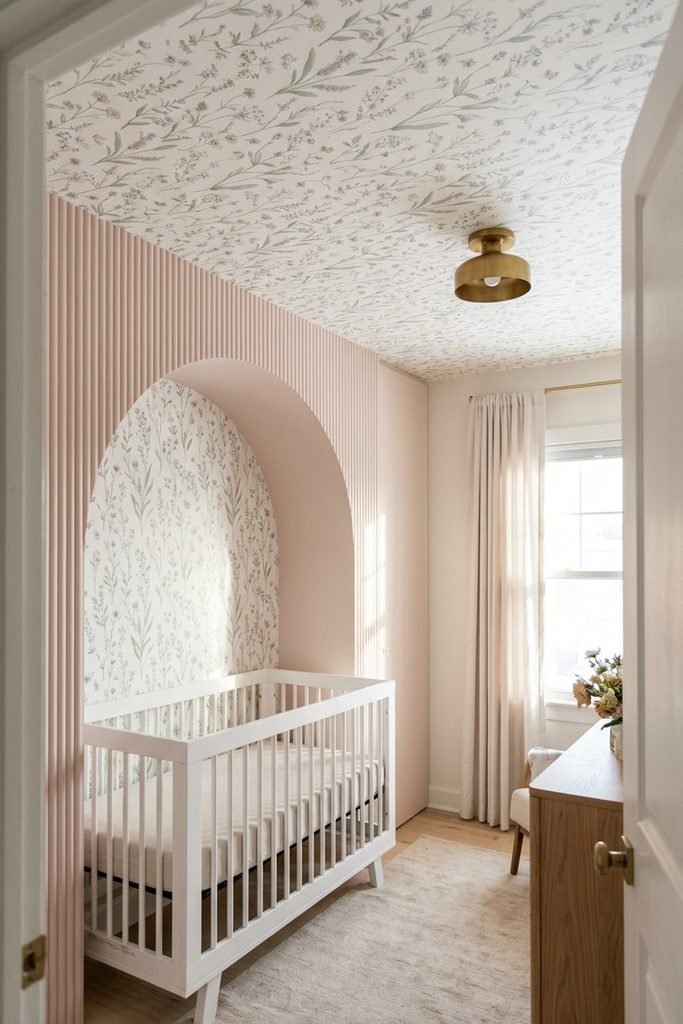
Sage and pale lilac can stay within the print, with pink carried into the surrounding wall finish. A restrained brass fixture adds a warm highlight above the softer colors. The effect depends on the ceiling and alcove being seen together, so avoid filling the backdrop with competing wall art.
Keep the sleep space separate from decorative styling. The CPSC recommends only a fitted sheet in a crib, with no pillows, blankets, bumpers, or toys. Flowers and other loose accents belong elsewhere in the room. For the surrounding palette, explore these baby girl nursery ideas.
9. Scatter Oversized Blue Butterflies Across a Child’s Ceiling
Large turquoise butterflies give a white ceiling movement through their shape and spacing. Vary their orientation so they appear to cross the room, with a few smaller silhouettes creating pauses between the larger wings.
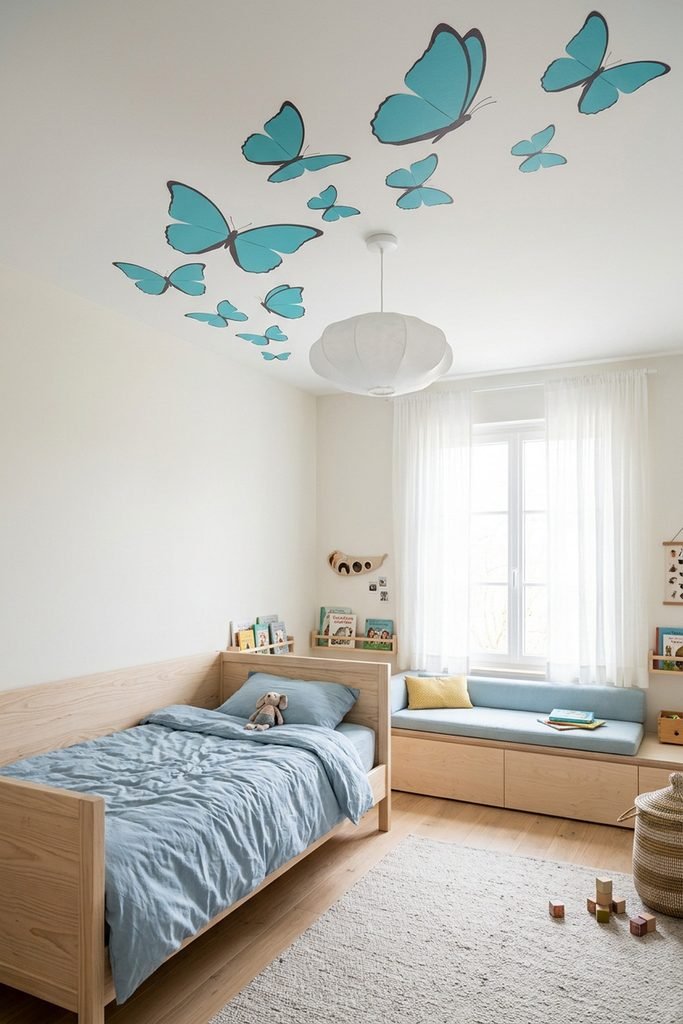
The white gaps are part of the design. They help each butterfly remain recognizable and prevent the ceiling from becoming a dense sheet of blue. Pale wood furniture, simple blue bedding, and a soft rug can carry the color into the room more quietly.
A diffused, cloud-like light fixture suits the airy effect. Keep the butterflies flush to the ceiling with a suitable, securely applied graphic treatment, so the visual movement comes from the arrangement itself.
Look for Flat Butterfly Graphics
Compare flat blue butterfly decals in varied sizes to preserve the white gaps and loose flight pattern overhead.
10. Set a Soft Cloud Mural Inside an Ornate Ceiling Frame
Hazy blue-gray clouds and crisp ivory molding make a compelling pair because their edges behave differently. The mural feels soft and atmospheric; the carved surround gives that softness a precise architectural boundary.
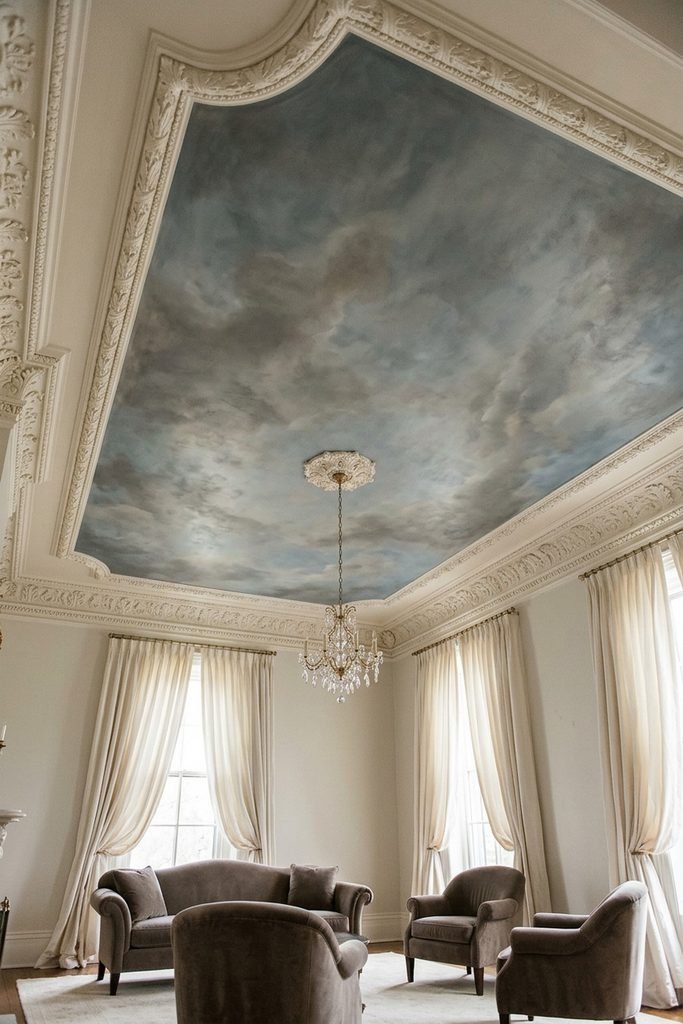
Choose a sky with gentle shifts in color rather than dramatic storm clouds. A muted field can suggest depth while still sitting comfortably above warm gray upholstery and subdued drapery. A crystal chandelier introduces small points of reflection through the center, leaving enough sky visible around it.
Let the ceiling frame carry most of the room’s ornament. Repeating equally elaborate patterns on curtains and large furnishings can make the sky feel crowded. Original or licensed mural artwork keeps the imagery appropriate for the project, and the light fixture needs its own suitable support.
11. Open a Living Room Up With a Bare-Branch Ceiling Mural
Bare branches can create an imagined view upward through a tree canopy. Dark limbs spread across a pale sky field, with finer twigs supplying detail between the broader lines.
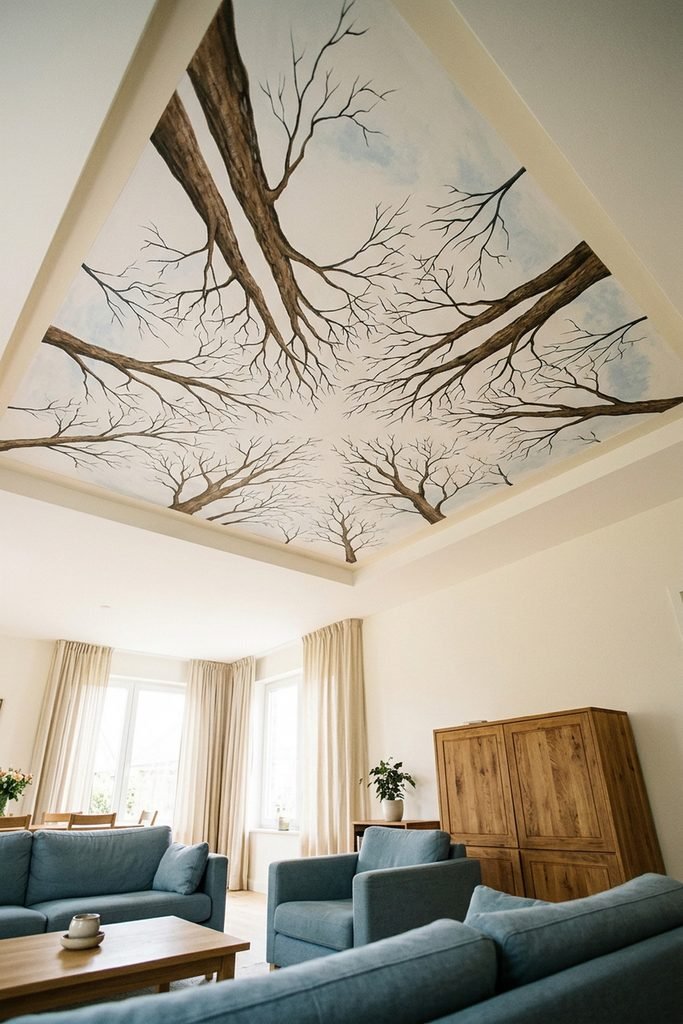
Scale makes this treatment convincing. The larger branches need room to travel across the overhead surface, while a quiet perimeter keeps the image from appearing abruptly cropped at every edge. Cream curtains and plain upholstery give the branching pattern space to remain legible.
Repeat the bark tones in one substantial wood piece, such as a cabinet or table. Additional botanical prints on every wall would compete with the canopy. A mural or professionally specified printed ceiling can provide the image treatment; this is a decorated indoor surface, with no claim of an actual opening to the sky.
12. Turn a Recessed Ceiling Into a Quiet Starry Sky
An indigo inset dotted with small stars can shift a familiar living room toward an evening retreat. The surrounding room can stay light, with ivory walls, warm gray seating, and a few small brass details.
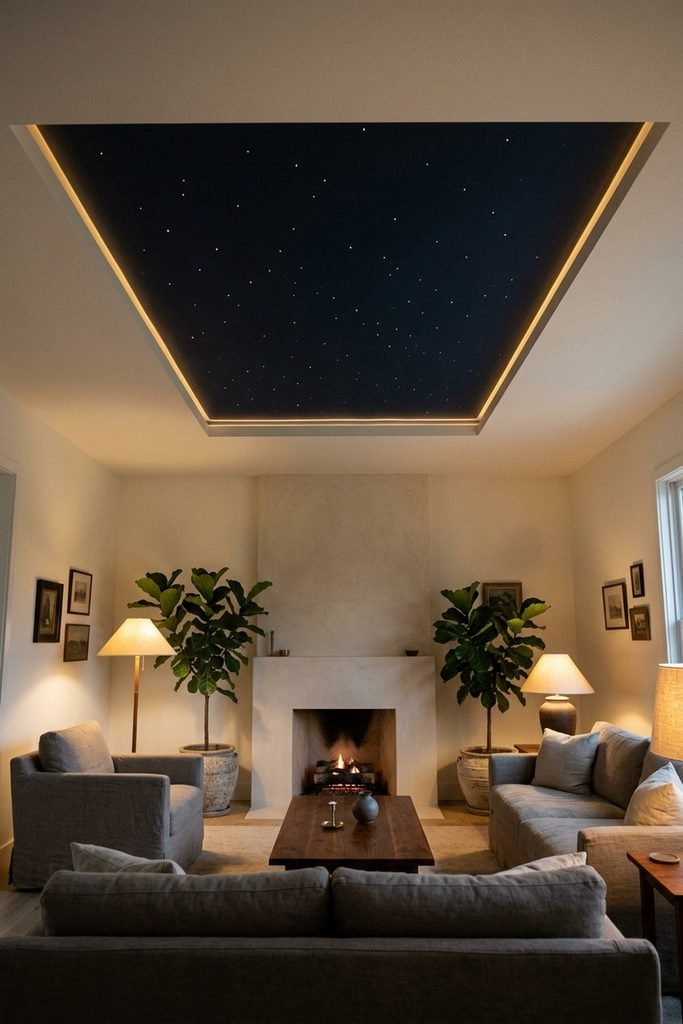
A thin warm border is the useful link between those two moods. It gives the cool night-sky field a gentle edge instead of leaving a sharply isolated dark rectangle above the furniture. Keep the stars small and their spacing varied, with enough dark space to appreciate the overall field.
A printed star surface and a professionally designed fiber-optic system are different ways to approach the appearance. Choose the route before planning the lighting and access. Low lamps around the seating area can support the evening atmosphere without filling the ceiling with competing bright points.
Explore Printed Night-Sky Patterns
For the printed version of this look, compare midnight-blue backgrounds with small scattered stars and plenty of open dark space.
Molding and Ornamental Ceilings With Architectural Character
Relief and framing give the ceiling shape as well as decoration. The depth of the treatment and its relationship to furniture help distinguish a quiet molded surface from a more substantial architectural grid.
13. Outline an Ivory Ceiling With Raised Molding and a Soft Cove
Ivory molding can create a detailed ceiling through shadow rather than strong color contrast. Shallow rectangles arranged around a central rosette give the surface order, while a softly illuminated perimeter draws a larger frame around the composition.
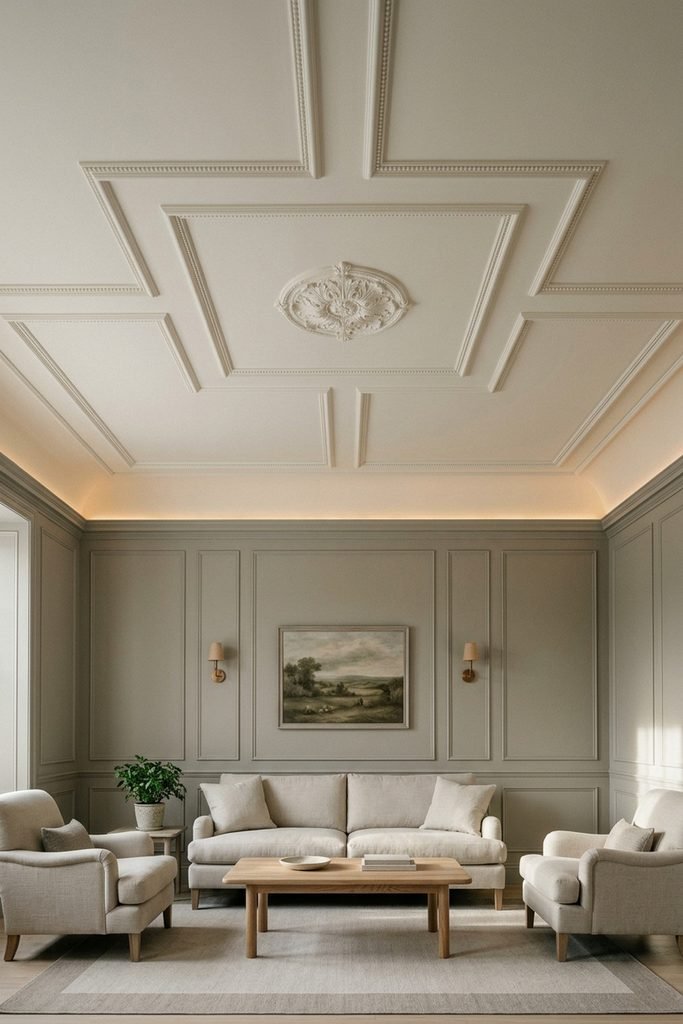
Keeping the relief close in color to the ceiling lets the room remain calm. Greige upholstery, a wood coffee table, and a small landscape painting provide enough variation below. Fine beaded edges become more noticeable because the larger furnishings are simple.
This treatment has a shallower visual character than deep coffering. Its depth and lighting details should respond to the actual room, with access to concealed fittings planned from the beginning. For more room-specific inspiration, see these luxury ceiling ideas for the living room.
14. Give a White Kitchen a Crisp Coffered Ceiling
A coffered ceiling feels especially convincing when its grid belongs to the kitchen below. The cabinet runs, island, and hood provide strong lines to work with, so the recessed boxes should feel related to those larger elements.
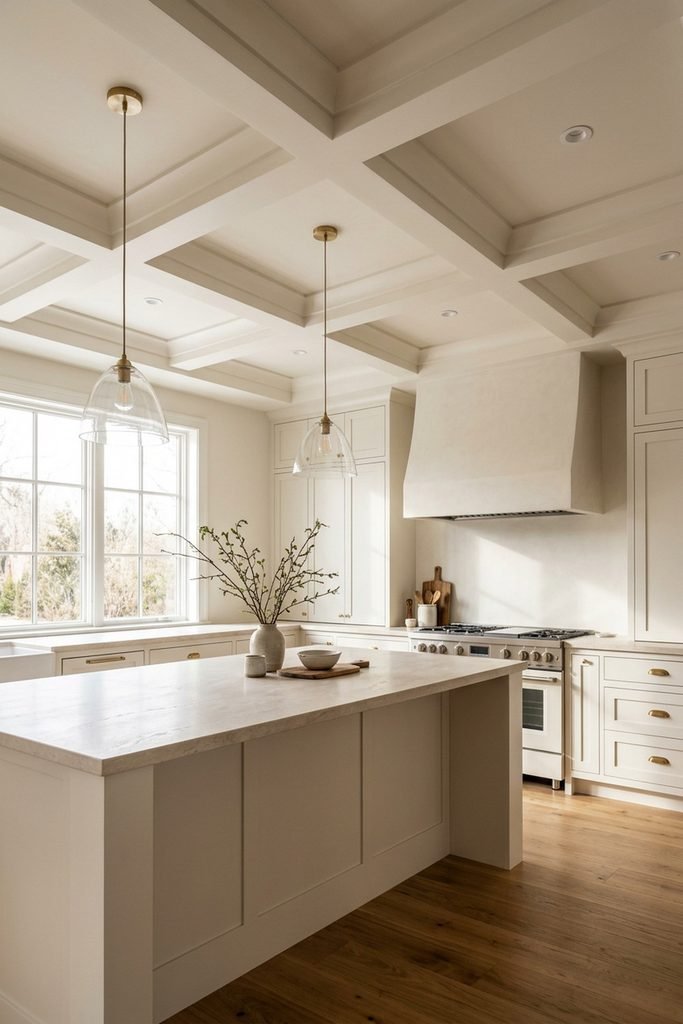
White paint keeps attention on depth and shadow. Clear-glass pendants leave more of the grid visible, and honey-toned flooring gives the otherwise pale room a warmer base. A few branches or a small countertop grouping are enough decoration beside such a defined ceiling.
Plan the grid as part of the whole kitchen composition. A coffer that appears awkwardly sliced by a hood or crowded against cabinet crowns can interrupt the rhythm. Ceiling height, ventilation, fixtures, and support all need coordination before the finished pattern is settled; the image alone cannot supply those dimensions.
15. Anchor a Dining Room With an Oversized Ornamental Medallion
A large ceiling medallion can give a relatively small pendant a generous architectural setting. In putty or warm ivory, the relief stays tonal, allowing its circular scale to stand out without adding another strong color.
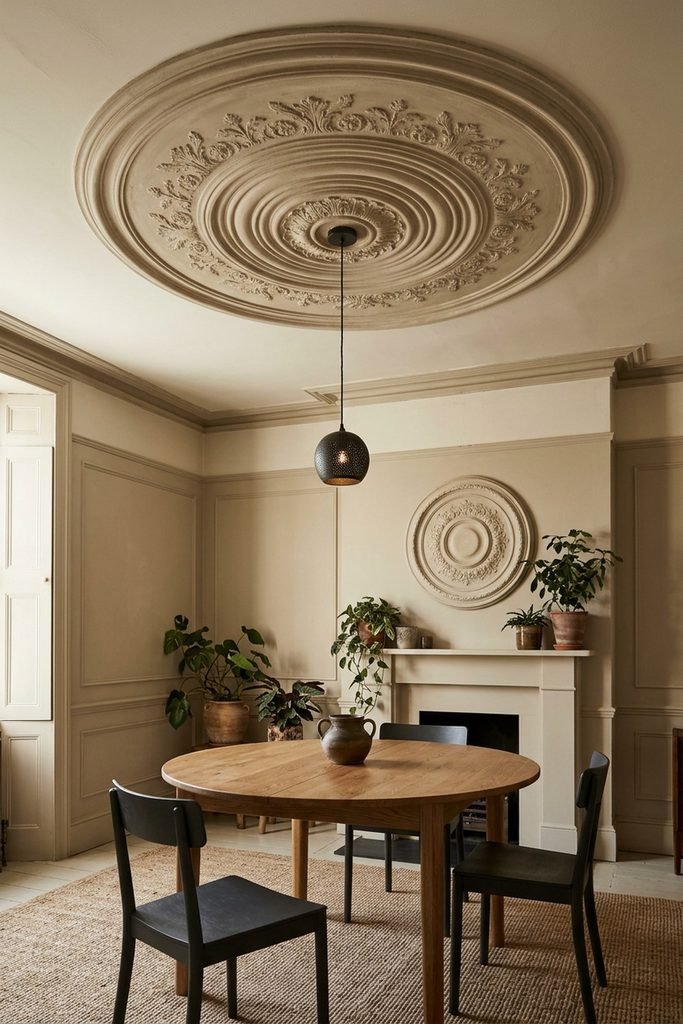
A round oak dining table repeats the shape below. That repetition connects ceiling and furniture, while a compact dark pendant sits between them as a smaller, more defined center. A woven rug and simple greenery can keep the surrounding room relaxed.
If you echo the medallion above a fireplace, make the wall version smaller and quieter. Matching both circles in scale would divide attention. The ceiling relief also needs an appropriate mounting system, and the pendant should be supported independently rather than treated as something the medallion can carry.
Compare Ornamental Ceiling Medallions
Look for broad ornamental relief that can complement a small pendant and the round dining table below.
16. Center a Moroccan-Inspired Ceiling Pattern Above Low Seating
Low seating leaves an expansive view of a patterned ceiling, making the room feel arranged around conversation and ornament. Terracotta walls, tobacco tones, and a framed geometric field create a warm base, with faded saffron, olive, and burgundy appearing in smaller accents.

The plain border around the ceiling pattern gives all that detail a boundary. A central lantern and low table reinforce the middle of the room, while patterned sofas and cushions carry pieces of the geometry closer to eye level.
Choose a few motifs or colors to repeat below rather than matching every surface. Daylight through arched windows can help the layered textiles remain readable, with lanterns adding softer evening light. A quieter woven rug leaves room for the ceiling and cushions to carry the finer pattern. Keep the central table low enough that the seating still feels like one connected conversation area.
Wood, Beams, and Brick for Warm Overhead Texture
Texture changes how a ceiling relates to the room’s larger shapes. Open grids, continuous slats, curved vaults, and patterned infill each establish a different rhythm above the furnishings.
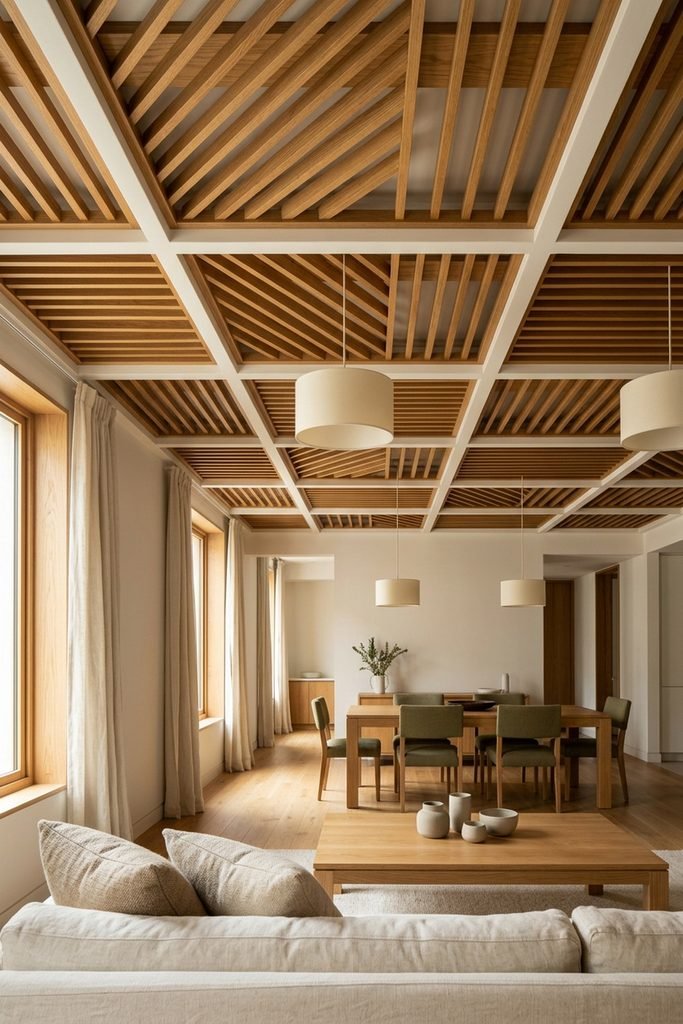
17. Warm an Open Living Area With a Timber Grid Ceiling
A timber grid can connect a living area and dining space through one repeated overhead pattern. Honey-toned slats against white framing create a clear rhythm, while open cells allow the ceiling behind them to remain part of the composition.
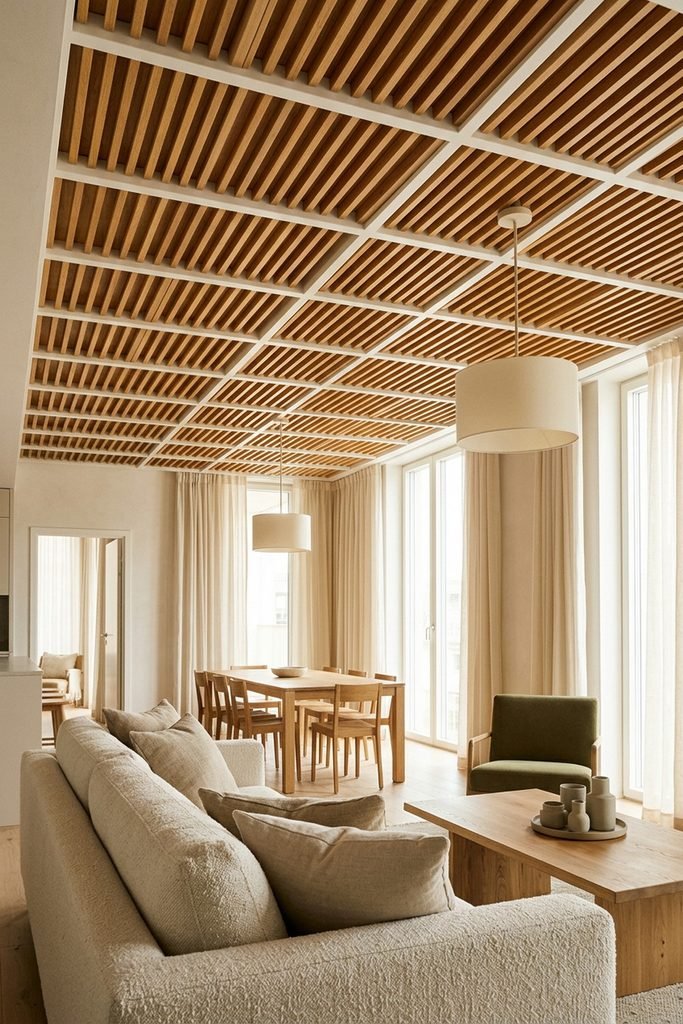
Align that rhythm with the room’s main axes. The grid should feel related to the length of the space and the furniture arrangement, with simple drum pendants leaving its geometry easy to see. Olive chairs and a cream sofa can keep the palette close to the wood and daylight beyond the windows.
Repeating a similar timber tone in the dining table carries the material below the ceiling. Keep shelf styling restrained so the lattice remains readable across the connected zones. The open cells should remain visible from the seating area; filling every bay with a pendant would interrupt the very rhythm that connects the room. A custom wood ceiling system still needs suitable attachment, headroom, and coordination with lighting and other services.
18. Extend a Wood Headboard Into an Illuminated Ceiling Canopy
The defining move here is the turn: narrow oak slats rise behind the bed and continue overhead, forming one connected frame around the sleeping area. The canopy feels more integrated when its rhythm matches the headboard wall.
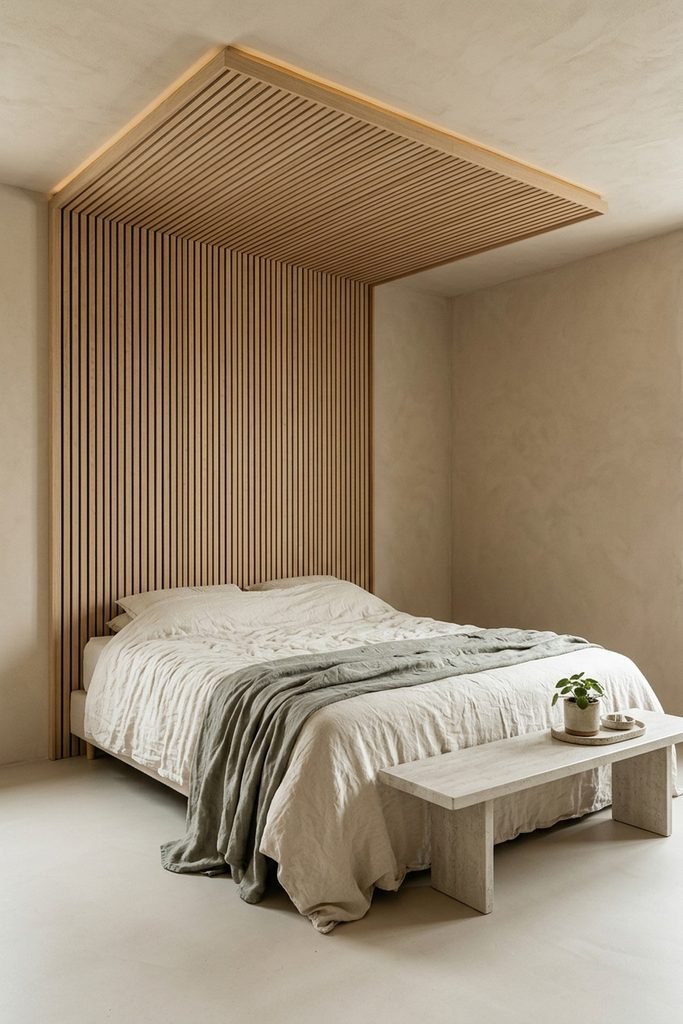
Sand-colored walls and ivory bedding keep the wood as the main architectural accent. Rumpled linen softens the precision of the slats, while a low pale bench and a small plant give the room enough detail without pulling attention away from the bed.
A discreet light reveal can outline the canopy’s edge. There is no need to repeat that glow beneath every nearby surface; one clear illuminated boundary is enough to explain the shape. Where height is limited, a shallower professionally detailed canopy can retain the wall-to-ceiling connection. Its support and lighting access need to be planned independently of the decorative slats.
19. Set a Warm Wood-Slat Inset Above a Stone Bathroom
Walnut-colored lines overhead can give a stone bathroom a warmer visual center. A long slatted inset repeats the dark vanity tones, while pale stone, a white freestanding tub, and black-edged shower glazing keep the surrounding surfaces distinct.
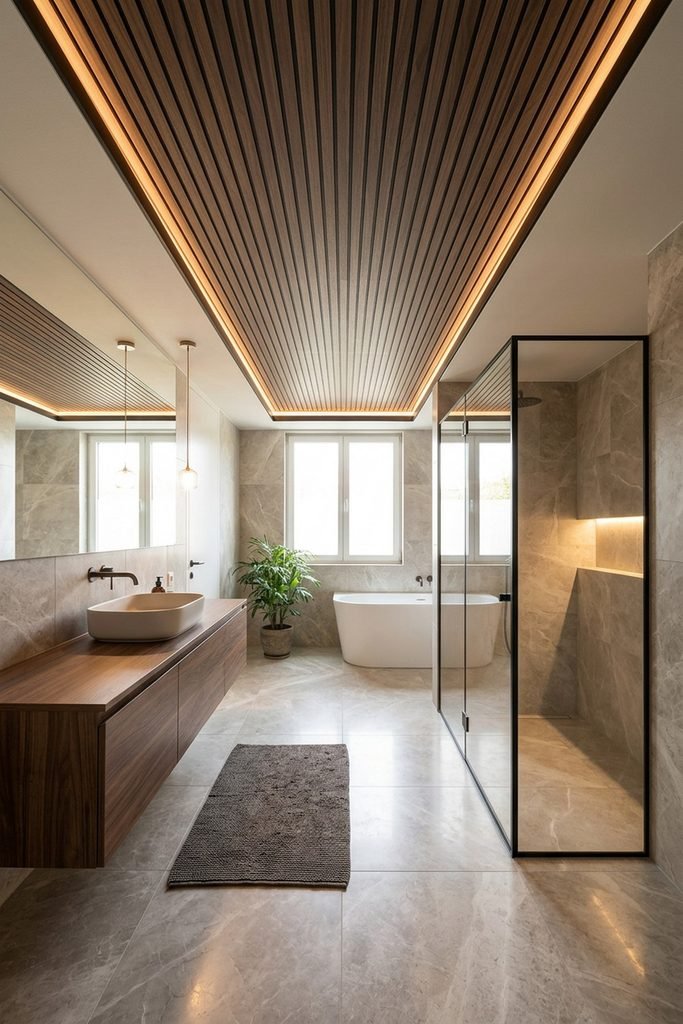
The material choice deserves particular attention in this room. Some manufacturers document woodgrain aluminum ceiling profiles for bathroom use, offering a route to the timber appearance. Have the actual finish and system approved for your bathroom conditions rather than assuming any wood-look panel is suitable.
Keep the slats parallel to the room’s length, with a controlled warm light border and clear task lighting at the vanity. One leafy plant can soften the hard surfaces. The ceiling will feel more connected when the rest of the bathroom decor repeats its walnut, ivory, and black palette selectively.
20. Pair a Brick-Faced Vault With a Soft Dining Room
Muted clay overhead gives a dining room texture that feels especially rich beside smooth cream arches. A brick-faced vault also introduces curvature, so the ceiling becomes part of the room’s enclosure rather than a flat decorative field.
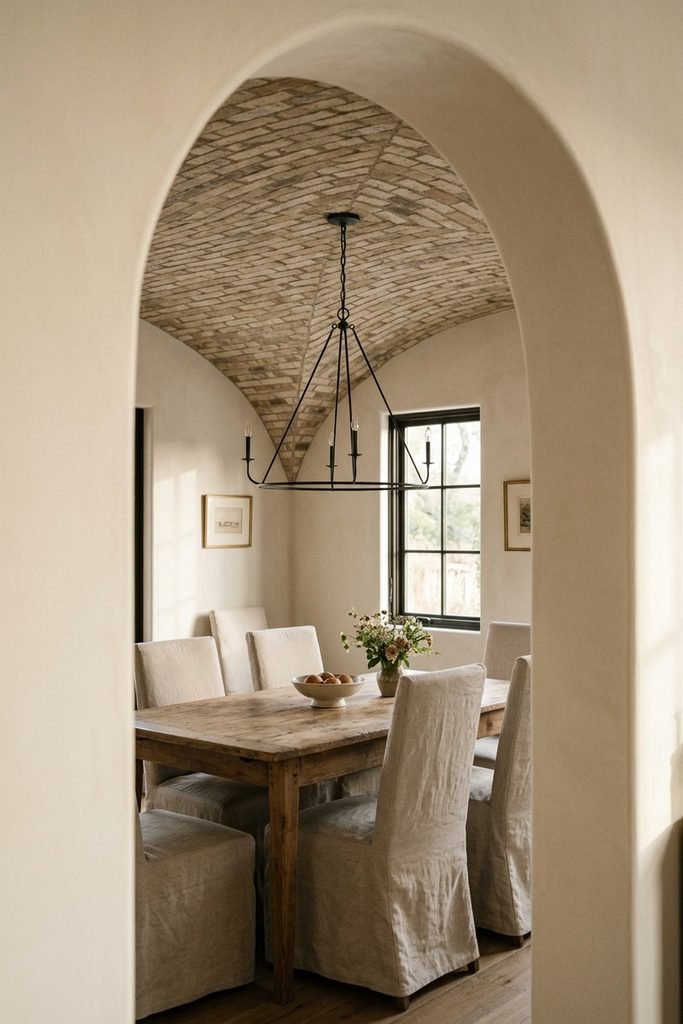
Pale linen chairs soften that masonry appearance. An aged wood table can sit between the two, with enough grain to relate to the ceiling but a simpler surface than the brick pattern. A slender dark chandelier leaves the curve visible around it.
Subtle variation in the brick tones gives the surface depth; strong patches of unrelated color can make it harder to read the vault as a whole. This look depends on suitable existing or professionally designed architecture and an appropriate overhead finish. A decorative brick surface by itself does not create or establish support for a vault.
21. Set Embossed Ivory Panels Between Dark Ceiling Beams
Charcoal-painted beams can organize a much finer pattern between them. Their dark finish establishes the larger lines across the ceiling, while embossed ivory panels fill the spaces with shallow ornamental detail.
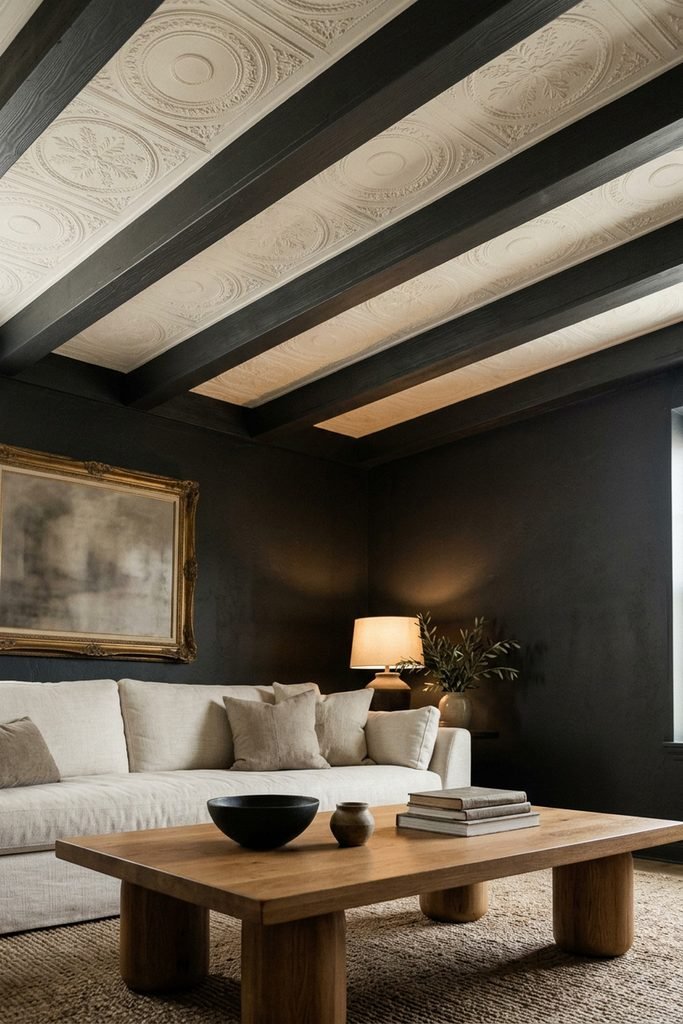
Repeat that contrast in the room below: an ivory sofa against a dark back wall gives the ceiling’s two main tones another place to appear. Warm oak, a large gold frame, and simple ceramics add smaller variations without introducing several competing patterns.
The beam spacing supplies the rhythm, so each strip of relief can stay intricate. Broad plain upholstery is useful here because it gives your eye somewhere quieter to rest. Select a ceiling-rated panel system and confirm the existing beams’ role before planning attachments. Their appearance alone cannot establish whether they are structural or decorative.
Find Fine Embossed Ceiling Patterns
Fine relief patterns can bring detail between the dark beams while preserving the room’s ivory-and-charcoal contrast.
Sculpted and Soft Ceilings That Define a Room
The final treatments depend on shape, folds, and open space. Their supporting rooms stay relatively quiet so you can appreciate the silhouette or the relationship between the ceiling and the area beneath it.
22. Light a Sculpted Butterfly Ceiling Above a Cream Living Room
A butterfly relief can become an architectural focal point when its wings are formed within a rounded ceiling recess. Keeping the sculpture ivory allows depth, cutouts, and shadow to explain the shape.
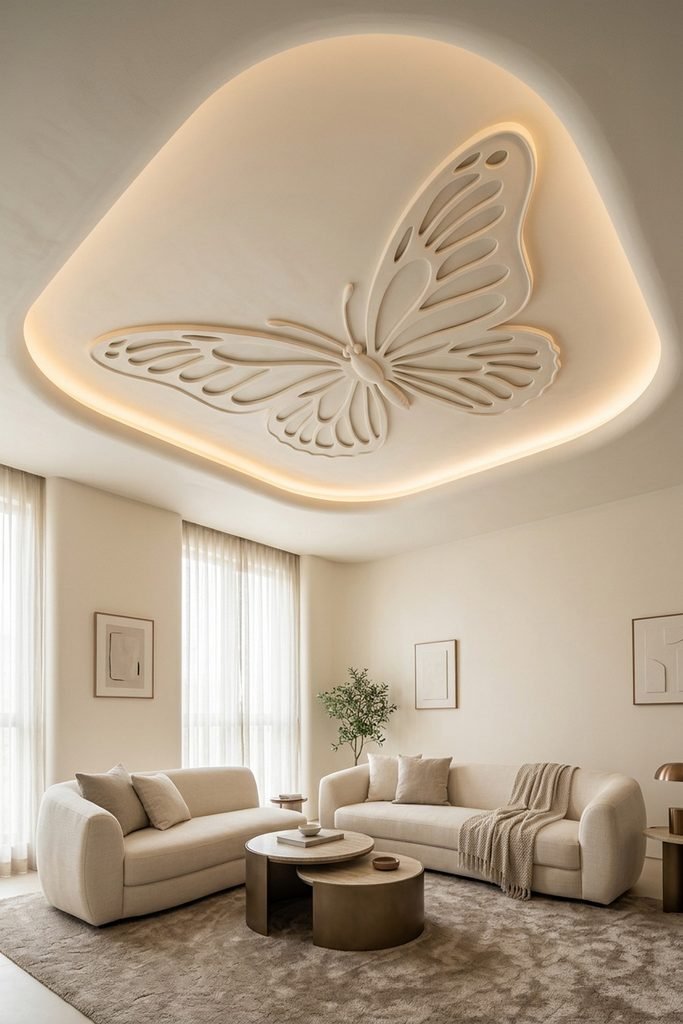
Soft edge light should reveal the wing outline and finer details without washing them out. A cream sofa, taupe rug, and a few curved tables can repeat the ceiling’s gentler lines below. Muted bronze adds a little contrast while preserving the quiet palette.
The room needs fewer competing features when the overhead silhouette is this recognizable. Keep wall art simple and avoid surrounding the butterfly with an unrelated cluster of decorative lights. Rounded sofa arms or a circular table can echo the wings’ softer outline without repeating a butterfly motif on the furnishings. A custom relief requires ceiling-suitable components, appropriate attachment, and coordinated lighting access; the finished effect should come from a resolved ceiling design rather than loose decorative pieces.
23. Drape a Small Bedroom Ceiling With Airy Patterned Fabric
Shallow folds gathered toward the center can give a guest bedroom the softness of a fabric canopy. A fine powder-blue motif on warm white keeps the surface light, while the radial folds supply movement across a plain ceiling.
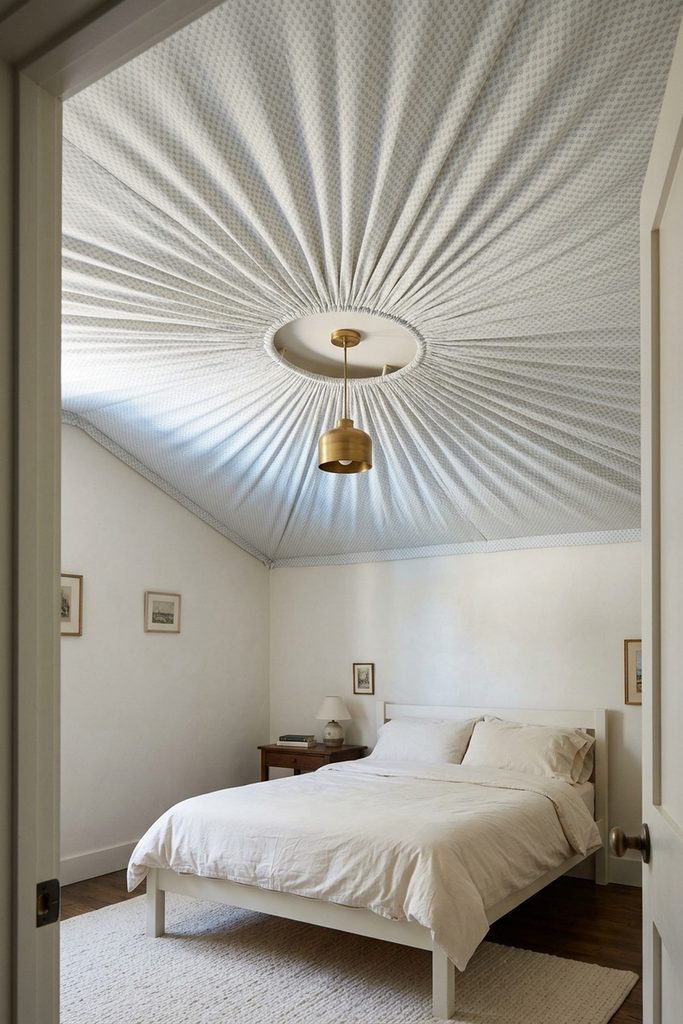
Keep the lowest parts of the drape comfortably above the room’s usable space. Supported edges and gentle folds preserve the airy effect; deep swags would give the same small room a much heavier overhead presence. Plain white bedding, a soft rug, and darker wood flooring provide enough contrast below.
Treat the textile and lighting as a professionally specified ceiling arrangement. The fabric, fixing, fixture clearances, and relationship to vents and detectors need to be resolved together. A small enclosed fixture can remain the visual center, but its suitability must be checked for the actual design. Additional wall patterns are optional; the folds already give the room its main decorative movement.
24. Float Staggered Felt Waves Above a Curved Dining Nook
Picture a curved cream banquette beneath a small group of clay-colored felt blades. Their shaped lower edges form a shallow wave, with the blades becoming less deep toward the window. Open gaps keep the original ceiling visible, and a deliberate clear channel gives an independently suspended pendant its own place.
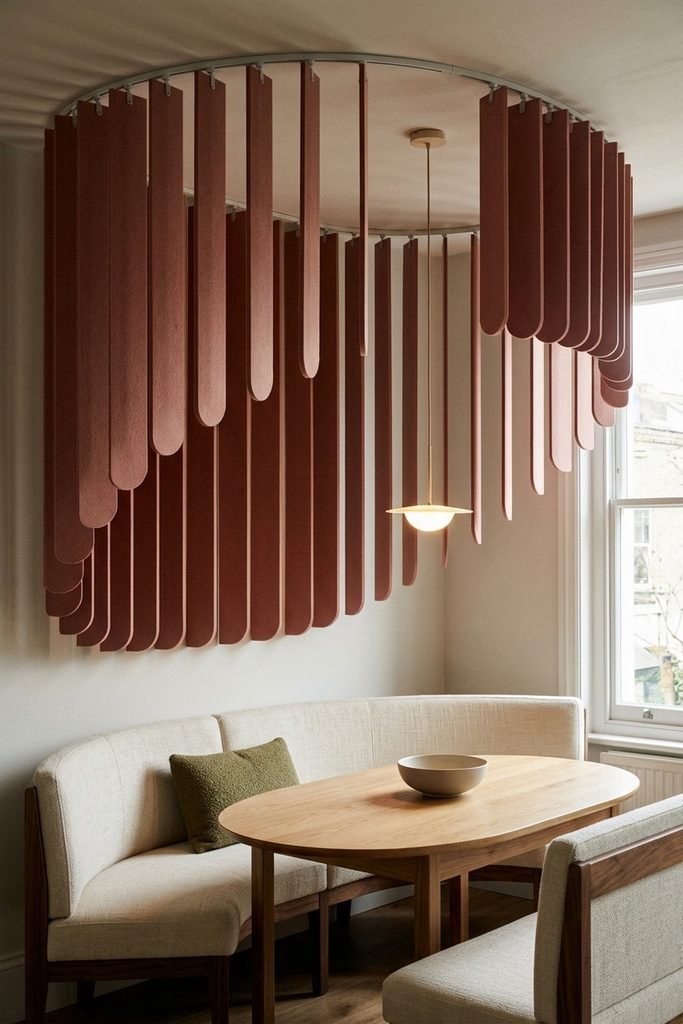
This proposed arrangement defines the dining nook through its relationship to the seating footprint. The graduated profile makes the overhead shape feel connected to the window side of the room, while linen upholstery and an oak table complement the felt’s softer surface. Keep the warm clay color concentrated in the blades, with cream seating and a small olive accent below. That distribution lets the canopy stand out through both shape and color.
Documented acoustic felt-blade systems provide a basis for specialist planning. The custom layout still needs review for support, headroom, lighting, and fire-system coordination. Any acoustic benefit depends on the specified assembly; no soundproofing result is promised.
Fewer, shallower blades can adapt the design to a smaller bay while preserving the taper and pendant channel. For actual visual privacy, explore room divider ideas; the canopy’s role is to mark the dining area overhead.
What to Check Before Choosing a Ceiling Treatment
First, decide whether the idea changes the surface or adds depth below it. Paint and printed imagery occupy a different kind of space from coffers, canopies, beams, and suspended blades. Look at the actual ceiling levels, furniture positions, doors, windows, and available headroom before settling on the shape.
Then check the proposed material for its real room conditions and installation system. Bathroom humidity, the weight of overhead finishes, fixture support, and access to lighting components all need project-specific answers. Fabric and suspended elements also need coordination with vents, detectors, and any sprinklers. Where an older surface may contain asbestos and work would disturb it, follow EPA guidance on professional assessment before proceeding.
Finally, separate atmospheric light from light needed for reading, cooking, or grooming. A glowing ceiling border can contribute to the room’s mood while the practical lighting is planned around what happens below. These lighting ideas for cozy rooms offer more inspiration for that layered approach.
Choose the ceiling ideas that fit the room you want to live in. A repeated color, an aligned grid, or one carefully framed pattern can be enough. When the overhead treatment relates to the furniture, materials, and light below, the ceiling becomes part of the room’s design rather than a separate surface waiting for attention.