





23 Home Office Ideas for a Workspace That Feels Like Home
Useful home office ideas begin with the room you already have: a bright living room, a bedroom corner, a spare closet, or a dedicated study. The desk matters, but so does its relationship to the sofa, window, shelves, and space around your chair.
- Choose a Workspace That Fits Your Day
- Home Office Ideas for Living Rooms and Bedrooms
- 1. A Slim White-and-Oak Workspace Beside the Sofa
- 2. A Curved Wood Desk in a Quiet Bedroom Corner
- 3. A Floral-Wallpaper Desk Inside a Bedroom Arch
- 4. A Window Desk Beside a Built-In Daybed
- 5. A Cane-and-Oak Desk Behind an Airy Slat Divider
- Built-In and Hidden Home Office Ideas
- 6. A Sage Closet Office With Full-Width Oak Shelves
- 7. A Butter-Yellow Office Hidden Inside a Tall Cabinet
- 8. A Staircase Office With Shelves That Follow the Slope
- 9. A Backlit Hexagonal Oak Work Niche
- 10. A Writing Desk With Sliding Art Panels Over the Tech Wall
- Home Offices With Library Storage
- 11. A Walnut L-Shaped Office With Storage on Both Walls
- 12. A White Library Wall With an Integrated Desk
- 13. A Charcoal Library With a Marble Desk and Ivory Lounge Chairs
- 14. A Double-Sided Library Spine With a Desk and Reading Bench
- Home Office Layouts for Two People
- 15. A Long Two-Person Desk Against a Charcoal Slat Wall
- 16. Two Separate Desk Bays Joined by a Shared Rug
- Home Office Decor With Personal Color and Character
- 17. A Plant-Filled Desk With Sage Textiles and Warm Light
- 18. A Softly Lit Dual-Monitor Desk in Cream
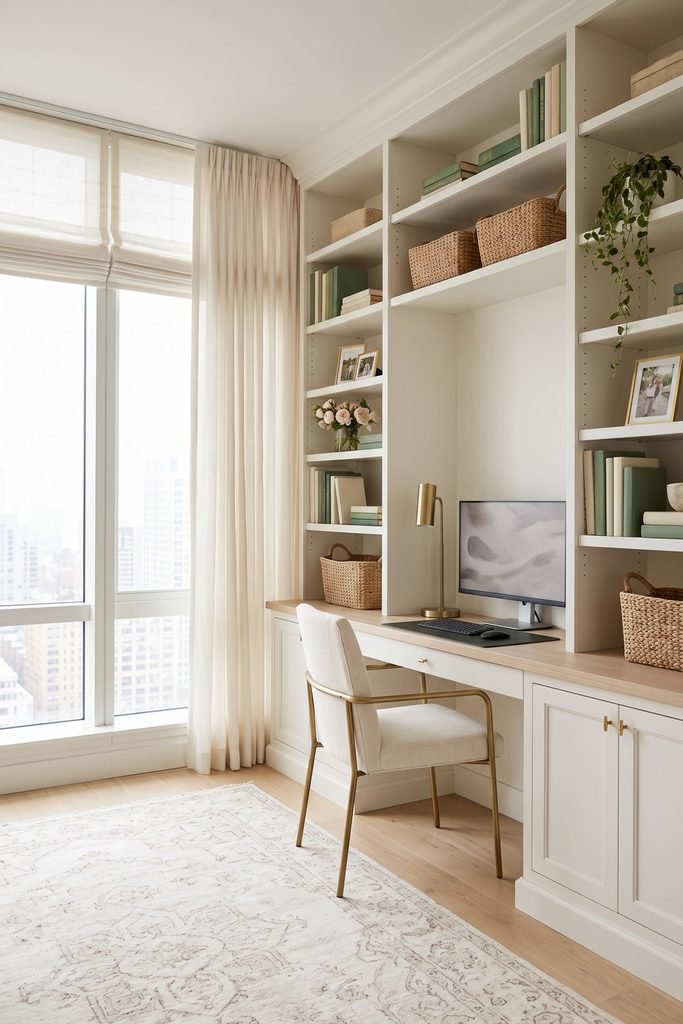
- 19. A White-and-Brass Desk Framing a City View
- 20. An Antique Writing Desk Beneath a Collected Gallery Wall
- 21. A Black Fluted Desk With Graphic Art and Pink Blossoms
- 22. A Pink Home Office With Walnut Shelves and a Scalloped Rug
- 23. An Orange Sculptural Chair Against Oversized Art
These 23 workspaces explore that relationship through different layouts and styles. Some use pale oak and open shelving to keep a shared room light. Others bring in charcoal cabinetry, collected portraits, or a confident pink palette. You’ll also find two-person arrangements and custom concepts that give furniture more than one useful face.
Look for a layout that suits your day, then borrow the colors and details that feel like home.
Quick Takeaways
- Let your daily work guide the layout, including the equipment, papers, and supplies you need within reach.
- Plan space for your chair to move and for other people to use the room around it.
- Repeat a few colors or materials between the workspace and its surroundings, especially in living rooms and bedrooms.
- Give the work surface useful task lighting, then add softer light and texture where they improve the room’s atmosphere.
Choose a Workspace That Fits Your Day
A laptop used for occasional paperwork asks different things of a room than two monitors and a full day of calls. Consider what stays on your desk, what needs a drawer, and what can live on a shelf. Your home office design should account for those everyday objects before decorative pieces fill the remaining spaces.
The chair belongs in this early decision. Check how it fits beneath the desk, how far it moves when you stand, and whether its arms interfere with the worktop. OSHA’s chair guidance emphasizes support and adjustment suited to the user, alongside the desk and equipment.
Light deserves the same attention. A sunny window can be lovely while still making a screen difficult to see. OSHA’s workstation guidance recommends arranging lighting to limit glare and providing task light for reading and paperwork. Shades, screen orientation, and an adjustable lamp give you choices as daylight changes.
With those needs established, the room’s character can guide the rest: an airy work corner, a sheltered writing nook, or a study filled with books.
Home Office Ideas for Living Rooms and Bedrooms
A workspace within a living room or bedroom benefits from a clear relationship to the furniture around it.
1. A Slim White-and-Oak Workspace Beside the Sofa
A white desk beside the sofa feels connected to the living room when its finishes echo furniture already nearby. Pale oak can repeat a coffee table or shelving unit, while an oatmeal chair picks up the sofa’s upholstery. That repetition gives the work corner a place in the room’s overall palette.
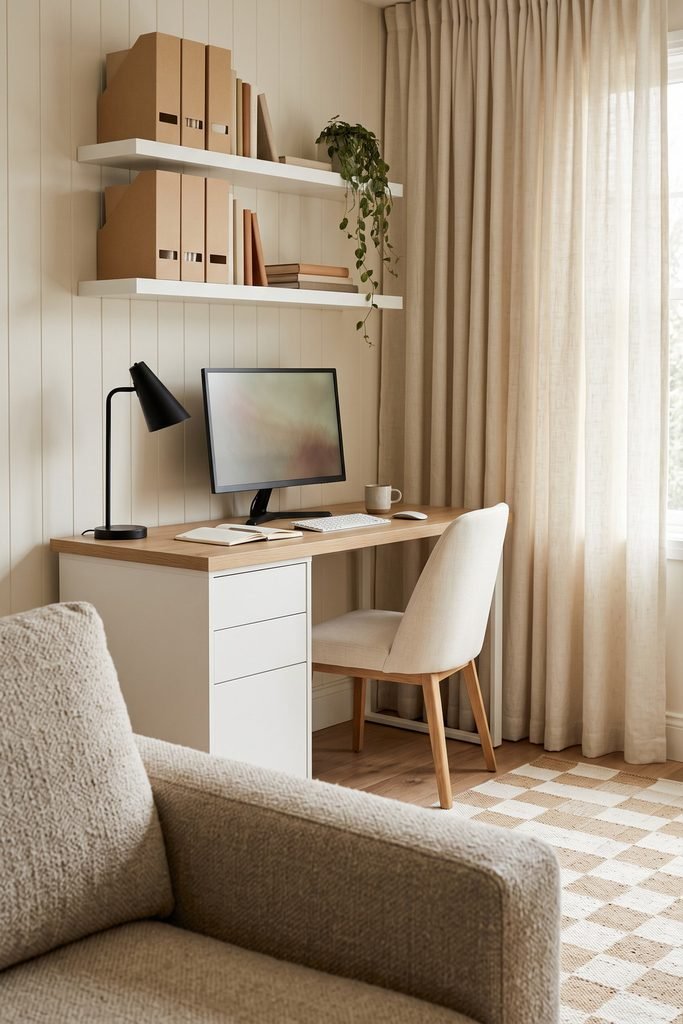
Keep the furniture’s outline light. A compact drawer pedestal provides a solid base at one end, balanced by open space beneath the rest of the desktop. Shelves above can carry files and books without adding another floor-standing piece beside the seating area.
Matching tan boxes make office supplies look orderly, and one trailing plant loosens the straight shelf lines. Leave the center of the desk available for your actual setup.
In small home offices, a chair that tucks beneath the desk keeps the view from the sofa quieter and leaves a clearer route through the room.
Find Storage for the Living Room Desk
Tan file boxes and a compact black lamp complement the pale desk while keeping the work corner connected to the living room.
2. A Curved Wood Desk in a Quiet Bedroom Corner
The rounded front of a wood desk can soften the point where two bedroom walls meet. Its curve is especially noticeable against straight floating shelves and simple window trim, giving the corner a distinct shape without a large piece of furniture.
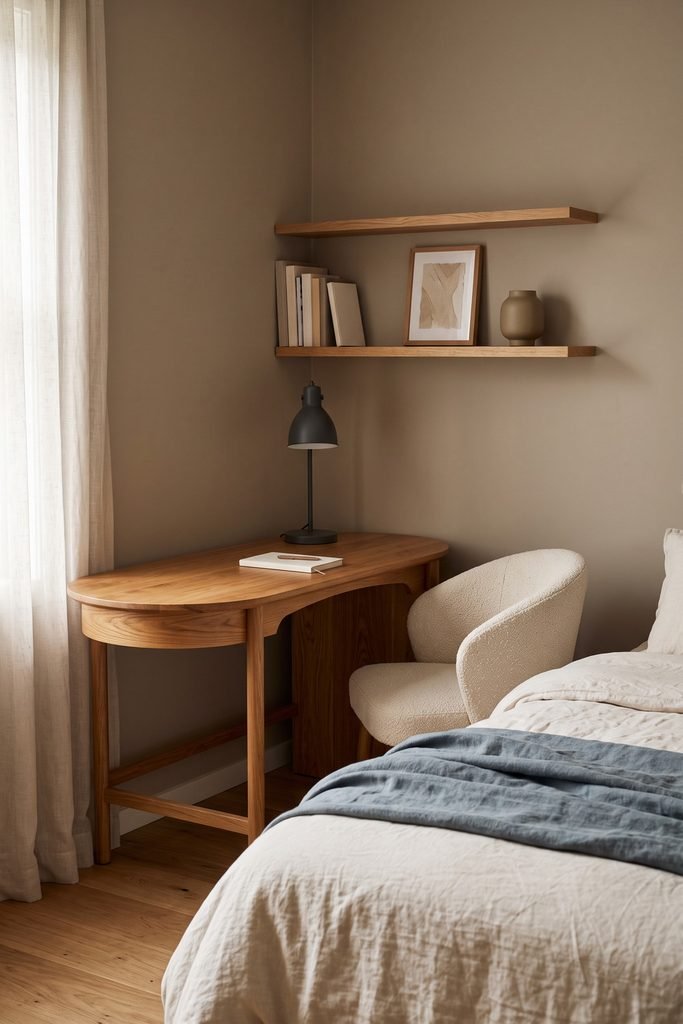
A cream upholstered chair adds a second curve and a different texture. Medium-toned wood keeps the arrangement grounded; warm taupe walls and linen bedding let those shapes remain the main attraction. A small dark lamp or frame gives the pale upholstery a crisp edge.
Two shelves are enough to establish height here. Give a framed print room beside a short book stack, and repeat one ceramic finish on the desktop. The bedroom can retain its restful character while the corner feels complete.
Allow room to sit and stand beside the bed, with desk depth suited to your equipment.
3. A Floral-Wallpaper Desk Inside a Bedroom Arch
An ornamental arch gives a little desk the presence of a built-in room. Inside that frame, floral wallpaper creates depth through pattern, while cream trim provides a quiet border between the busy print and the bedroom beyond.
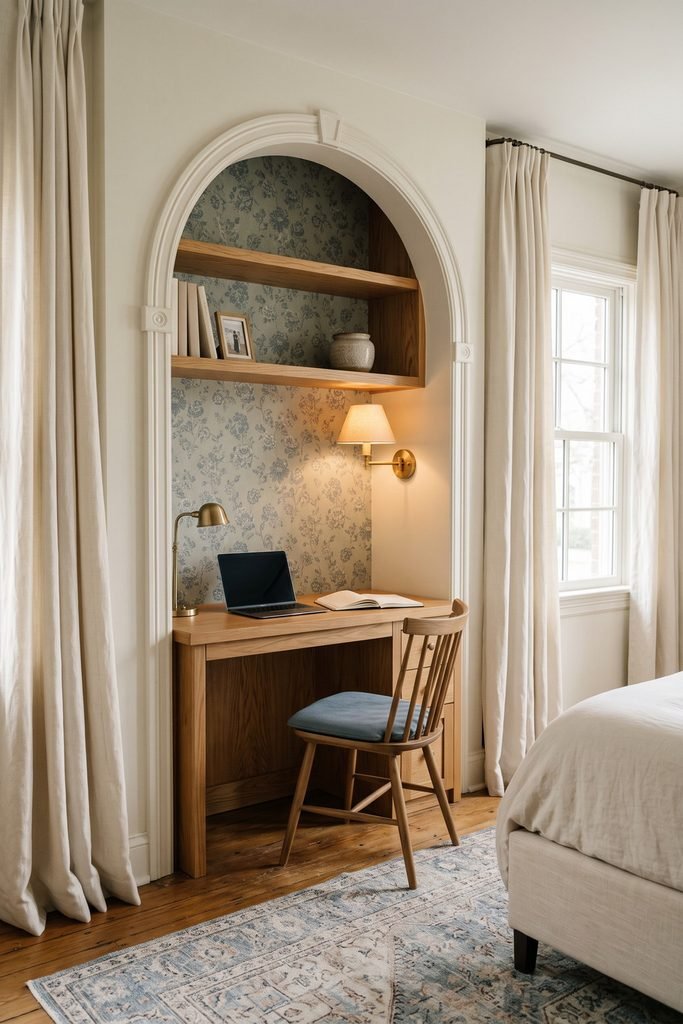
Choose the wallpaper first, then pull a few of its softer colors into the seating and textiles. Dusty blue on a chair cushion can connect with a small blue detail in the rug; faded green leaves can sit comfortably beside a real plant. The oak desk and shelf edges carry one continuous wood tone through the recess.
Lighting adds another layer of scale. A shaded wall sconce brings a gentle glow to the floral background, and a compact brass task lamp marks the writing surface.
A few upright books, a photograph, and a ceramic pot can leave the pattern visible. The arch feels richly finished, with space below to open a notebook.
Floral Wallpaper and Blue Cushions
Muted blue-green wallpaper and a dusty blue cushion repeat the colors that give the arched nook its character.
4. A Window Desk Beside a Built-In Daybed
A desk and daybed can share a window corner without asking either piece to do both jobs. The desk provides a clear working surface, and the upholstered seat offers somewhere to read or pause with the laptop closed.
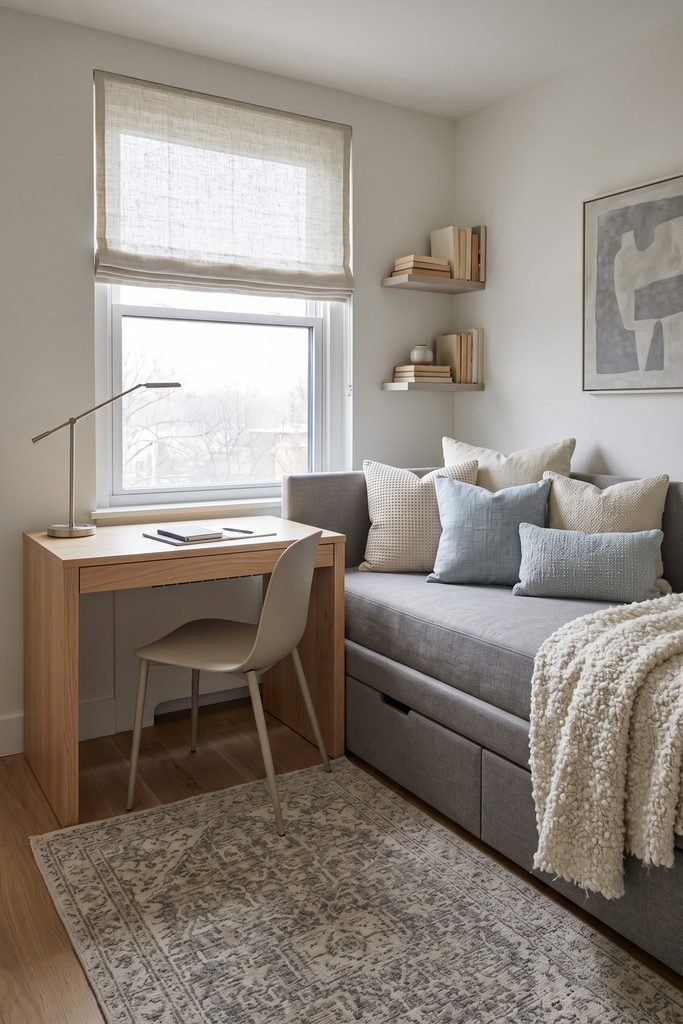
Pale oak and soft gray work well across the two pieces because the continuous colors make their junction feel considered. Let the daybed carry most of the softness: a woolly throw, tailored cushions, and a little pale blue. A slim metal lamp gives the desk a more precise outline beside those layers.
Storage beneath the seat can hold items that would otherwise crowd the desktop. Keep everyday work supplies closer to the chair, so using the daybed doesn’t require moving a collection of papers first.
Leave access to the daybed when the chair is pulled out. If overnight guests are central to your plan, explore these home office guest room combo ideas for that more specific room relationship.
5. A Cane-and-Oak Desk Behind an Airy Slat Divider
Oak slats give a bedroom desk a boundary while allowing glimpses of the bed beyond. Their repeated lines connect the screen to the furniture arrangement.
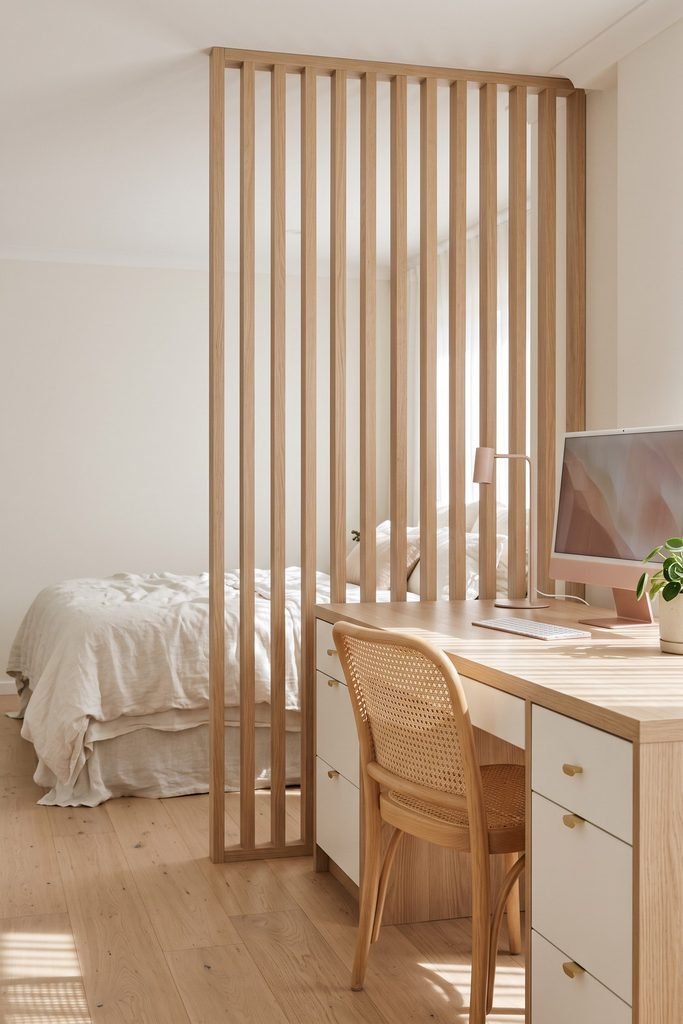
A cane-backed chair carries that same rhythm at a smaller scale. Pair it with a pale wood desktop and white drawer fronts, then use a few brass details to sharpen the otherwise soft palette. The screen already contributes plenty of pattern, so the work surface can stay restrained.
The positioning matters as much as the materials. The desk needs to face its own useful area, with the divider separating work from the sleeping zone rather than trapping the chair in a narrow slot. Check drawer opening and chair movement together.
Treat the slats as visual zoning; they don’t establish sound isolation. Their support also needs to suit the installation. For other ways to define neighboring areas, browse these room divider ideas.
Built-In and Hidden Home Office Ideas
Architectural openings and fitted furniture can give the workspace a stronger boundary, along with storage planned around daily use.
6. A Sage Closet Office With Full-Width Oak Shelves
Open closet doors can frame a workstation as clearly as a doorway frames a room. Sage paint across the back gives the little office its own color, and full-width oak shelves carry that color scheme from top to bottom.
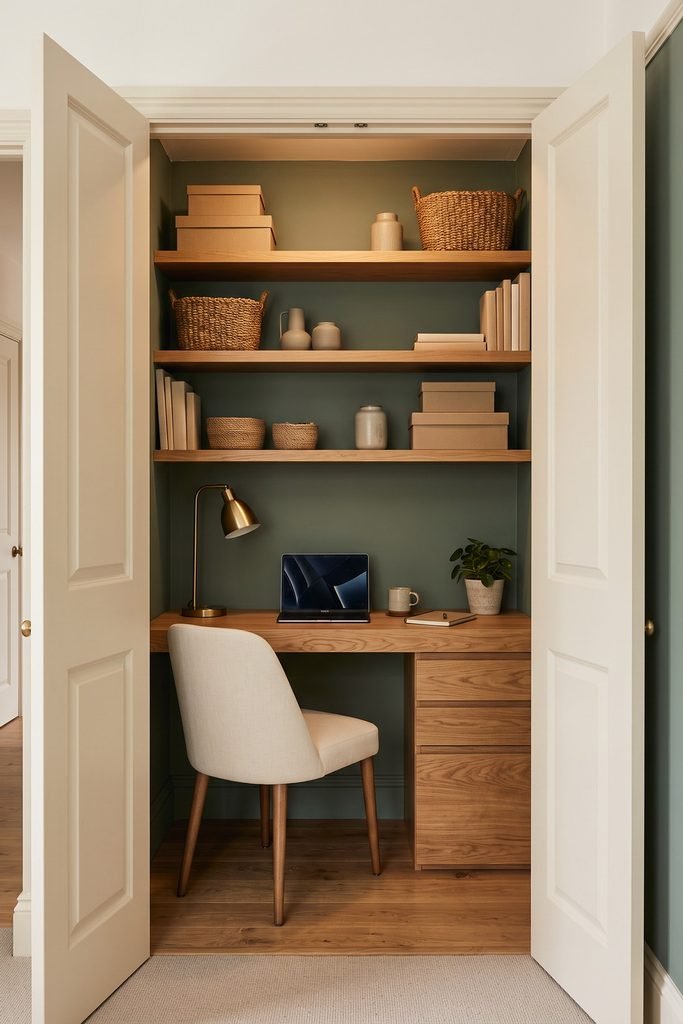
The shelves look more cohesive when they share a consistent thickness and finish. Their contents can vary: upright books on one side, lidded boxes on another, and a small ceramic piece between them. Leaving some sage visible keeps the recess from becoming a solid wall of storage.
A brass lamp and cream chair bring lighter notes into the enclosure. Task lighting distinguishes the desk from the shelves when the surrounding room is dimmer.
For a cozy home office inside a closet, comfort begins with the fit. The opening needs to accommodate your equipment, legs, and chair, along with the movement of the doors. Power access and equipment airflow belong in the plan before the interior is fully fitted.
7. A Butter-Yellow Office Hidden Inside a Tall Cabinet
The pleasure of this cabinet office comes from its change of color. Closed, the pale exterior sits quietly beside living-room furniture. Open, its butter-yellow interior turns the small working compartment into a bright focal point.
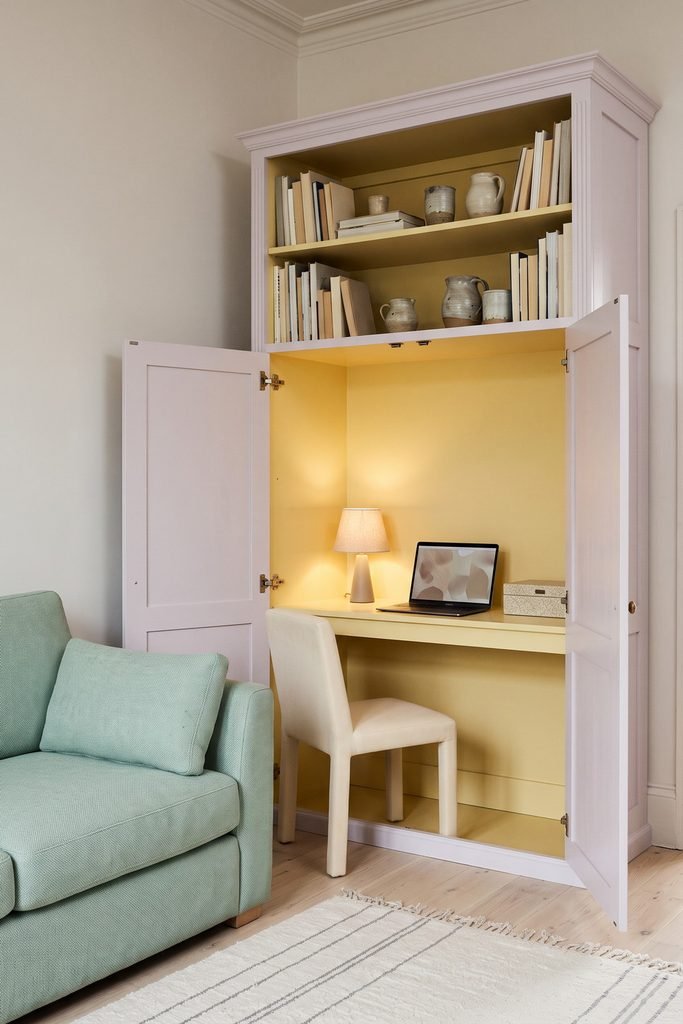
Carry the yellow across the back and inner sides so the opening reads as one complete space. A simple timber or painted seat, a compact lamp, and a laptop can keep the middle visually clear, while upper shelves hold a few books and a closed box. A pale lilac exterior or nearby mint upholstery gives the yellow a gentle partner without competing with it.
Furniture of this kind needs to accommodate the whole work routine, including where the chair goes when the doors close. Plan usable depth, knee space, power access, and equipment airflow around the devices involved, with support and installation suited to the piece.
8. A Staircase Office With Shelves That Follow the Slope
The diagonal beneath a staircase already gives the room a strong line. A level oak desktop beneath it introduces a useful counterpoint, while shelves that step with the slope make the fitted furniture feel connected to the architecture.
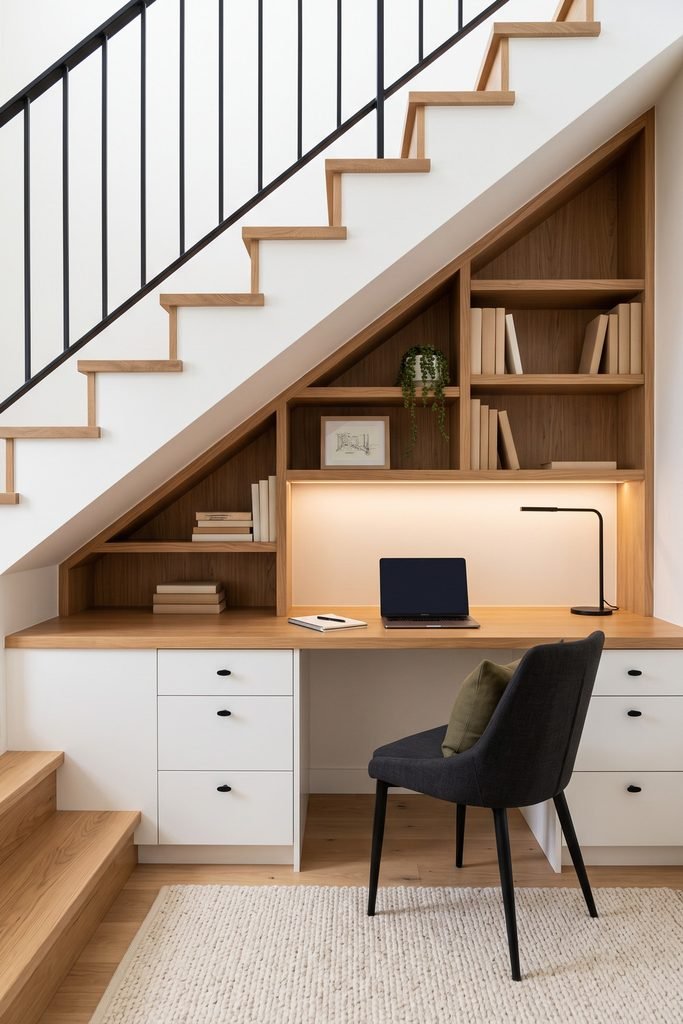
Position the chair toward the taller end, with drawer bases flanking an open knee area. White fronts keep the lower section quiet; black pulls and a black task lamp can repeat the stair railing above.
Shelf styling can follow the available height. Lower spaces suit short book stacks and small framed pieces, while a taller opening can hold a plant or a few upright volumes. Soft shelf lighting helps distinguish the display from the stair structure.
A successful arrangement also leaves the neighboring route usable when the chair is pulled out. Have the actual headroom, supports, power, and circulation reviewed for the space. The fitted office should work with the existing stair, with any structural changes handled as a separate professional design decision.
9. A Backlit Hexagonal Oak Work Niche
A large hexagonal oak outline makes an otherwise ordinary corner read as a complete work niche. The shape draws attention first; vertical timber slats inside it give the eye a finer texture to explore.
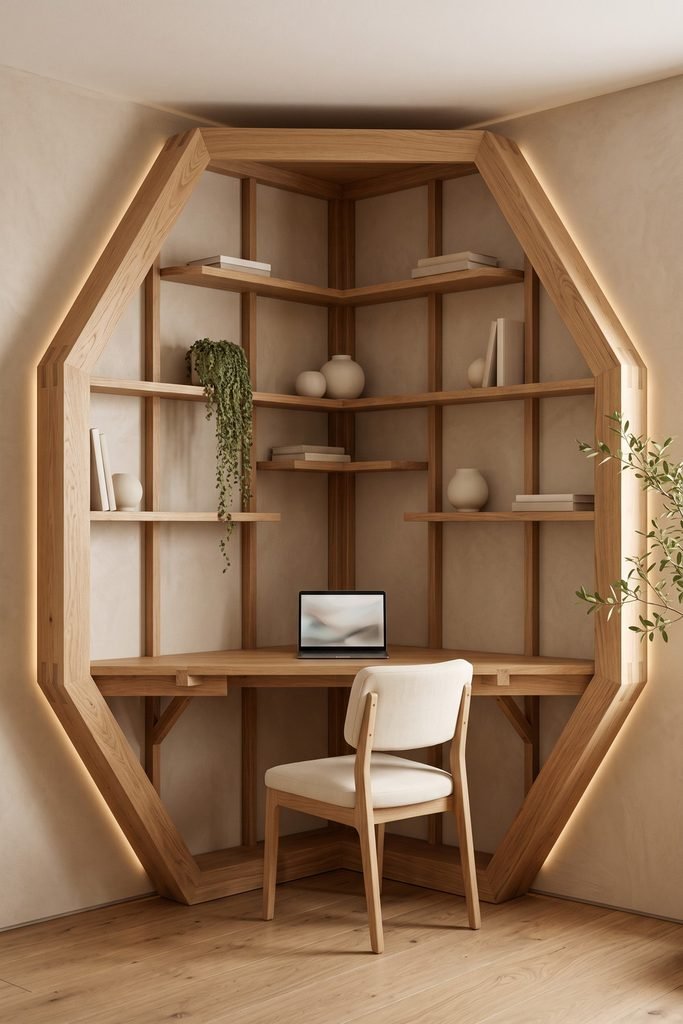
Let the same wood tone connect the perimeter, desk, and shelf edges. Too many competing finishes would weaken the sense of one enclosure. Beige walls and matte ivory ceramics give the honey-colored timber a quieter background, while a small amount of greenery interrupts its geometry.
The shelves can sit at different heights within the frame, with enough open backing visible to preserve the polygon’s shape. A trailing plant works particularly well near an upper edge, where its loose outline softens the precise joinery.
This custom home office desk concept needs a believable working position inside the decorative frame. A supportive chair, useful legroom, and properly designed desktop supports are part of the finished result. Concealed light can trace the enclosure, with a separate task-light provision where needed. A joinery professional should resolve the anchoring, wiring access, and spans for the actual installation.
10. A Writing Desk With Sliding Art Panels Over the Tech Wall
Artwork can become the moving front of a working wall. In this proposed arrangement, framed panels slide sideways over a recessed monitor and planning board, while a writing desk stays open and available below.
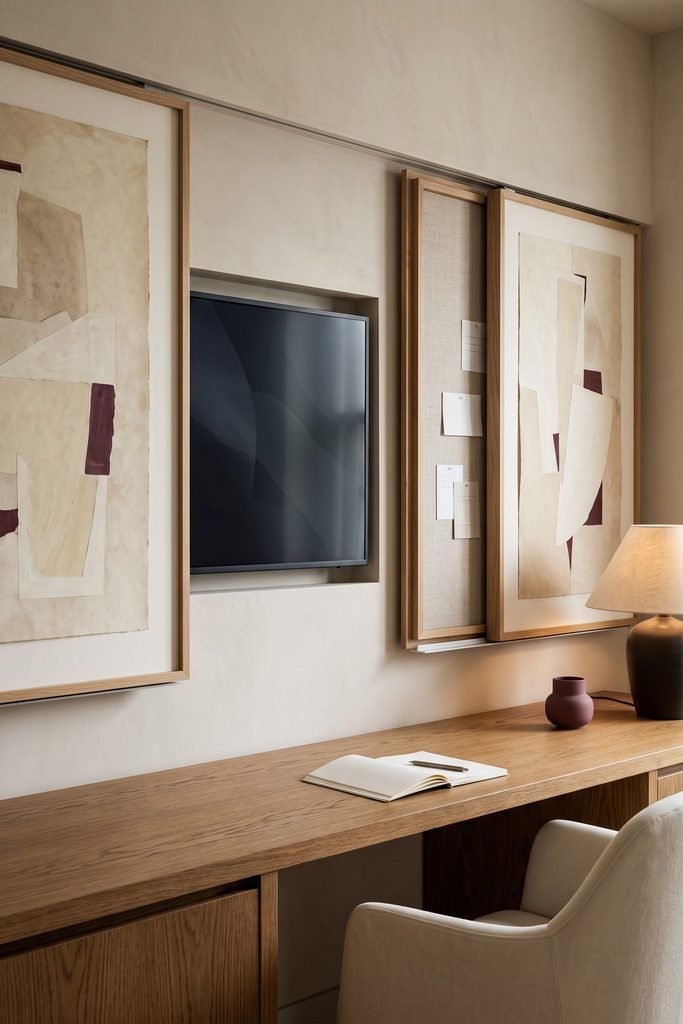
Picture a warm oak desktop beneath two parchment-toned artworks, perhaps with a muted burgundy shape repeated in a small desk accessory. Slide one panel onto a reserved stretch of wall and the monitor appears. The other panel can still cover part of the notes, allowing the wall to change gradually between a gallery and a visible workspace.
The important relationship is between that upper recess and the desk below. A notebook, lamp, and everyday supplies can remain in place when the artwork closes over the technology. That gives the room a quieter backdrop without requiring the whole working surface to be packed away.
Lateral sliding cabinet hardware offers a starting point for the mechanism. This framed-art application still needs hardware matched to the panels, guides and stops, adequate support, and enough wall space for the panels to park. The design also needs equipment clearance, airflow, and access to cables.
For a narrower wall, one artwork could slide over a smaller monitor recess. The defining feature remains the same: artwork moves across a genuine equipment bay, with an accessible writing surface beneath it.
Home Offices With Library Storage
Books and storage can establish a room’s architecture, from a single fitted wall to furniture that serves two sides.
11. A Walnut L-Shaped Office With Storage on Both Walls
An L-shaped dark wood desk gives computer work and paperwork separate stretches of the same surface. The continuous walnut finish connects those activities visually, while the turn in the desk creates a natural point of separation.
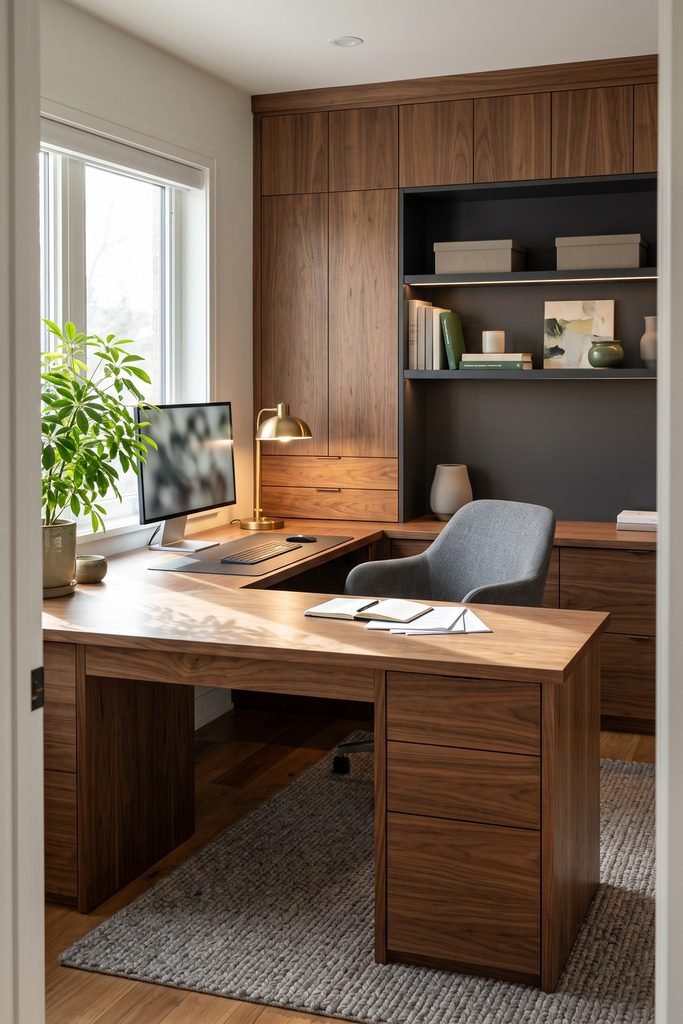
Black open shelves above can hold books and selected objects without making every wall read as timber. Closed cupboards provide a quieter place for supplies. The difference between those open and closed areas gives the room a more useful storage hierarchy.
A large green plant near the window can balance the cabinetry’s solid mass. Repeat a little brass in the task lamp and one smaller detail, allowing the walnut grain to remain the strongest pattern. A textured gray rug gives the chair area a softer boundary.
Check access at the inside corner: a drawer should open when the chair is positioned at the other arm. The return should add a genuinely usable surface, with its supports and depth planned around your work.
12. A White Library Wall With an Integrated Desk
A white library wall can hold a substantial collection while still giving the desk a clear place of its own. The central recess establishes a calm rectangle beneath the varied books and objects.
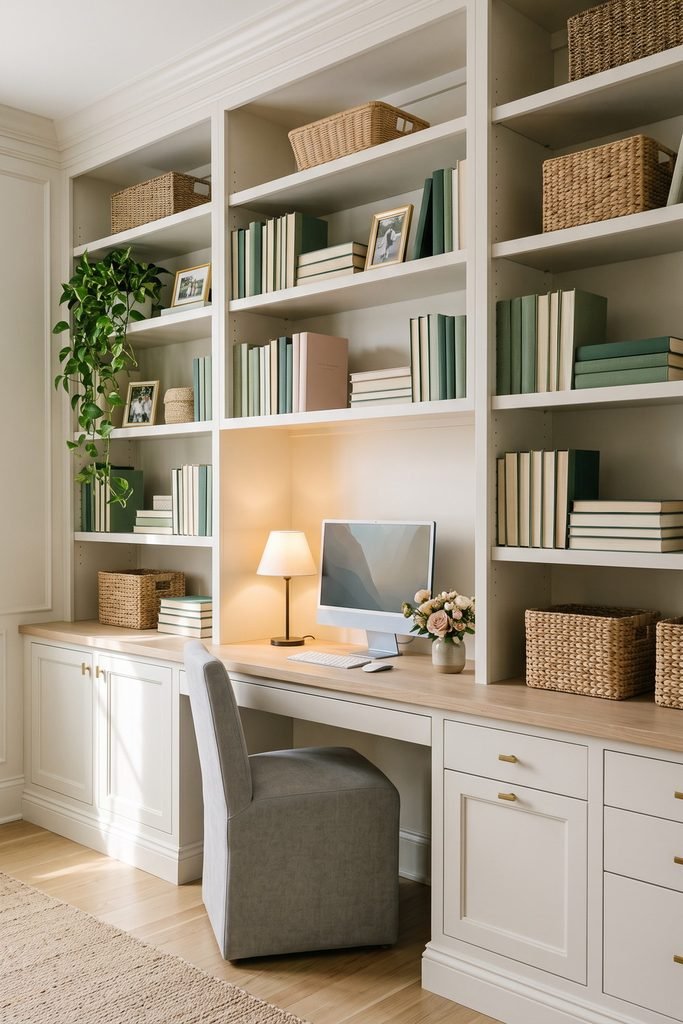
Closed lower cupboards help establish that order. Papers and supplies can sit behind plain doors, leaving the upper shelves for books, baskets, and personal pieces. Grouping some books upright and others in short horizontal stacks introduces variation without scattering small objects evenly across every shelf.
A pale gray upholstered chair brings softness to the work bay. Small gold frames and a restrained blush arrangement can repeat that gentler feeling among the white cabinetry. Warm niche light gives the desktop its own identity within the larger wall.
Keep frequently used items reachable, and treat tall storage as furniture that needs proper installation. The CPSC’s anchoring guidance recommends following manufacturer instructions when securing furniture. The finished wall should offer both a readable display and a practical place to work.
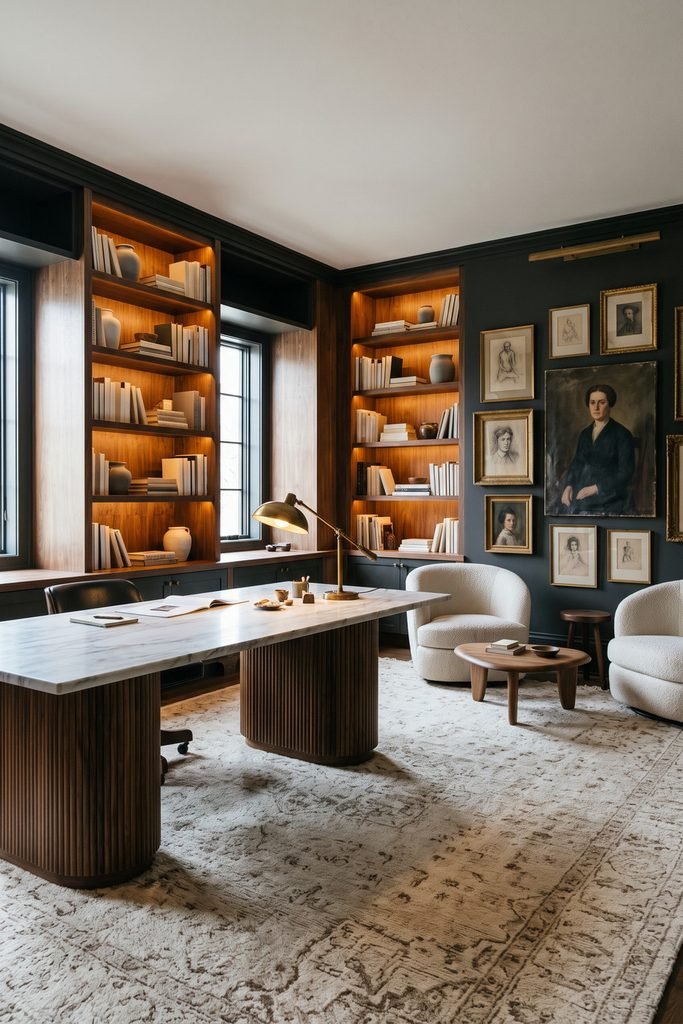
13. A Charcoal Library With a Marble Desk and Ivory Lounge Chairs
Charcoal walls and walnut shelves give a study a sheltered, library-like character. Their dark tones become more expressive when a pale marble desktop introduces a broad, lighter surface at the center of the room.
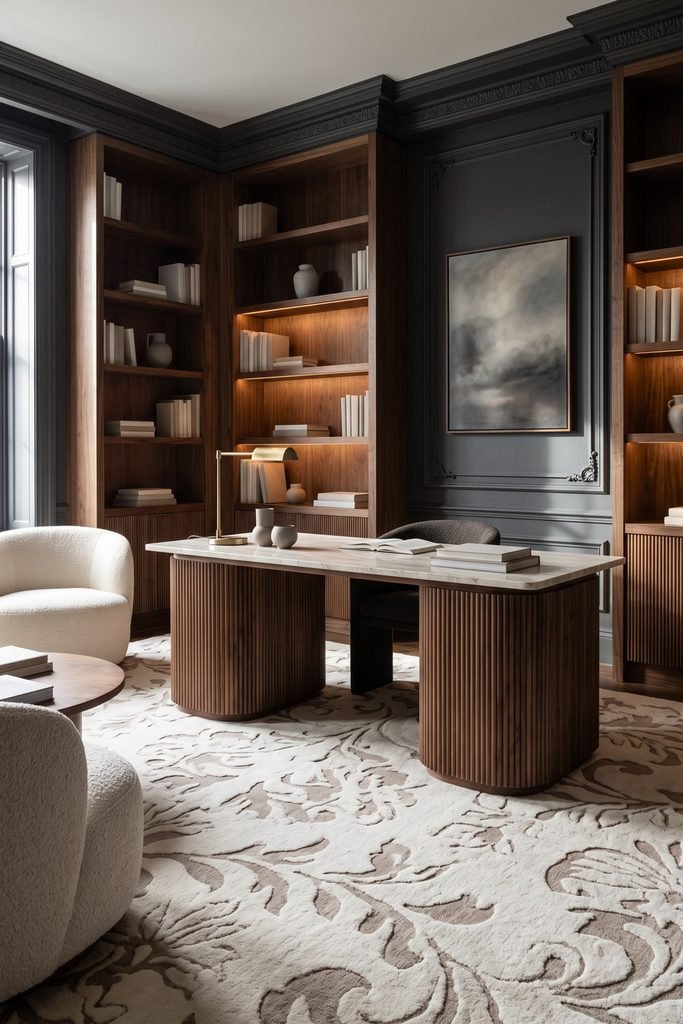
The contrast works through scale. The stone is one substantial plane, while the books create smaller variations behind it. Ribbed timber beneath the desk adds a different rhythm without introducing another strong color. Brass lighting can appear sparingly along those darker surfaces.
Two rounded ivory lounge chairs bring another kind of relief. Their soft outlines balance the desk’s weight, and a patterned cream rug carries that lighter tone across the floor. Positioning the pair to one side gives conversation its own area.
For a moody study office, layered light matters to the composition. Shelf lighting can reveal the books and timber, with daylight and a task lamp serving the active desk. Preserve enough circulation around the heavy pieces, and have the stone top and fitted shelving supported appropriately.
Find Rounded Ivory Seating
Rounded ivory chairs provide the pale, soft contrast beside dark shelving and the marble desk.
14. A Double-Sided Library Spine With a Desk and Reading Bench
A library can form the boundary between a work area and a reading spot. This proposed furniture arrangement uses one shared storage spine, with a desk projecting from one face and an upholstered bench on the reverse.
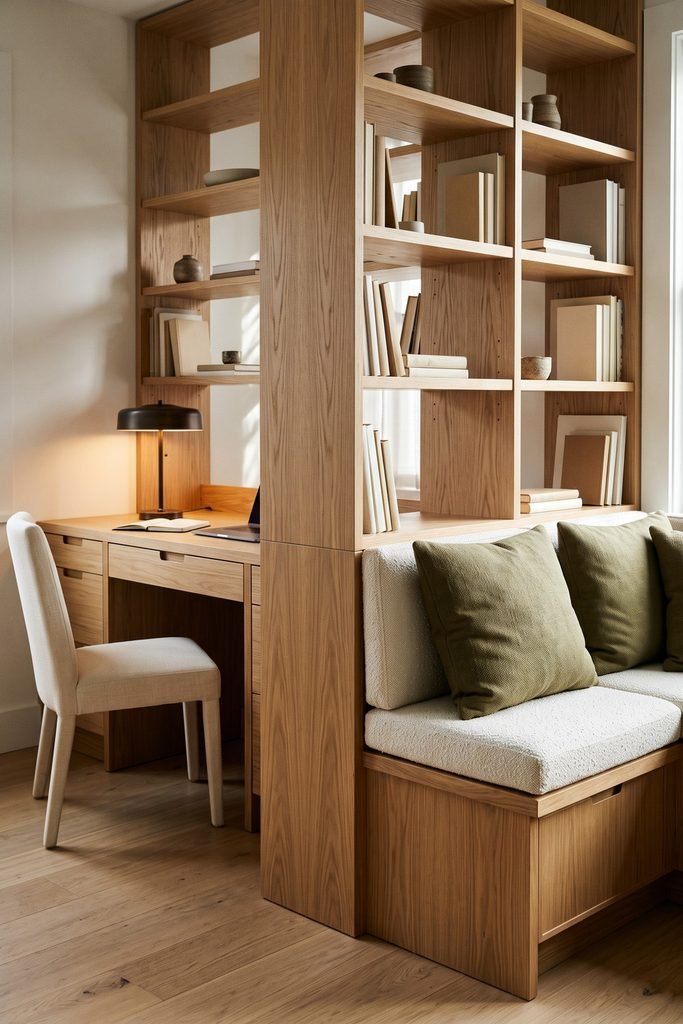
On the office side, drawers hold supplies beneath or beside the worktop. The lower central core screens the desk from the adjoining seating area. On the living side, a cushioned bench faces away from the workstation, with a shallow book ledge or accessible shelves serving the reader.
Upper shelving connects the two faces. Some open sections allow views and light through, helping the piece read as furniture within the room. Oak across the desk, shelves, and bench base establishes one continuous structure; cream upholstery and muted olive cushions make the reading face feel settled.
Both sides need to work at the same time. Someone should be able to sit at the desk while another person uses the bench, with clear routes around the free end. That reciprocal relationship is what makes the shared core useful.
This is a custom joinery concept requiring professional decisions about stability, anchoring, desk and seat supports, and shelving loads. Where a long projecting spine would crowd the room, a shorter module secured as a wall return could preserve the same opposite-facing arrangement. The desk, reading seat, and storage would still belong to one carefully planned piece.
Home Office Layouts for Two People
Shared offices need a layout that accommodates two real routines, with enough individual space within a coherent room.
15. A Long Two-Person Desk Against a Charcoal Slat Wall
A long oak desktop can give two people a place along one wall, leaving the center of the room open. Equal work bays make the shared arrangement legible, with separate lamps and equipment areas beneath a continuous shelf.
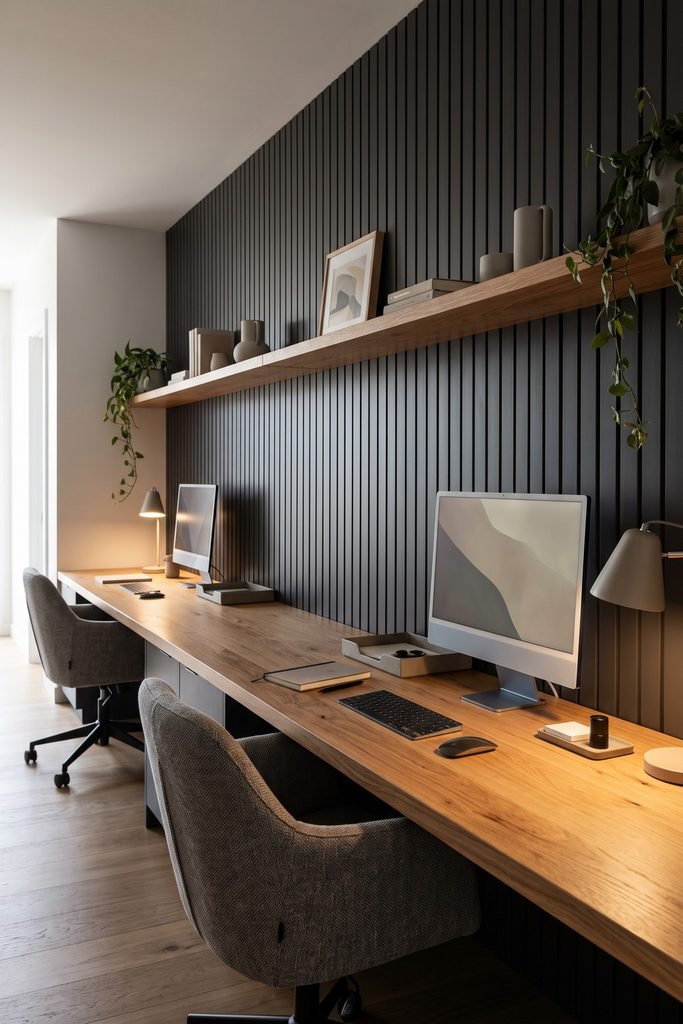
Charcoal slats provide a strong background for this repeated layout. Their vertical lines balance the length of the desktop and shelf, while upholstered gray chairs keep the lower half softer. A few green plants can break up the dark wall without occupying either person’s working area.
Personal storage can vary within that structure: paper trays at one station, space beside a second display at the other. Allow those differences within the same material palette.
Plan the full setup with both chairs in use. Each person needs space to sit, stand, and access supplies, along with a clear route behind them. Individual cable routes and reachable outlets can keep the shared desktop from becoming a tangle between the two stations.
16. Two Separate Desk Bays Joined by a Shared Rug
Two desks on different walls can suit people who want to share a room while keeping their own immediate surroundings. A short return or shallow storage tower gives the bays a visible edge, and each desk can have its own lamp, shelf, and art.
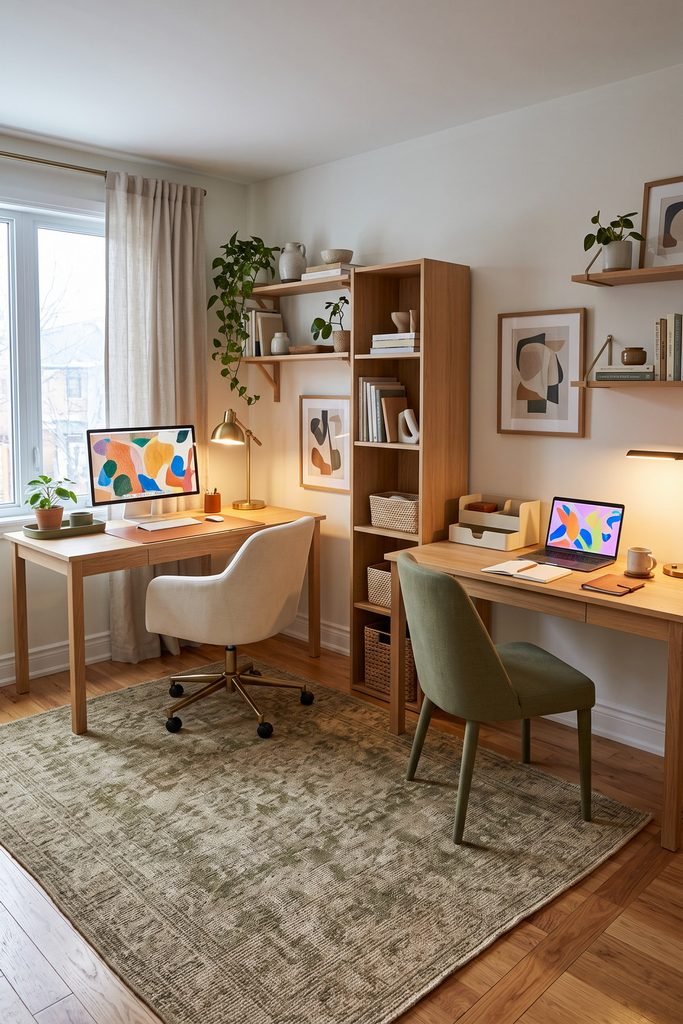
The room still benefits from common elements. Repeat the oak finish across both worktops and let one woven rug extend through the center. Cream and muted olive can appear in different proportions around each desk, allowing variation without splitting the room into unrelated schemes.
One station might hold a larger monitor, the other a more open writing surface. Each person’s facing direction can reflect those needs.
Leave the center useful. Both chairs should pull out without blocking the route between the desks. The divider establishes visual territory; any need for private calls requires separate consideration of the room’s sound and enclosure.
Home Office Decor With Personal Color and Character
Once the layout suits your work, color, art, greenery, and furniture shape can give the room a more personal character.
17. A Plant-Filled Desk With Sage Textiles and Warm Light
Greenery feels more integrated when it appears at several heights around a workstation. A larger plant beside the desk gives the arrangement a base, while trailing stems on upper shelves create a looser outline around the screen.
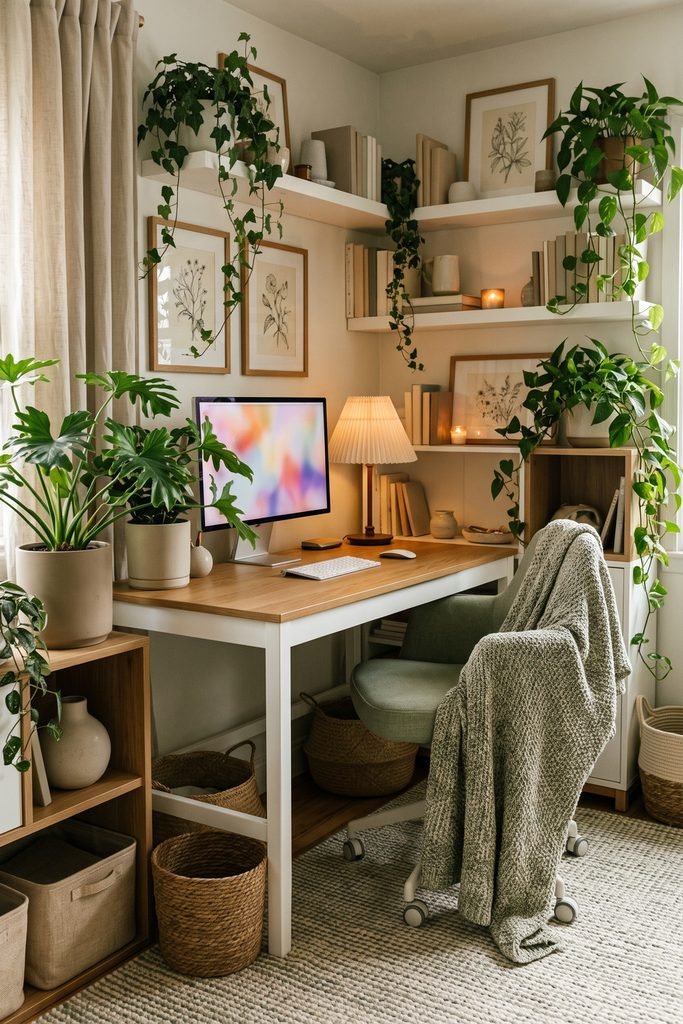
White furniture and an oak desktop provide a calm field for those varied leaves. Repeat softer greens through a sage cushion, botanical print, or knit throw, so the palette extends beyond the plants themselves. A woven basket under a side shelf introduces another texture without covering the worktop.
A pleated lamp can give the desk a small pool of useful light. Softer decorative lights or flameless candle-style accents belong farther from the keyboard, where they can contribute to the evening atmosphere.
The middle of this plant-filled workspace should remain available for work. Keep foliage out of the screen area, protect timber from watering spills, and choose plants for the room’s actual light. Give individual leaf shapes enough room to register.
Add the Sage Textile Layer
A sage knit throw and a pleated lamp carry the desk’s green palette into softer textiles and evening light.
18. A Softly Lit Dual-Monitor Desk in Cream
A cream palette can make a dual-monitor setup feel more connected to the room around it. The screens remain prominent, but a matte desk, matching peripherals, and soft upholstery reduce the number of competing colors beneath them.
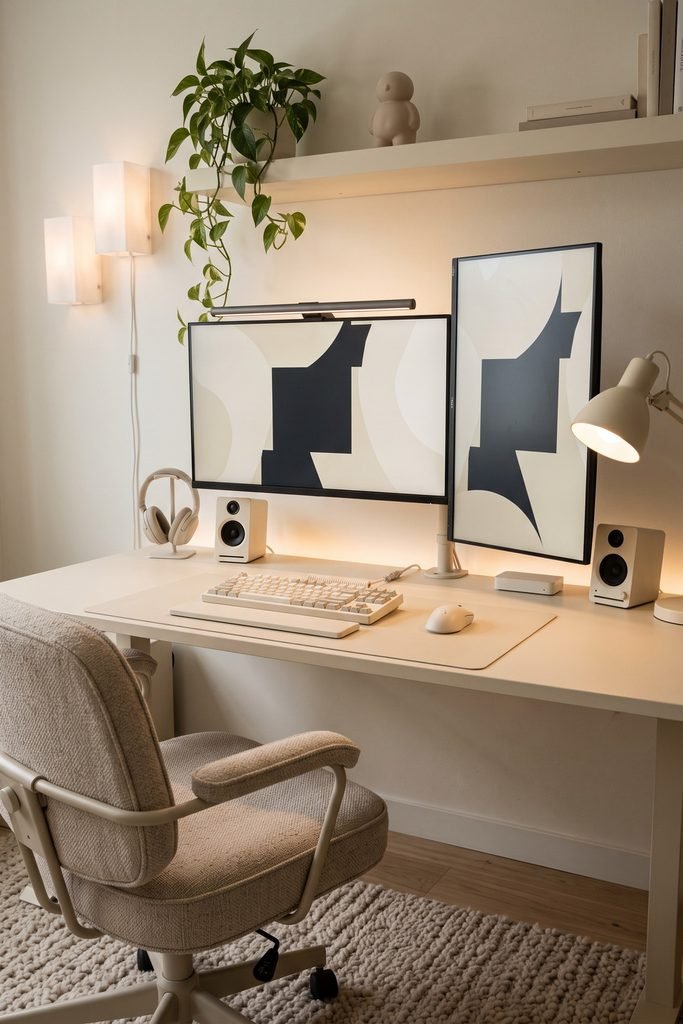
Give the equipment a clear arrangement before adding decorative lighting. OSHA’s workstation checklist places the primary monitor in front of the user, with a secondary display beside it, adjusted to how the screens are used. A landscape-and-portrait pairing can follow that relationship while preserving space for the keyboard.
Warm ambient light beneath a shelf can soften the wall behind the displays. A task light still needs to serve papers or a notebook, with brightness adjusted to the actual activity.
One playful shelf object can personalize the setup. Give speakers, headphones, and cables clear positions, with equipment airflow unobstructed. The result can retain its soft cream character while accommodating the real objects involved in computer work.
19. A White-and-Brass Desk Framing a City View
A city view gives a desk a backdrop that changes throughout the day. White drawer units keep the furniture visually light, while champagne-brass details introduce a little definition against the glass and pale walls.
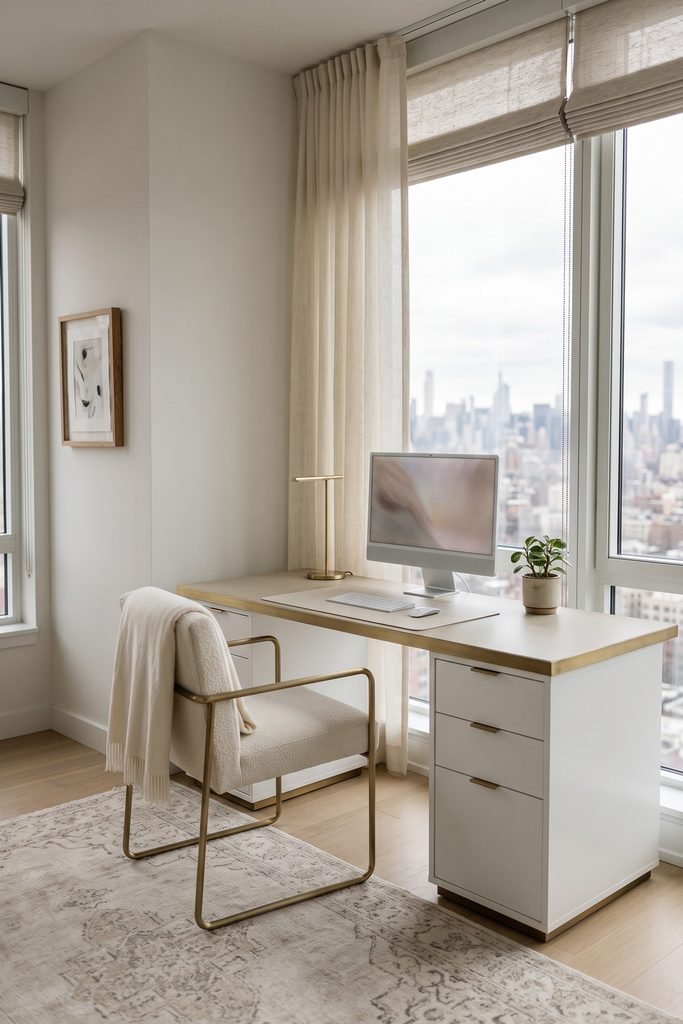
The chair can carry most of the softness. Cream upholstery and a small textured throw make it feel related to the rest of the home, and a pale patterned rug gives the whole workstation a defined area on the floor. Keep the desktop accessories low enough to preserve the outlook above and around the monitor.
Repeat brass between lamp and chair frame, and carry the rug’s pale tones into a desk mat.
Plan for the less photogenic moments, too. An adjustable shade and a screen position suited to the changing light help make the window useful during work. The view can remain the main visual feature while you retain control over brightness and reflection.
20. An Antique Writing Desk Beneath a Collected Gallery Wall
A collected gallery wall can give an antique desk a natural setting. Begin with one portrait large enough to organize the wall, then arrange smaller frames around it with varied spacing and finishes.
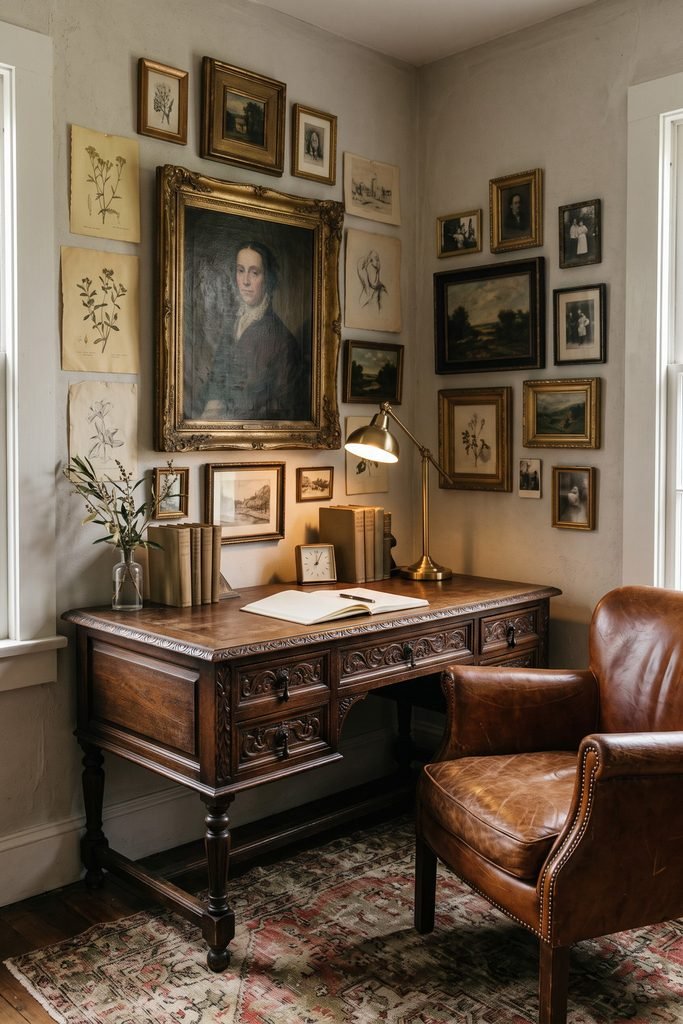
Aged gold, dark timber, and parchment-colored artwork share enough warmth to sit comfortably together. Cognac seating continues that palette below the frames, while a woven or patterned rug brings texture to the floor. The desk’s carved legs and drawer fronts provide much of the detail, so a few well-chosen objects can be enough on top.
A brass lamp gives this classic home office its intimate scale. Its light can fall across an open notebook, with a clock or small book stack grouped farther back.
A family photograph or an artwork chosen for its subject can supply the most personal note. That variation is part of the appeal. Keep the main portrait readable and a useful working area open beneath the gallery.
21. A Black Fluted Desk With Graphic Art and Pink Blossoms
A curved black desk has a strong silhouette of its own. Vertical fluting adds a finer rhythm to that solid shape, and oversized black-and-white prints can repeat the curve above it at a much larger scale.
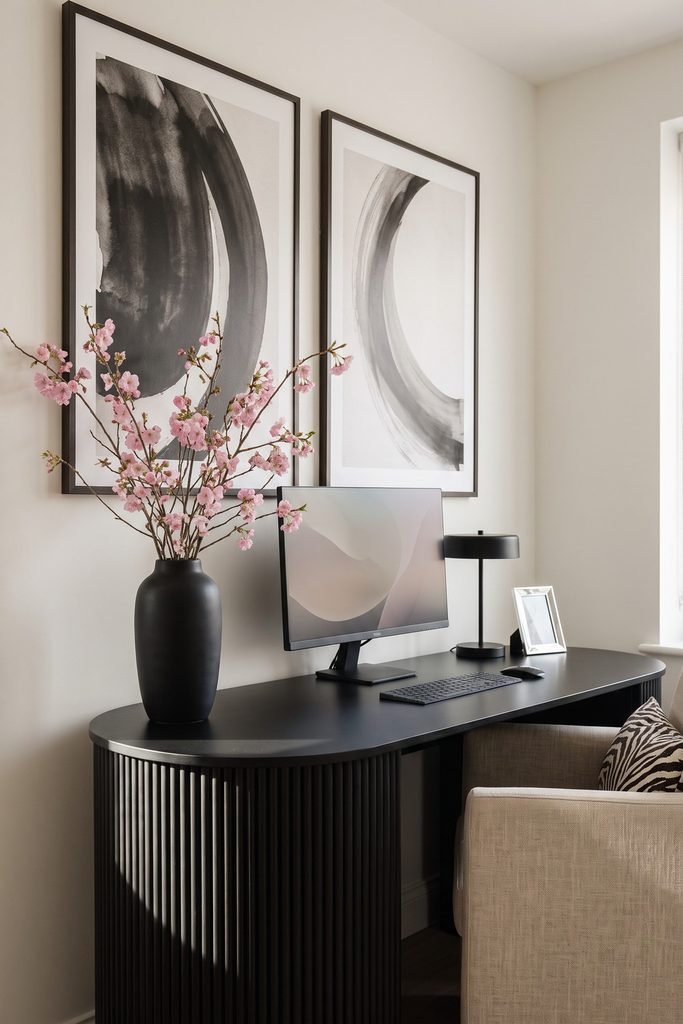
Pink blossoms introduce a different line. Their irregular stems and soft flower heads interrupt the graphic arrangement, giving the eye something loose beside the precise desk and frames. A tall dark vase keeps that floral accent connected to the furniture below.
The supporting patterns can stay small. A zebra cushion offers a second black-and-white motif, while a little silver photo frame catches light on the darker surface. A low black lamp lets the flowers remain the taller desktop feature.
Leave space around the curved desk end and the artwork borders. The flowers can sit beside the display in a stable vessel clear of the electronics.
Explore the Graphic Art and Vase Pairing
Large monochrome prints and a tall black vase echo the desk’s dark curves while leaving the pink blossoms visible.
22. A Pink Home Office With Walnut Shelves and a Scalloped Rug
Pink can define the entire room when the furniture gives it enough structure. Rose walls and a pink pendant establish the color envelope; a substantial walnut desk and tall timber shelving give that softness a firmer outline.
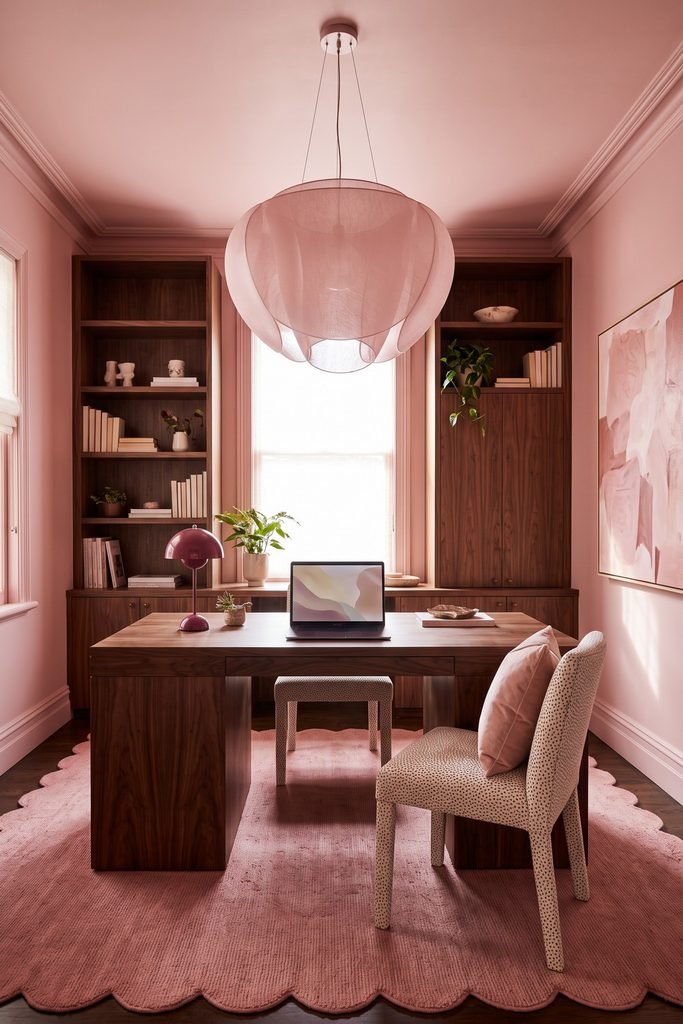
Use variation within the pink family. A blush artwork can sit behind a deeper rose lamp, while the rug carries another version of the color below the desk. Repeating pink at different heights connects the shades.
The scalloped rug adds a broad decorative shape, and a spotted chair contributes a smaller pattern. Their scales are different enough to remain readable beside the grain of the walnut. Green plants on the shelves provide a contrasting accent among books and ceramics.
Keep an open working area at the center of the desk. The surrounding color and shelving already carry plenty of personality, allowing the desktop itself to stay comparatively quiet. Choose the chair and rug with their everyday interaction in mind.
Carry Pink From Floor to Ceiling
A scalloped pink rug and a pink pendant repeat the room’s main color at two different heights.
23. An Orange Sculptural Chair Against Oversized Art
An orange sculptural chair can turn a simple workstation into a memorable furniture composition. Its saturated color and unusual outline need room to register, so a clear glass desktop and white wall make useful partners.
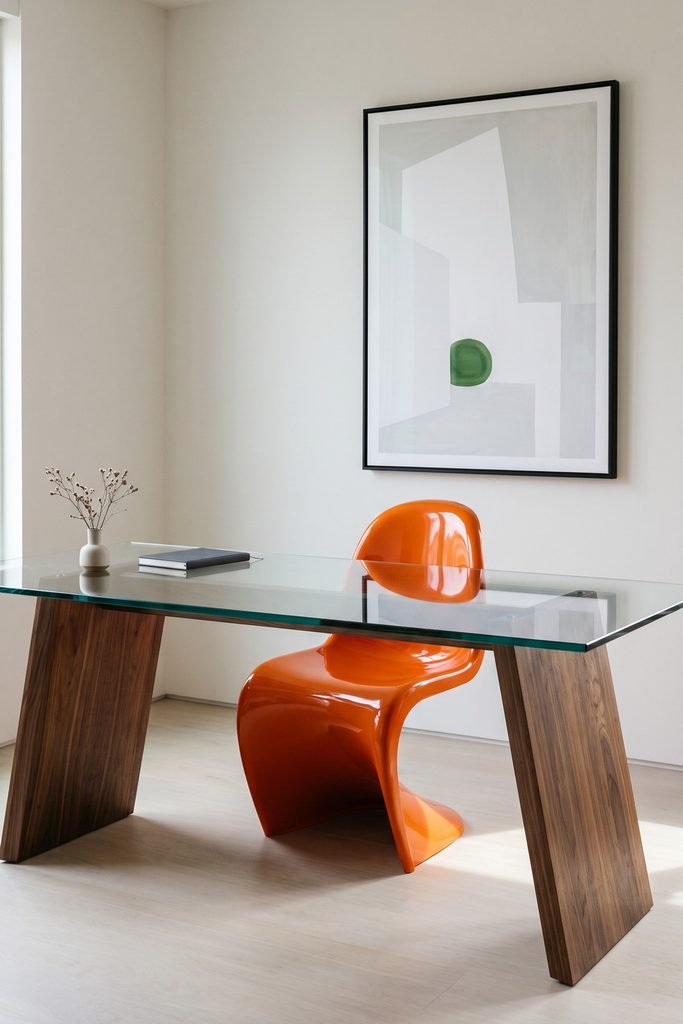
Oversized art gives the chair a backdrop at a different scale. A dark frame can relate to the desk’s timber supports, while one contained green accent in the artwork creates a second color point above the orange.
A small flower vessel and closed notebook can leave the chair as the strongest object.
This kind of expressive seating can be especially appealing for occasional desk use. For longer computer sessions, choose a seat that provides appropriate support and adjustment. The sculptural piece can retain its place in the room as an accent chair, with suitable working seating available when needed.
The home office that suits you may begin with a sofa-side desk, a wall of books, or a room shared with someone else. Choose the relationship that makes sense for your daily work, then develop its colors and textures selectively. A repeated wood finish, a well-scaled artwork, or a softer chair can carry an idea into your own home. Leave enough space for the work itself, and let the rest reflect how you like to live.