




22 Black Nouveau Decor Ideas That Feel Dark, Rich, and Artful
Black Nouveau decor is not simply a room painted black and finished with a few gold accents. The strongest versions use darkness as a backdrop for movement: curling botanical motifs, rounded furniture, expressive pattern, warm wood, reflective metal, saturated textiles, and lighting that breaks the room into softer pools instead of one flat field.
- Quick Takeaways
- How to Keep Black Nouveau Decor From Feeling Too Heavy
- Black Nouveau Living Rooms and Salons
- Float a Cream Curved Sofa Against a Black Botanical Mural
- Soften a Black Lounge With a Wavy Mirror and Rounded Seating
- Layer Chinoiserie, Jewel Tones, and Zebra in a Black Salon
- Mix Cognac Leather, Leopard, Palms, and Persian Rugs
- Grow an Urban Jungle Around a Zebra Rug
- Pair a Carved Black Relief Wall With Raw Wood and Woven Lights
- Keep Black Nouveau Airy With Ivory Architecture and Black Velvet
- Turn the Ceiling Into a Draped Nouveau Canopy
- Black Nouveau Bedrooms
- Build a Velvet-and-Walnut Black Bedroom Around Tiffany-Style Lamps
- Pair Black Chinoiserie Panels With Blush-Pink Bedding
- Build a Mustard Canopy Bed Between Palms and a Gilded Mirror
- Carve a Geometric Wood Headwall Into a Modern Black Bedroom
- Anchor a Black Bedroom With Oversize Art, Walnut, and Cream Textiles
- Black Nouveau Kitchens and Bathrooms
- Make a Black Kitchen Bloom With Pink Lotus Pendants and Orchids
- Pair Matte Black Bathroom Walls With White Penny Tile and Florals
- Make Black Marble Glow With Emerald Textiles and Brass
- Use an Arched Grid Shower and Geometric Floor in an Olive-Black Bath
- Give a Small Powder Room a Gallery Wall and Historic Patterned Floor
- Black Nouveau Entries, Nooks, and Decorative Corners
- Frame a Gothic-Arched Reading Nook With Art and Black Leather
- Style a Candlelit Art-and-Vanity Corner With Gilded Frames
- Balance a Black Entry With Graphic Flooring and Brass
- Turn Black Built-Ins Into a Botanical Panel Library Wall
- Black Nouveau Decor FAQ
- What is Black Nouveau decor?
- What is the difference between Art Nouveau and Art Deco decor?
- What colors work best with black in a Nouveau-style interior?
- Can Black Nouveau decor work in a small apartment?
- Creating Your Own Black Nouveau Look
- You May Also Like
That connection to movement matters. Historic Art Nouveau drew heavily from the natural world and is associated with sinuous lines, organic forms, and the famous whiplash curve. In a contemporary Black Nouveau interior, those ideas can show up through floral murals, carved relief, arched openings, curving mirrors, trailing plants, decorative glass, or even the silhouette of a sofa. The goal here is not to reproduce a period room. It is to translate that decorative language into dark interiors that feel layered, personal, and livable.
Below are 22 ways to do it across living rooms, bedrooms, kitchens, bathrooms, entries, and smaller corners of the home.
Quick Takeaways
- Let black act as the grounding color rather than the only interesting element in the room.
- Use cream, cognac, walnut, brass, jewel tones, or greenery to separate dark surfaces and create depth.
- Curves, florals, botanical forms, and expressive ornament carry more Nouveau character than black-and-gold alone.
- Give the room one dominant focal point, then let smaller details support it instead of competing with it.
- Layer lighting at different heights so velvet, wood, stone, lacquer, and metal remain visible after dark.
- In a small apartment, one wall, rug, mirror, cabinet, or lighting moment can carry the look without turning every surface black.
How to Keep Black Nouveau Decor From Feeling Too Heavy
The easiest way to lose the richness of a dark room is to let every large surface collapse into the same value. Black walls, black furniture, black flooring, and low light can erase the very details that make the space interesting. The fix is not necessarily to use less black. It is to give the black something to work against.
Contrast can come from a cream sofa, pale tile, ivory bedding, or a light ceiling. Warmth can come from walnut, cognac leather, mustard velvet, antique brass, or amber-toned lamps. Organic movement can come from palms, floral motifs, arched forms, or a wavy mirror. Texture can do another job entirely: boucle, carved wood, wool, glass, stone, and lacquer catch light differently, so a limited palette still has depth.
Focal hierarchy matters just as much. A room with a botanical mural, zebra rug, jeweled cabinet, patterned floor, dramatic chandelier, and gallery wall can still work, but one of those elements needs to lead. When every feature demands the same amount of attention, richness turns into noise.
Lighting is the final layer. Dark rooms are especially responsive to shaded lamps, sconces, pendants, and other localized sources because they reveal texture in sections. If you want more ideas for building that kind of layered glow, Apartment Charm’s lighting ideas for cozy rooms explores several ways to create softer focal lighting.
Black Nouveau Living Rooms and Salons
Float a Cream Curved Sofa Against a Black Botanical Mural
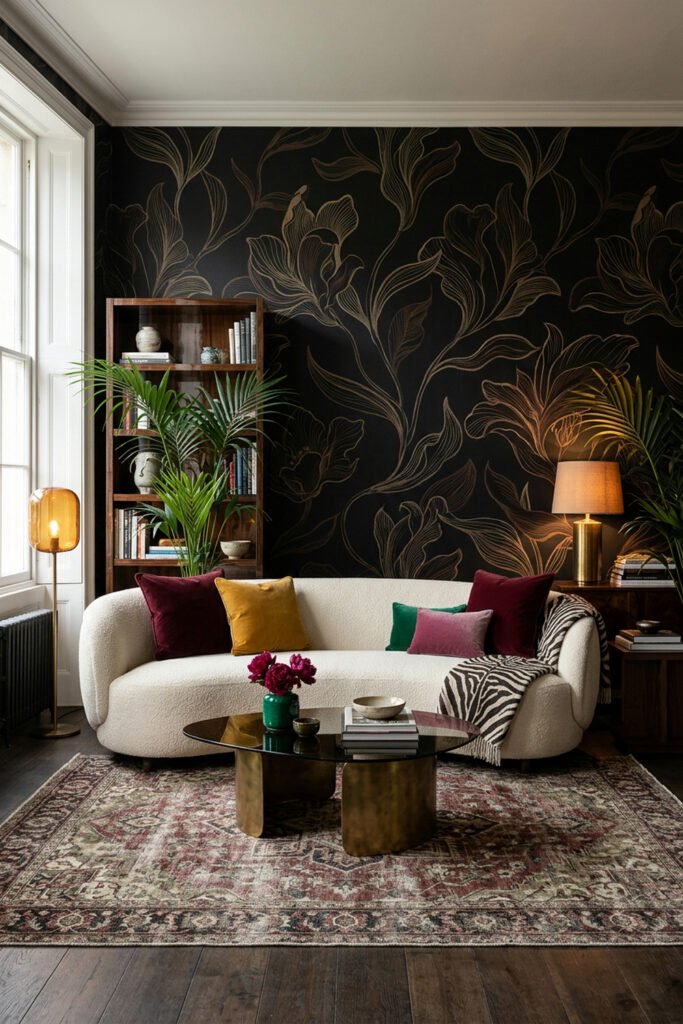
An oversized botanical mural can carry almost the entire Black Nouveau identity of a living room. Give it a charcoal or near-black ground, then let sweeping leaves and stems move across the wall in antique gold, bronze, or a muted earthy line. In front of it, a cream curved sofa becomes the visual pause the composition needs.
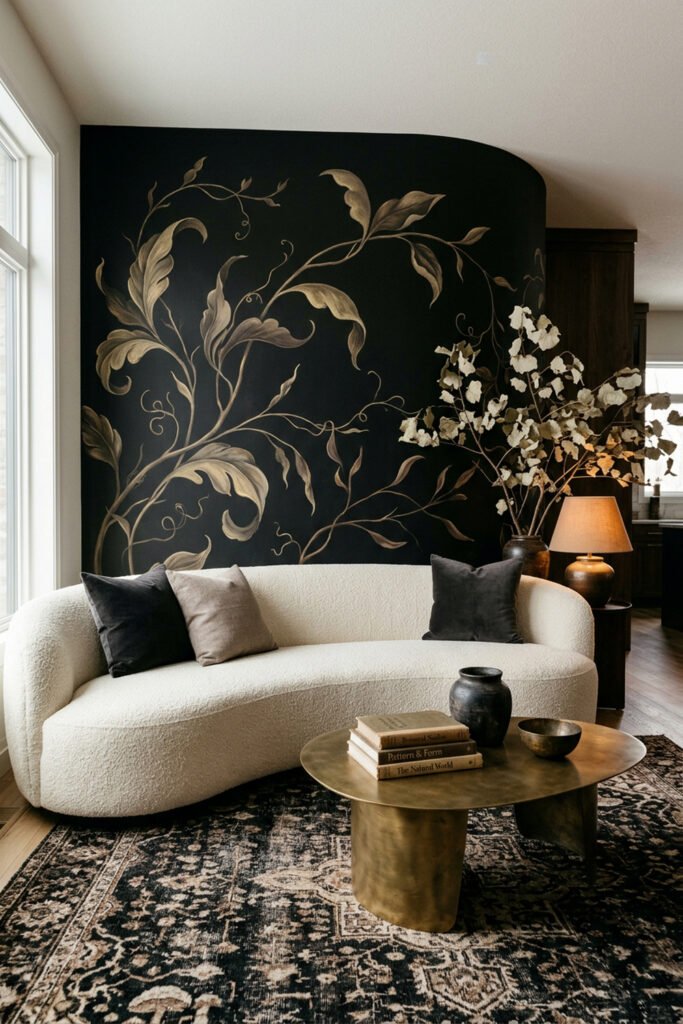
That light sofa does more than brighten the room. Its broad, uninterrupted shape separates the mural from the floor and gives the eye somewhere quiet to land. Boucle is especially effective here because the nubby surface catches light without adding another pattern. A low brass or bronze coffee table can echo the metallic lines in the wall, while black pillows keep the sofa connected to the darker shell.
Keep the smaller styling edited. A few books, a dark ceramic vessel, and dried branches are enough when the wall is already doing the decorative work. The result is dramatic from across the room but still easy to read.
Recreate the Botanical Contrast
If you want the same dark botanical backdrop without replacing major furniture, focus on the wall treatment and a few black-and-brass accents around the seating.
Soften a Black Lounge With a Wavy Mirror and Rounded Seating
Black paneling can feel formal when every line around it is straight. A tall wavy mirror changes that immediately. Its irregular outline interrupts the rigid architecture, and the reflected light creates a second layer of depth without requiring more color.
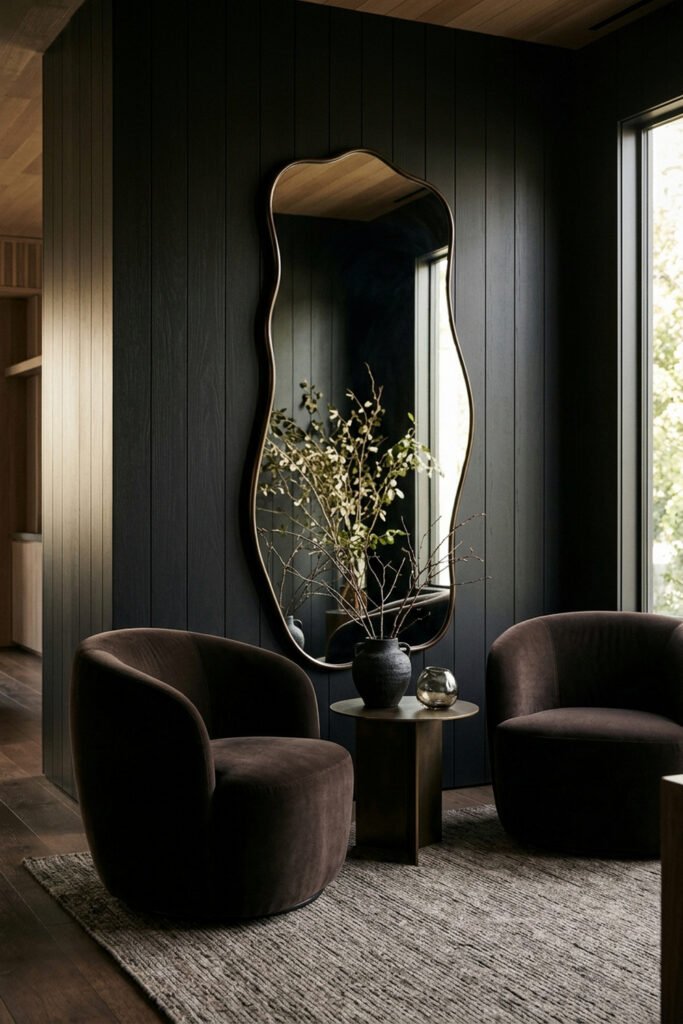
Build the seating around that same curved language. Rounded lounge chairs in espresso velvet or deep charcoal make the room feel softer than boxy club chairs would. A small bronze table or dark wood pedestal adds just enough contrast between matte fabric and a harder reflective surface.
This version of Black Nouveau decor is useful if you like the mood but not the abundance. Instead of filling shelves and walls, concentrate on silhouette. One sculptural mirror, two rounded seats, and a restrained arrangement of branches can communicate the style through shape rather than through collections of objects.
Layer Chinoiserie, Jewel Tones, and Zebra in a Black Salon
For the more maximal side of Black Nouveau, start with one ornate anchor such as a lacquered chinoiserie cabinet or screen. Against a dark wall, its painted florals and small metallic details become clearer, especially when the rest of the palette pulls from saturated mustard, burgundy, magenta, emerald, and antique gold.
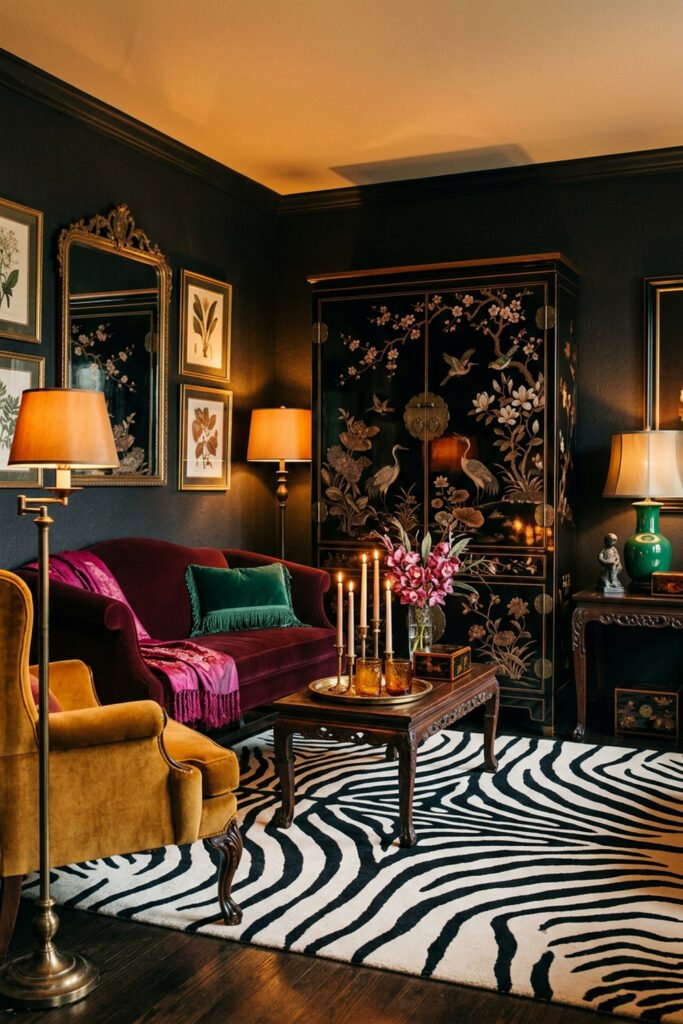
Animal pattern works surprisingly well in this setting because zebra reads almost like graphic linework. Use it on a rug or one strong upholstered piece rather than scattering it everywhere. Velvet adds another kind of richness: a burgundy chair, mustard throw, or magenta cushion can hold deep color without becoming visually sharp.
The trick is repetition with restraint. If emerald appears in a ceramic bowl, repeat it once in a small textile or plant vessel. If magenta shows up in flowers, let the same family appear in a candle or cushion. Those echoes make the room feel collected rather than random, while the lacquered cabinet remains the unmistakable focal point.
Build the Jewel-Tone Salon Layer
The easiest pieces to shop for here are the decorative layers that create the contrast: chinoiserie imagery, graphic animal pattern, and saturated velvet accents.
Mix Cognac Leather, Leopard, Palms, and Persian Rugs
Cognac leather is one of the most effective bridges between black and a warmer, more relaxed palette. Against dark walls, the orange-brown tone reads almost luminous. Add leopard in smaller doses, then surround the seating with tall palms or other broad-leaf greenery to introduce a cooler organic counterpoint.
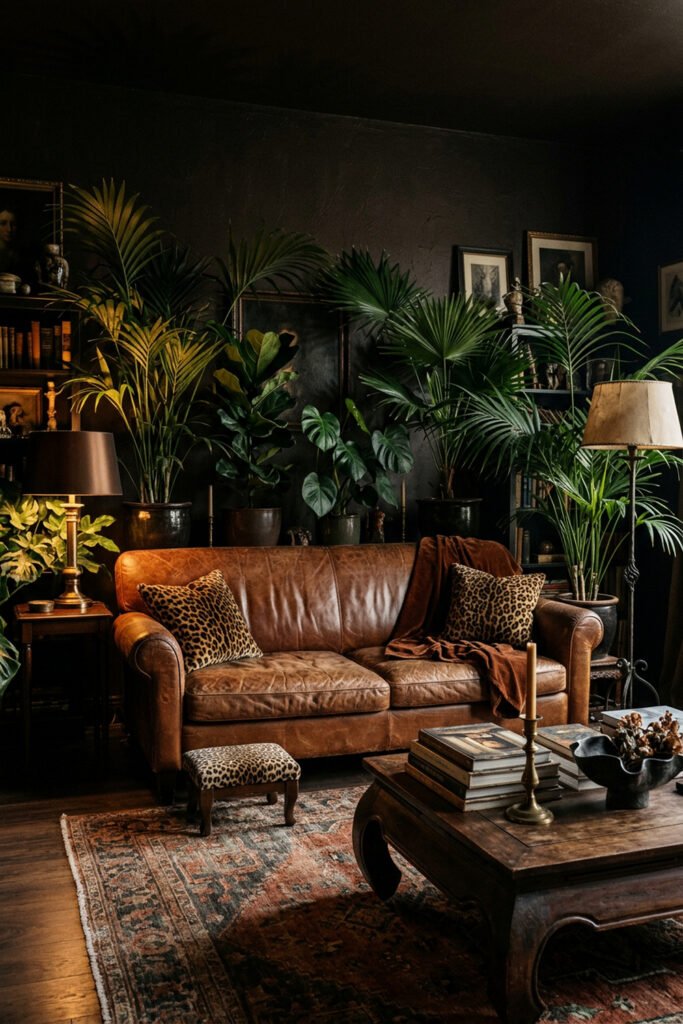
A Persian-style rug can carry rust, black, cream, and muted green through the floor, which helps the palette travel beyond the sofa. That matters in a room with strong walls. Without a patterned floor or lighter textile, all of the color can become concentrated at eye level.
Keep the furniture substantial and low. A deep leather sofa, dark wood coffee table, and one patterned chair create enough weight to hold the room together. Then let the plants break the hard outline of the architecture. The finished space feels dense and layered, but each material has a separate role: leather brings warmth, wool brings pattern, foliage brings movement, and black gives everything contrast.
Find the Pattern and Warmth Layers
You can echo the collected salon feeling through leopard pattern, an old-world rug, and warm metallic lighting without turning the section into a full furniture replacement project.
Grow an Urban Jungle Around a Zebra Rug
A smaller apartment can carry the same dark, expressive energy by letting plants create most of the vertical drama. Instead of filling the room with heavy furniture, use a dark sofa, a zebra-pattern rug, and several tall plants placed around windows, corners, and the edge of the seating area.
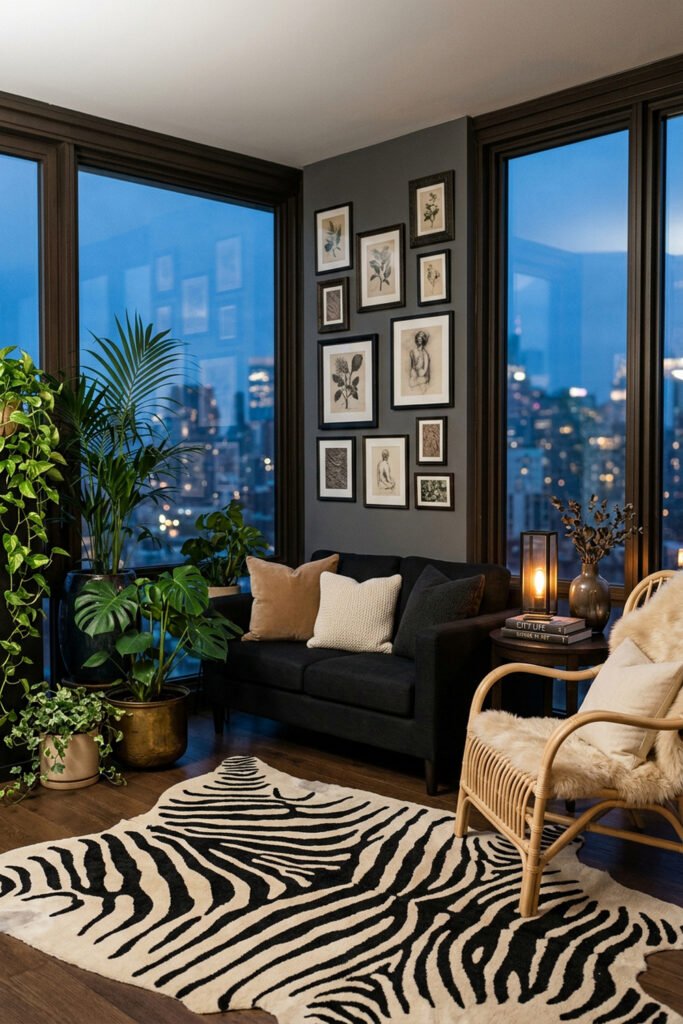
The zebra pattern is strongest when the rest of the upholstery is fairly quiet. It gives the floor movement and creates a visual path toward the sofa, while the greenery softens the hard black-and-white contrast. Cane, rattan, or pale faux fur can add a lighter tactile layer so the room does not become a wall of dark upholstery.
In a city apartment with generous windows, keep the tallest plants near the glass and allow some open space around the frames. That preserves the daylight and makes the dark interior feel more dimensional. A few framed artworks, stacked books, and warm lamps can add the collected feeling without crowding the circulation zone.
Pair a Carved Black Relief Wall With Raw Wood and Woven Lights
Black does not need to be smooth to feel sophisticated. A carved or relief wall treatment can become the main ornament in a room, especially when the pattern is large enough to read from across the space. Instead of adding wallpaper, art, and shelving on top, let the wall itself provide the movement.
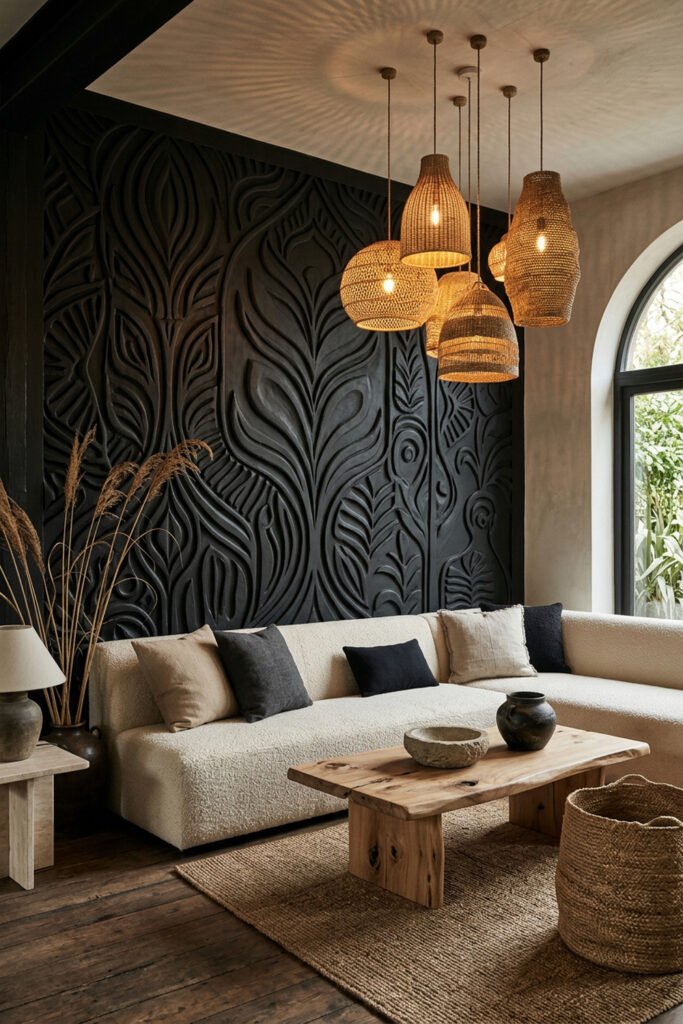
Raw or heavily grained wood is the ideal counterweight. A low timber bench, sculptural coffee table, or thick wood ledge introduces warmth without competing with the relief. Woven pendant lights add a third texture, and their softer surface keeps the black architecture from feeling too polished.
A cream or sand-colored sofa gives all of those materials breathing room. The effect is earthy rather than gilded, which makes this direction useful for anyone who likes Black Nouveau’s organic side more than its ornate side. Dried grasses and monochrome pillows can stay quiet so the carved wall remains the dominant feature.
Keep Black Nouveau Airy With Ivory Architecture and Black Velvet
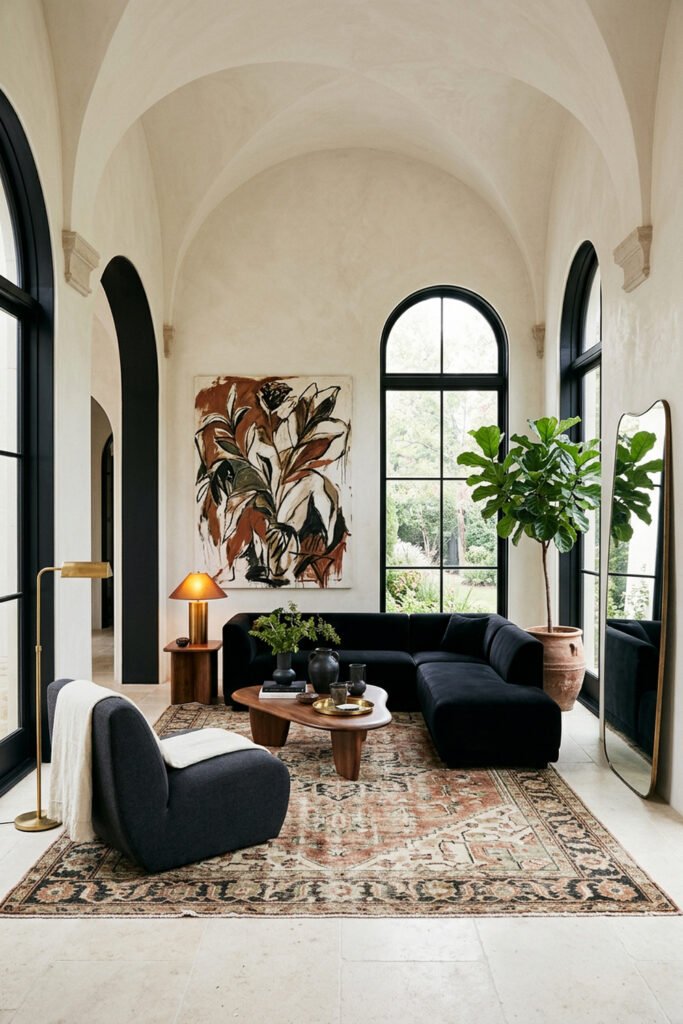
You do not have to paint the entire room black to create a Black Nouveau interior. In fact, one of the strongest ways to keep the look airy is to leave the architectural shell pale and concentrate black in the furniture, art, and lighting.
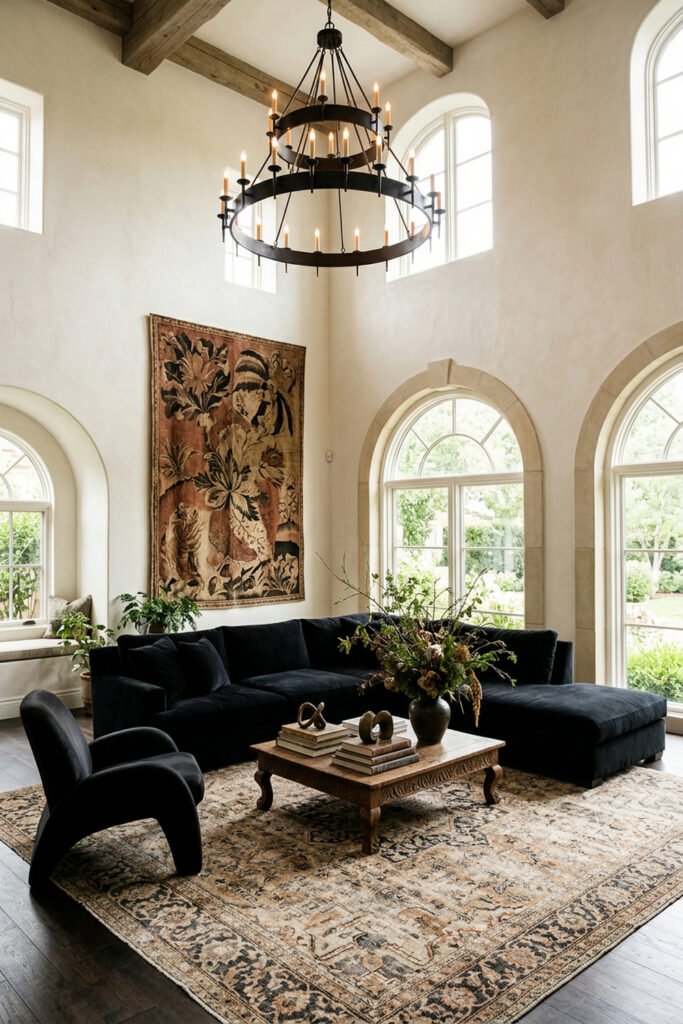
Picture ivory walls, tall windows, a black velvet sectional, and one overscale tapestry or dark-framed artwork. The dark furniture sits low, so the upper half of the room still reflects daylight. A black chandelier can connect the ceiling to the seating without filling the walls with more dark paint.
This approach also makes ornate details easier to see. A carved coffee table, embroidered pillow, or patterned rug does not have to fight a dark background for attention. The light shell becomes negative space around those objects. If an all-black room feels too committed, this is one of the most convincing ways to get the mood while keeping the architecture open.
Turn the Ceiling Into a Draped Nouveau Canopy
When the ceiling becomes the focal point, the rest of the room can be surprisingly simple. Fabric gathered toward a central pendant creates radial movement overhead and gives a lounge the feeling of an intimate tented salon.
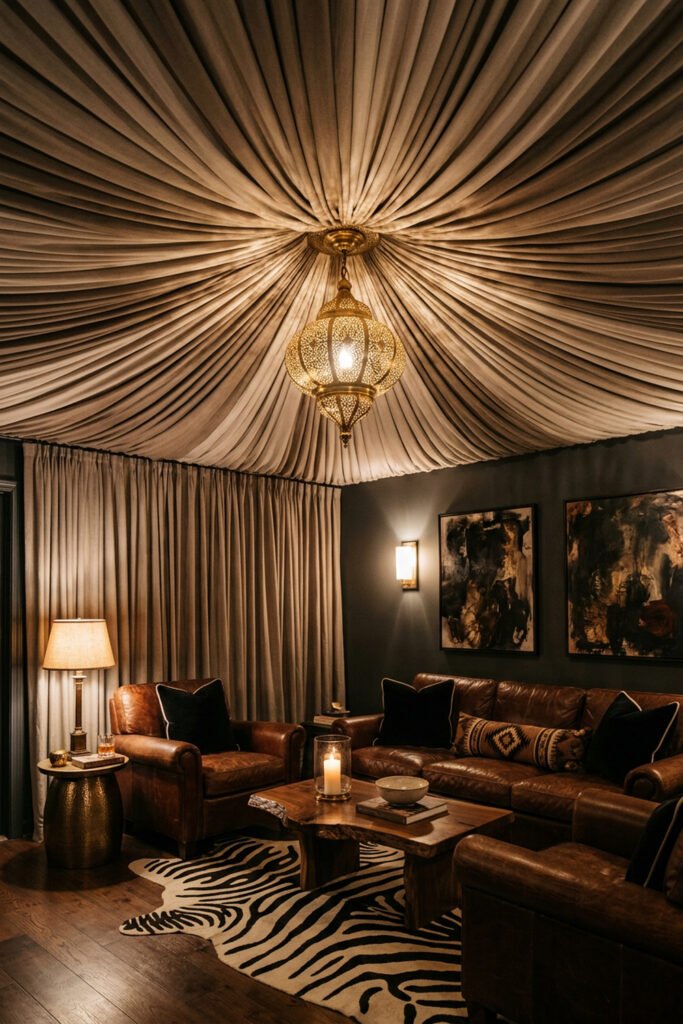
The visual weight works best when the palette stays controlled. Taupe, espresso, ivory, and black allow the folds to show through shadow rather than through multiple competing colors. Low leather seating and a zebra-pattern floor can ground the room, while a perforated or sculptural pendant becomes the center of the ceiling composition.
This is a high-drama treatment, so resist the urge to add another major statement wall. Art, side tables, and textiles should support the canopy rather than challenge it. For a real installation, the method, hardware, fabric choice, and clearances need to suit the actual ceiling and fixtures. Treat the image as design inspiration first, then use qualified installation guidance for the physical build.
Black Nouveau Bedrooms
Build a Velvet-and-Walnut Black Bedroom Around Tiffany-Style Lamps
A dark bedroom becomes much easier to live with when the light sources are part of the decoration. Tiffany-style lamps or other warm decorative glass lamps create small amber pools on either side of the bed, revealing the grain of walnut nightstands and the sheen of black velvet.
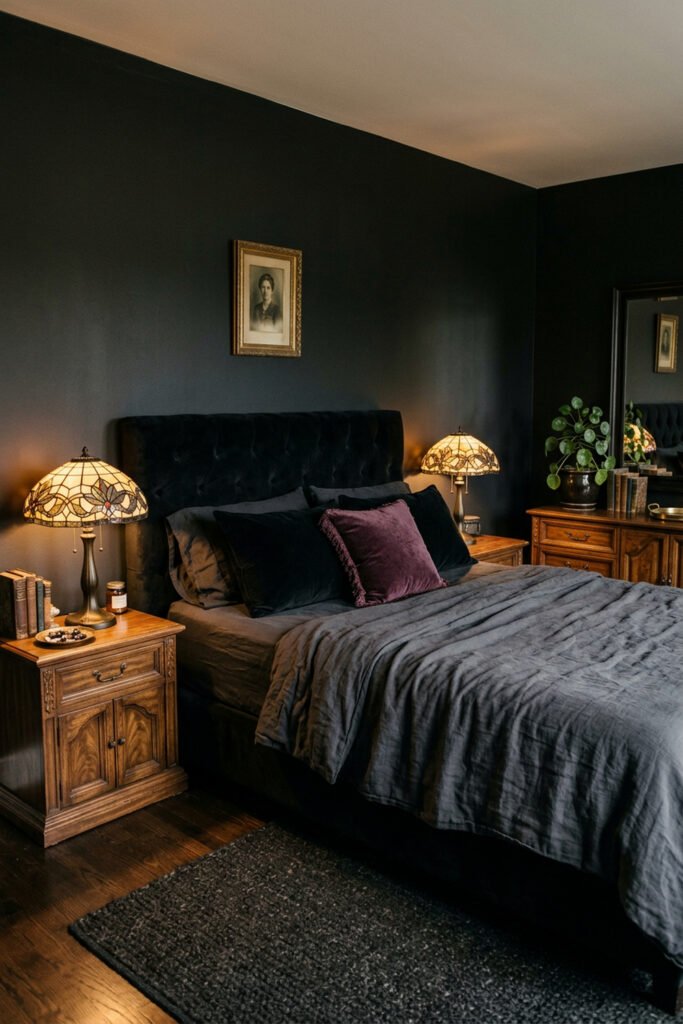
Symmetry is useful here. Matching lamps stabilize a room that already contains rich surfaces and framed art. The bed can remain the largest dark mass, while walnut chests or bedside tables keep the lower half from turning into one continuous black block.
Introduce plum or smoky mauve in a single pillow or throw rather than spreading another saturated color around the room. Plants and small framed portraits can add detail near the edges. The appeal comes from the transition between materials: soft velvet, carved wood, glowing glass, and matte walls each absorb or reflect light differently, making the room feel cocooning instead of flat.
Bring In the Amber Bedroom Glow
The decorative lamps do most of the atmospheric work in this bedroom, while black velvet and dark wood details reinforce the richer material story around them.
Pair Black Chinoiserie Panels With Blush-Pink Bedding
Black and blush can create a much softer bedroom than their contrast suggests. The black wall or chinoiserie panels provide structure and pattern, while layered pink bedding becomes the luminous center of the room.
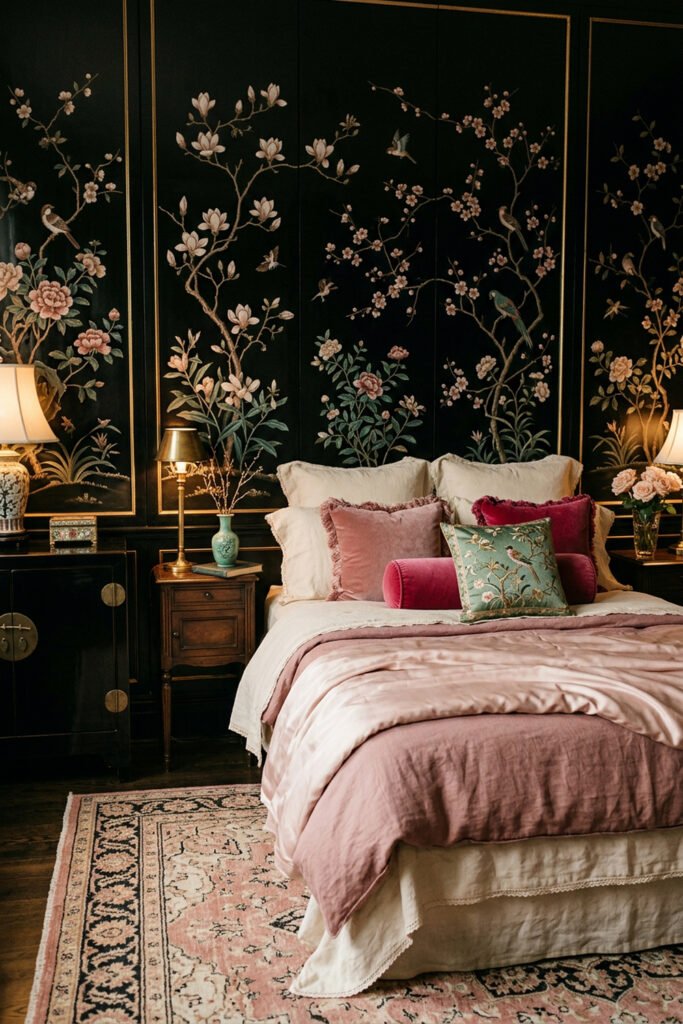
Let the wall carry the smallest decorative details. Floral branches, birds, and delicate painted motifs can remain intricate because the bedding is broader and simpler. Raspberry piping, jade green, or muted aqua can appear in a few cushions to keep the palette from becoming only black and pink.
Glossy lacquer furniture and porcelain accessories work well because they reflect small points of light against the matte textiles. Keep the bed generous with pillows and a draped coverlet, but avoid introducing several unrelated patterns at the same scale. The room feels richest when the black botanical backdrop is detailed, the bedding is soft and expansive, and the smaller accent colors act as bridges between them.
Recreate the Black-and-Blush Palette
For this room, the strongest shopping direction is the contrast itself: luminous blush textiles against a dark floral backdrop, with one muted green accent to bridge the two.
Build a Mustard Canopy Bed Between Palms and a Gilded Mirror
Mustard is a powerful companion to black because it brings warmth without needing to become bright yellow. On a canopy bed, it can become the main color mass in the room. Pair it with ivory canopy fabric so the bed has both depth and a lighter vertical element.
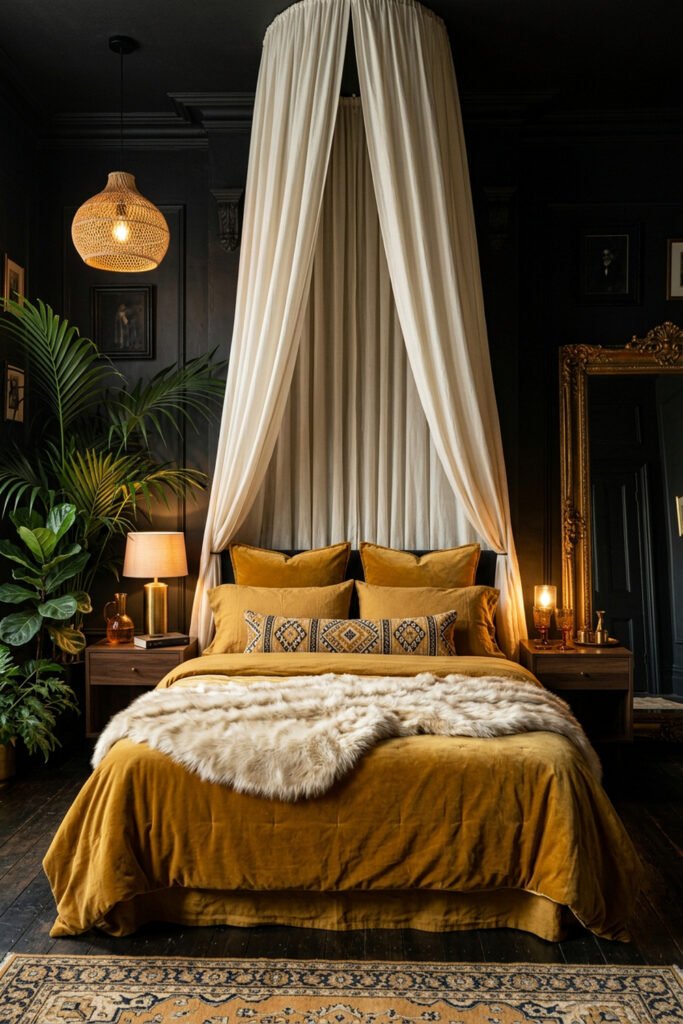
Large palms work beautifully beside that structure because their arching leaves echo the drape of the canopy. On the opposite side, an ornate gilded mirror adds reflection and a warm metallic edge. The room can hold a lot of detail, but the hierarchy stays clear: mustard bed first, plants and mirror second, patterned pillows and smaller objects last.
A woven pendant or amber lamp keeps the light soft enough for the dark walls to remain rich. Faux fur or a thick rug can soften the foot of the bed, especially if the furniture and mirror frames are visually heavy. This is maximalism, but the pale canopy gives the eye a deliberate pause.
Carve a Geometric Wood Headwall Into a Modern Black Bedroom
Black Nouveau can lean contemporary when the decorative movement comes from relief rather than floral pattern. An oversized carved or slatted wood panel above the bed creates shadow, line, and scale while keeping the palette disciplined.
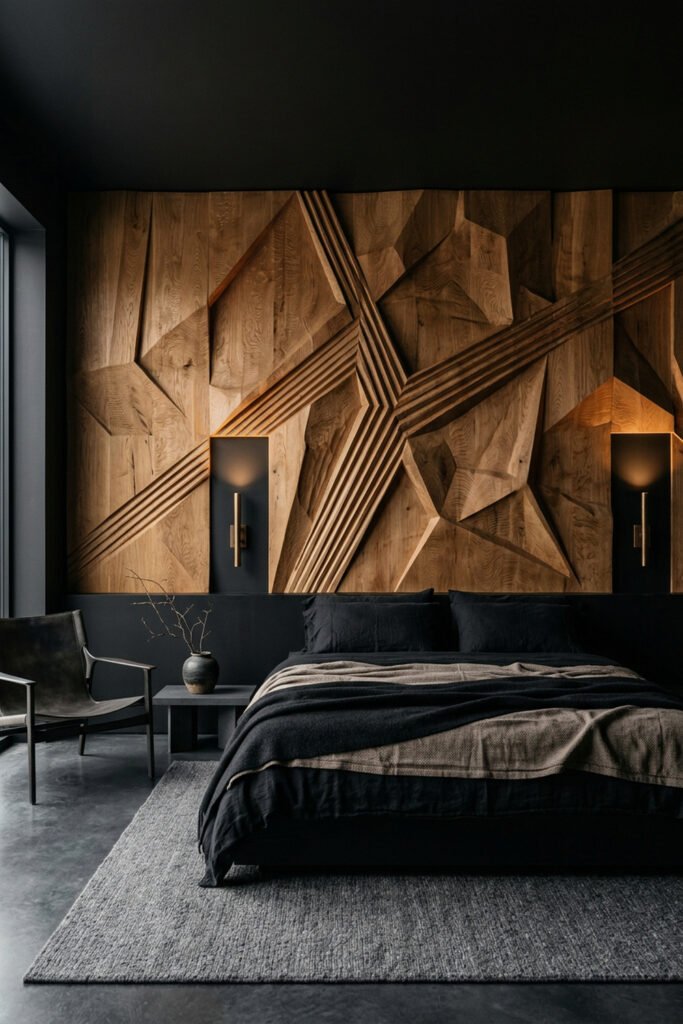
The wood should be warm enough to separate clearly from the black wall. Natural oak, smoked oak, or another brown wood tone can do the job visually, depending on the room. Keep the bed low and mostly charcoal or black so the headwall remains the first thing you notice.
Slim sconces can graze the surface and reveal the depth of the carving after dark. Because the wall already carries a strong graphic rhythm, the bedding and rug can stay simpler, with texture taking the place of extra pattern. This direction is especially useful if you want the drama of Black Nouveau without antique furniture, florals, or dense ornament.
Anchor a Black Bedroom With Oversize Art, Walnut, and Cream Textiles
One large artwork can replace an entire gallery wall. In a dark bedroom, that scale matters because dozens of small frames can make the wall feel fragmented. A single expressive figurative or botanical piece gives the bed a clear center and lets the surrounding black wall act almost like a frame.
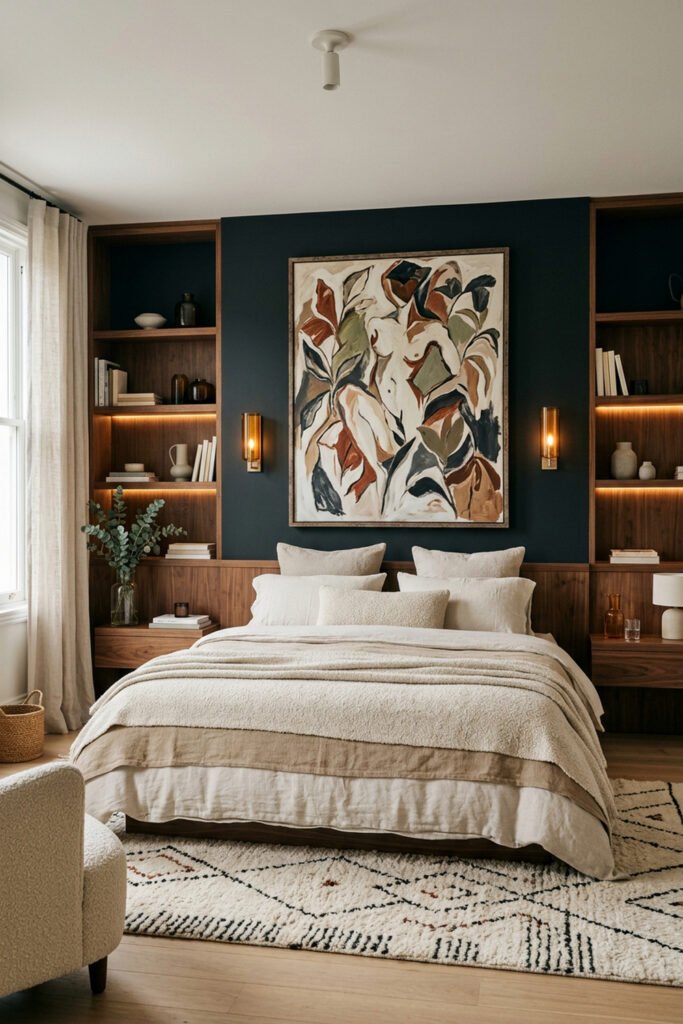
Cream bedding provides the largest light surface, while walnut shelves or a wood headboard create a middle tone between cream and black. Rust, muted green, or brown can enter through pillows and ceramics without changing the calm structure.
Keep bedside styling low and compact. A couple of books, a ceramic vessel, and a warm sconce are enough when the artwork is oversized. This is one of the simplest Black Nouveau apartment ideas because the room does not depend on architectural changes. The drama comes from proportion, contrast, and the relationship between one large artwork and a restrained set of supporting materials.
Black Nouveau Kitchens and Bathrooms
Make a Black Kitchen Bloom With Pink Lotus Pendants and Orchids
A dark kitchen can support one flamboyant decorative gesture exceptionally well. Flower-shaped pendant lights in saturated pink or fuchsia become even more vivid against black or deep oxblood cabinetry, especially when the counters remain relatively clear.
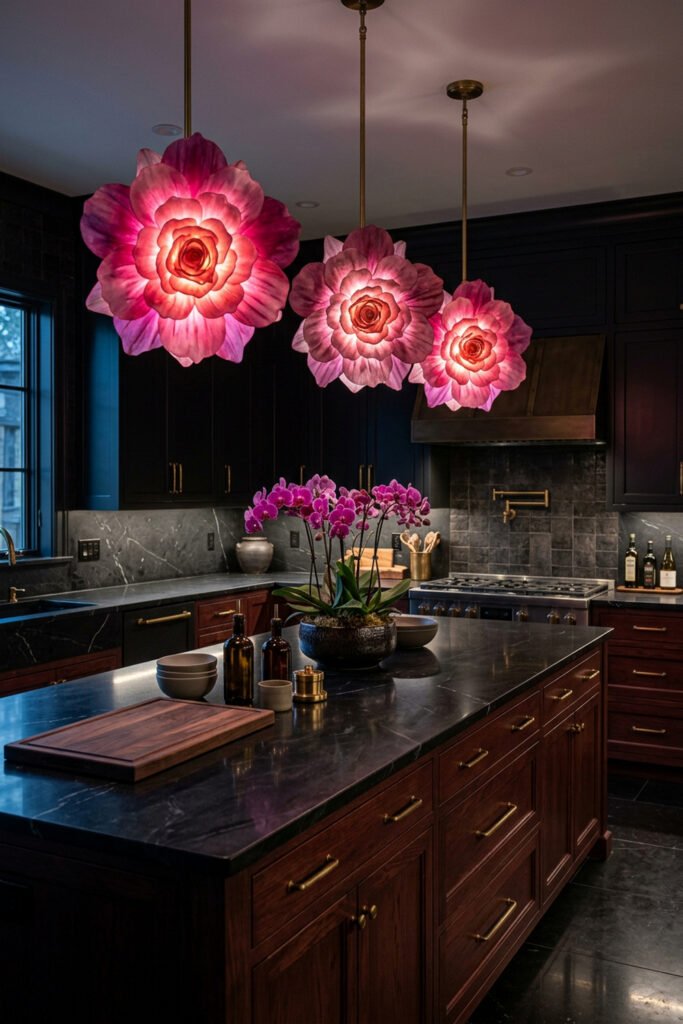
Repeat the floral idea below with orchids or another sculptural bloom on the island. The repetition makes the lighting feel connected to the room rather than like a novelty fixture dropped into an unrelated kitchen. Dark polished stone can add subtle reflection, while warm metal or wood details keep the black surfaces from looking overly cool.
Three pendants over a long island create a strong rhythm, but the exact number should suit the room and fixture scale. The important lesson is contrast: when the cabinetry is visually quiet and dark, one expressive light family can carry the decorative identity. Electrical installation should always follow the fixture manufacturer’s instructions and applicable requirements for the home.
Pair Matte Black Bathroom Walls With White Penny Tile and Florals
Small bathrooms benefit from clear dark-and-light zoning. Matte black walls can wrap the upper half of the room, while a white or warm-white penny tile floor creates a crisp reflective base below. The separation keeps the bathroom dramatic without making every surface recede into darkness.
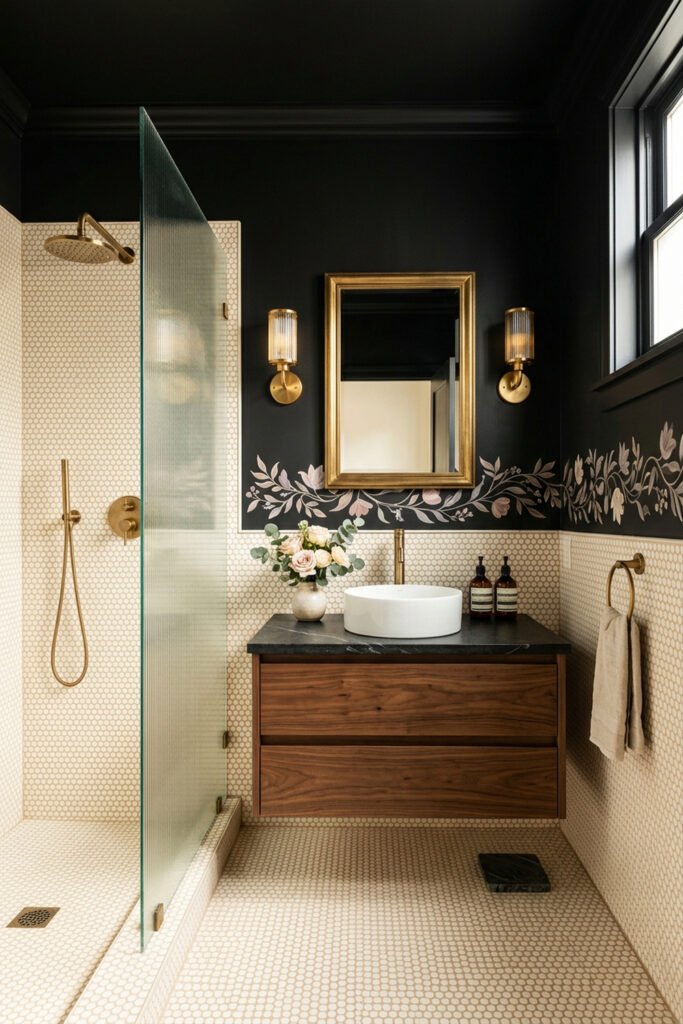
A narrow floral frieze, botanical wallpaper area, or painted motif can bring in the Nouveau element without adding another major color block. Brass or warm metal fixtures then sit between black and white, acting as a visual bridge. A vintage-style mirror and a vase of pale flowers can repeat those warmer notes around the vanity.
Pattern scale matters in a compact room. Penny tile is small and repetitive, so keep the wall motif more open and flowing. If wallpaper, tile, paint, or another finish is being used near water, choose products specifically intended for that location rather than assuming a decorative material is suitable everywhere.
Make Black Marble Glow With Emerald Textiles and Brass
Black stone or black-marble-look surfaces can feel exceptionally rich when they are paired with emerald rather than more neutral gray. Deep green towels, a small upholstered stool, or a textile runner introduce saturated color while staying within the room’s dark tonal range.
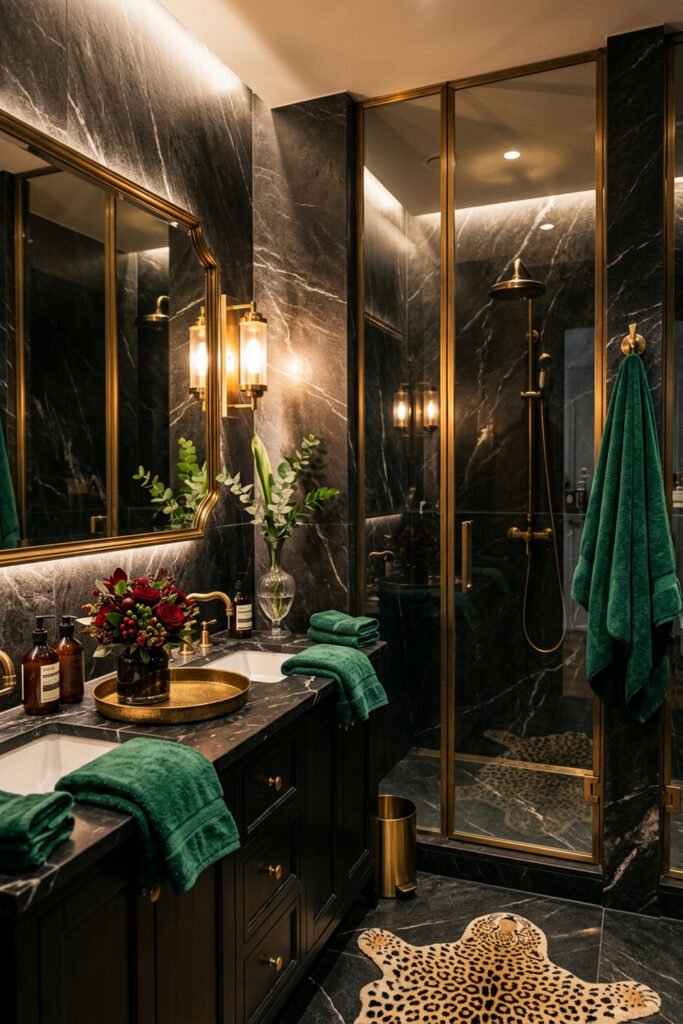
Brass adds a different kind of contrast. It reflects the warm light around a vanity or shower, so faucets, mirror frames, and small trays can punctuate the black surfaces without requiring another large color. A restrained leopard-pattern rug can work as a smaller-scale accent because its tan and black connect the stone to the warmer metal.
Keep the green repeated in only a few areas. One towel by the sink, another near the shower, and perhaps a floral arrangement are enough to make it feel deliberate. The goal is not to cover the room in jewel tones. It is to let emerald, brass, and patterned textile break up the visual density of the stone.
Add the Emerald-and-Brass Layer
Emerald textiles and warm metal accessories can break up a dark bathroom effectively without covering the stone or introducing another major pattern.
Use an Arched Grid Shower and Geometric Floor in an Olive-Black Bath
An arched shower enclosure gives a dark bathroom a strong architectural curve, which is especially useful when the floor carries angular geometric pattern. Those two shapes play against each other: the arch softens the grid, while the floor keeps the room from becoming overly ornate.
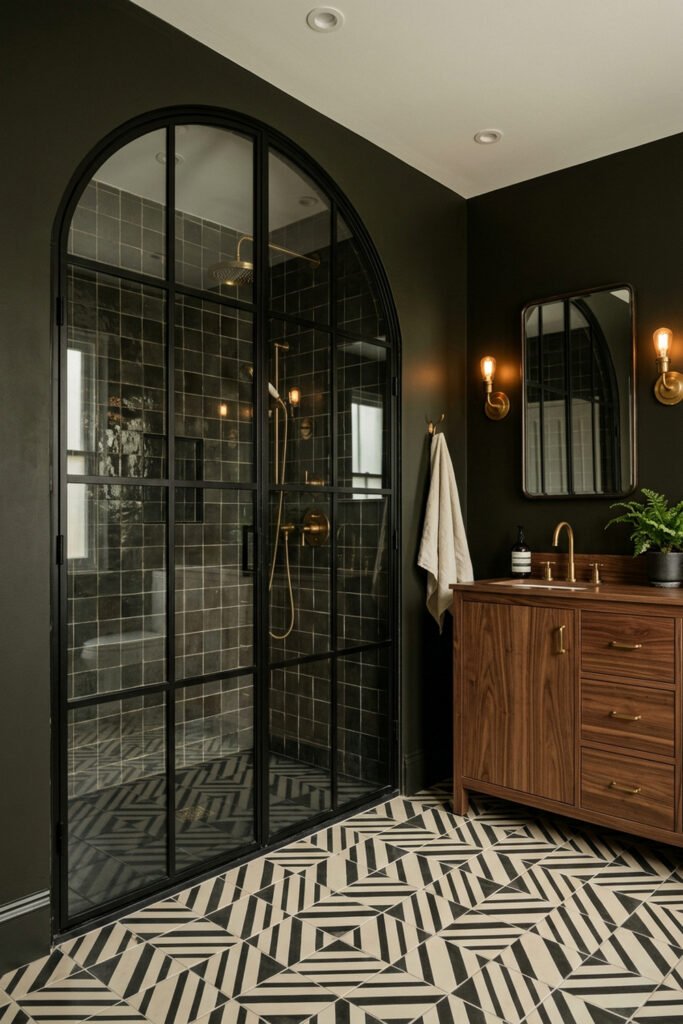
Olive-black or very deep green walls can be easier to read than pure black under warm lighting. Pair them with a walnut vanity and aged brass details so the room has a clear sequence of dark, medium, and warm reflective tones.
Because the floor already has a lot of movement, the wall treatment can stay relatively quiet. A framed mirror, two sconces, and a few well-chosen objects around the sink are enough. The shower frame remains the vertical focal point while the patterned floor pulls the eye through the room. For real bathroom work, enclosure, electrical, and wet-area specifications should be handled according to the products and installation conditions being used.
Give a Small Powder Room a Gallery Wall and Historic Patterned Floor
A powder room is one place where dense pattern can feel concentrated rather than overwhelming. Dark walls set the background, a pale toilet or sink creates a clear central contrast, and a gallery of framed portraits or architectural prints pulls the eye upward.
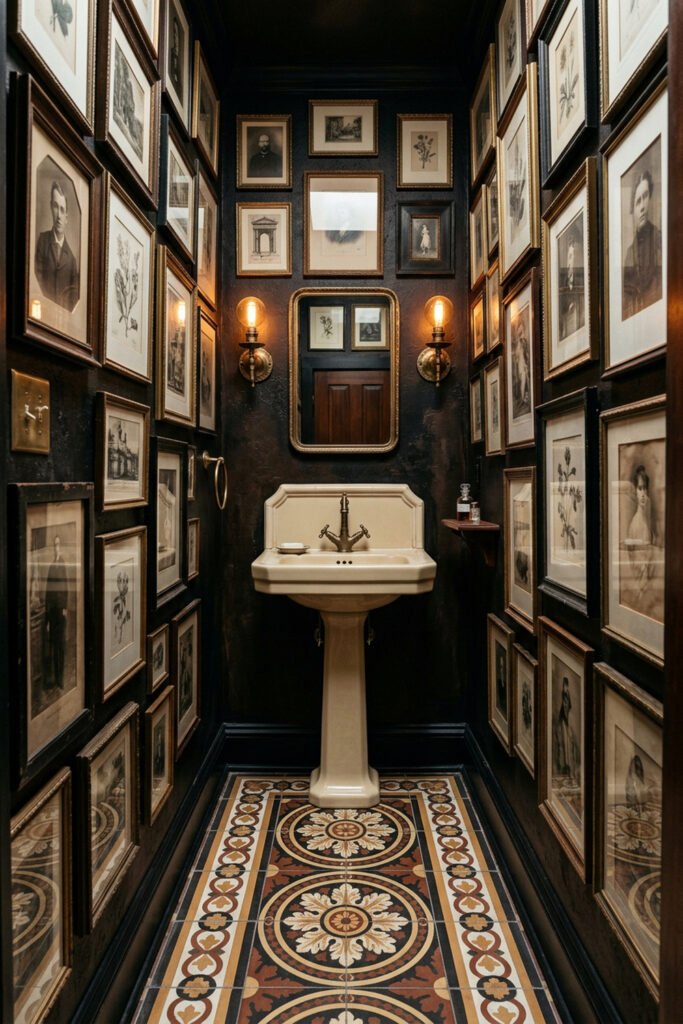
The floor can be the second major feature. Choose a pattern with an old-world feeling, such as floral medallions, geometric borders, or black-and-cream motifs with rust or ochre accents. Because the room is small, the floor appears almost like another artwork.
Keep accessories compact. A pair of wall lights, a small shelf, and perhaps one lantern-style object are enough. The gallery wall should feel deliberate, with similar frame tones or a repeated spacing rhythm, rather than like leftover art squeezed into a small room. When choosing actual flooring and wall finishes, use materials suitable for the specific bathroom conditions and follow their care and installation guidance.
Black Nouveau Entries, Nooks, and Decorative Corners
Frame a Gothic-Arched Reading Nook With Art and Black Leather
A reading nook can carry the entire aesthetic with only a few strong moves. A tall arched window or arched mirror establishes the vertical curve, while a black leather bench or daybed gives the lower half enough weight to feel grounded.
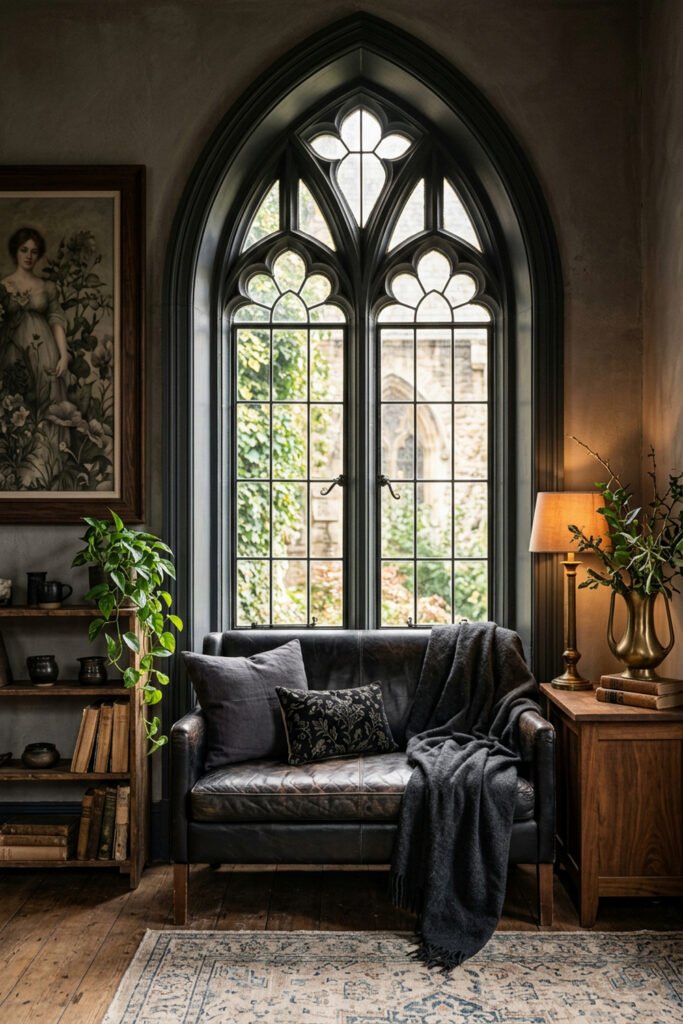
Place one substantial artwork beside or above the seat rather than surrounding it with tiny frames. Books and a botanical arrangement can fill the remaining space with softer, irregular shapes. Walnut or another dark brown wood is useful here because it separates the black leather from the black wall without changing the mood.
Natural light is especially valuable in this kind of nook. During the day, it reveals the difference between leather, painted wood, paper, and foliage. At night, one shaded lamp can take over without flattening the entire corner. It is a compact way to create Black Nouveau decor without changing the rest of the room.
Style a Candlelit Art-and-Vanity Corner With Gilded Frames
A vanity, console, or narrow dresser can become a miniature Black Nouveau composition when the wall behind it is dark and the objects are grouped rather than evenly scattered. Start with one large gilded mirror or framed artwork, then build downward with glass bottles, flowers, books, and a few metal pieces at different heights.
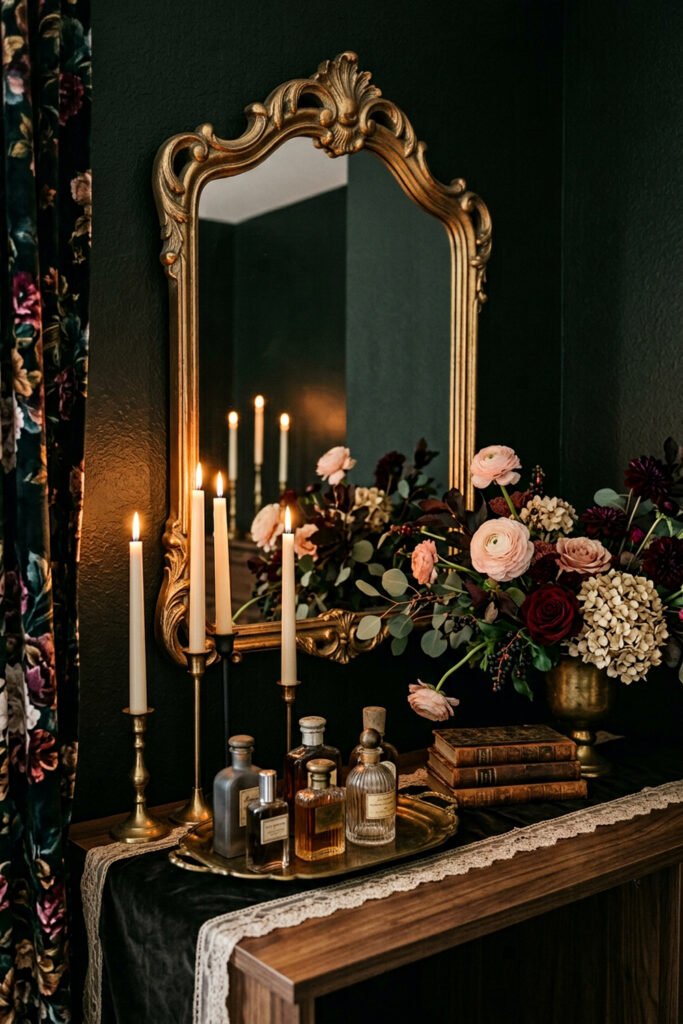
The reflective materials matter as much as the objects themselves. Glass catches small points of light; brass warms the edges; a lace runner or velvet cloth introduces softness underneath. Burgundy, blush, or cream flowers can break the black-and-gold combination with a natural color.
Dense styling feels more controlled when the tallest items sit near the center or one side, while the rest steps down in height. If you want candle-like glow near fabric, books, curtains, or dried botanicals, flameless candles are a practical way to achieve the visual effect without placing an open flame close to those materials.
Find the Reflective Vanity Details
A gilded mirror, decorative glass, and flameless candlelight capture the layered glow of this vignette without needing to crowd the surface with dozens of objects.
Balance a Black Entry With Graphic Flooring and Brass
A narrow entry does not need dark walls on every side. Black can work more effectively as a frame: a black door, arch, trim, console, and narrow section of wall can define the route through the space while ivory walls keep the hallway open.
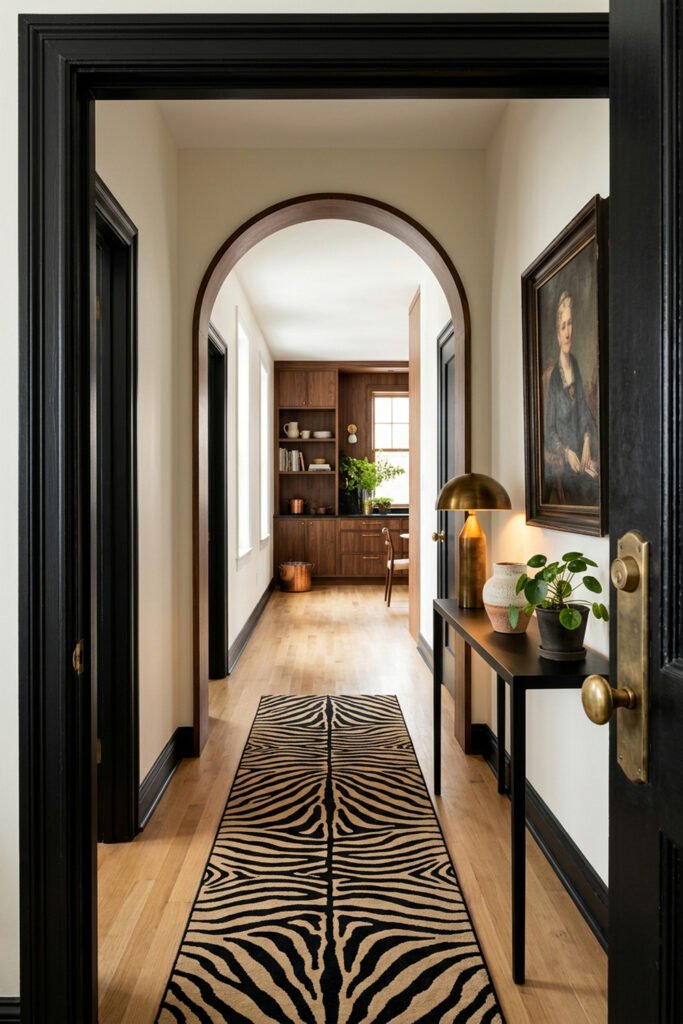
A zebra runner, checkerboard floor, or another black-and-tan graphic pattern draws the eye forward. Brass hardware and a warm lamp give the palette a warmer break, while one green plant prevents the entry from becoming entirely geometric.
This is a particularly useful approach for a Black Nouveau apartment because it concentrates the drama at the threshold. Visitors understand the aesthetic immediately, but the pale architecture still carries light into adjoining rooms. A single portrait or oversize artwork above the console is usually stronger than a busy gallery when the floor already has a bold pattern.
Build the Entryway Contrast
A graphic runner carries the black pattern through the floor, while one brass light and a portrait-style artwork add warmth and character above it.
Turn Black Built-Ins Into a Botanical Panel Library Wall
Built-ins can become much more than storage when tall botanical panels occupy the center of the composition. Paint the shelving and surrounding wall black, then place one or more large floral panels between the bookcases so pattern has a clear place to live.
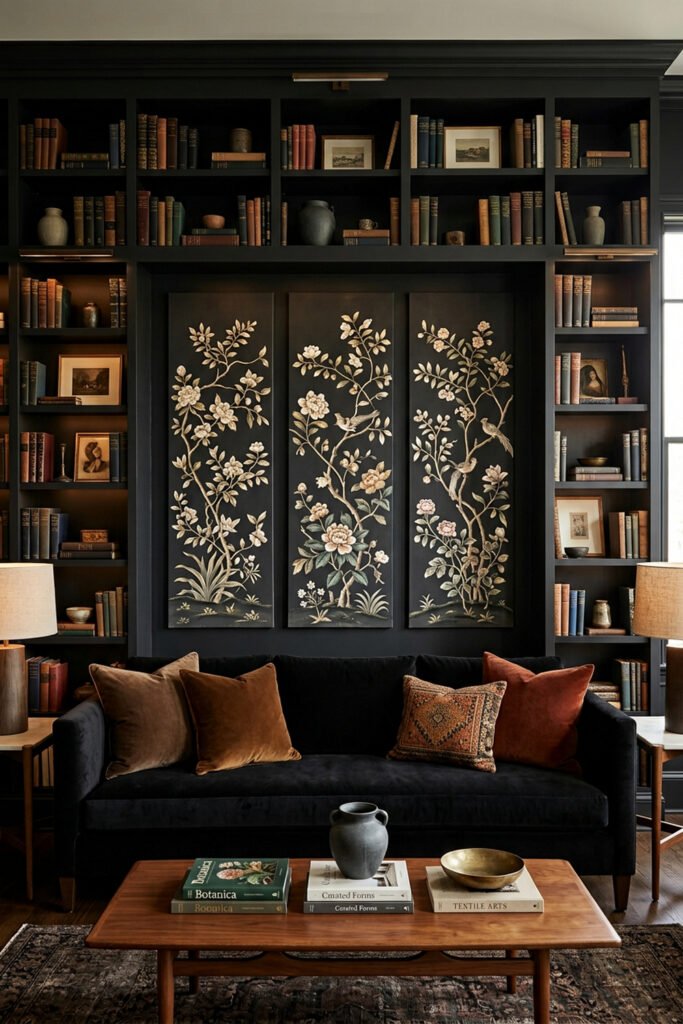
A black velvet sofa below creates a continuous dark base, but tobacco, rust, or copper-toned pillows can keep the seating from disappearing into the cabinetry. Books add fine-grained color around the edges, while the central botanical artwork provides larger, more readable shapes.
Shelf styling should stay edited near the focal panels. Leave some gaps between books and objects so the entire wall does not become equally dense. A few ceramics or framed pieces are enough. The best version feels architectural first, decorative second: storage frames the artwork, the sofa anchors the bottom, and the botanical motif provides the movement that identifies the Black Nouveau direction.
Black Nouveau Decor FAQ
What is Black Nouveau decor?
Black Nouveau decor is best understood here as a contemporary dark-interior interpretation that draws from recognizable Art Nouveau language rather than as a separate historical movement. Art Nouveau is strongly associated with inspiration from nature, organic forms, sinuous lines, and the whiplash curve. In a modern dark room, those qualities can appear through botanical motifs, curved furniture, decorative glass, arched forms, carved surfaces, and expressive ornament.
The black foundation changes the mood, making those organic details feel more theatrical. Warm metal, wood, cream, plants, and jewel tones help the room retain depth.
What is the difference between Art Nouveau and Art Deco decor?
Art Nouveau is generally associated with flowing organic lines, nature-derived motifs, tendrils, and curving forms. Art Deco developed later and is strongly associated with modernity, geometric form, luxurious materials, and a more streamlined or graphic design language.
In practice, interiors can mix references from both, so not every curved mirror or geometric floor belongs neatly to one category. For a Black Nouveau room, prioritize botanical movement, asymmetry, curves, and decorative craft when you want the Nouveau side to read more clearly.
What colors work best with black in a Nouveau-style interior?
Black works especially well with colors that either create warmth or provide a luminous break. Cream and ivory give the strongest light contrast. Walnut, cognac, mustard, rust, and antique brass warm the palette. Emerald, burgundy, magenta, plum, and blush can make the room feel more expressive.
You do not need all of them. A strong room often uses black as the base, one major secondary color, one lighter relief tone, and a warm material or metal that repeats in smaller details.
Can Black Nouveau decor work in a small apartment?
Yes, especially when the style is concentrated instead of spread across every surface. A black botanical wall behind a cream sofa, a dark entry with a graphic runner, a gilded mirror over a small console, or a black bedroom anchored by one oversize artwork can all carry the aesthetic.
In compact rooms, preserve light where it is most useful. Keep some pale surfaces, avoid blocking windows with bulky furniture, and let one focal feature do more of the decorative work. The result can feel dramatic without making the entire apartment visually dense.
Creating Your Own Black Nouveau Look
The most compelling Black Nouveau rooms do not succeed because they contain the largest number of dark objects. They succeed because black gives other things more presence: a cream curve, a brass edge, a palm leaf, a pink flower, a carved wood surface, or a pool of amber light.
Choose the relationship you love most from these ideas and build from there. It might be black with blush and chinoiserie, black with cognac and greenery, or a dark wall behind one monumental artwork. Once the main relationship is strong, smaller details can support it rather than compete for attention.
That is where Black Nouveau decor becomes more than a mood. It becomes a visual language you can adapt room by room.
You May Also Like